-
Use Cases
-
Resources
-
Pricing
The Hellenistic Period was an era of ancient Mediterranean and Near Eastern history that began with the death of Alexander the Great in 323 BCE and ended with Rome's annexation of Egypt in 31 BCE. During this time, Greek culture spread across a vast multicultural empire, blending with local traditions to create a vibrant, cosmopolitan civilization marked by advances in art, science, philosophy, and politics. More Less
750 BC
% complete
Southern Italy (Magna Graecia) and south-eastern Sicily were colonized by the Greeks during the 8th century BC. These colonies later became important centers of Greek culture in the western Mediterranean and played significant roles during the Hellenistic period.
Image source: Magna Graecia
600 BC
% complete
Massalia (modern Marseille) was the first Greek colony in Gaul. By the 4th century BC it had become one of the largest trading ports of the Mediterranean with about 6,000 inhabitants, serving as a conduit for Greek culture into western Europe.
Image source: Massalia
500 BC
% complete
The city of Emporion (modern Empúries), originally founded by Archaic-period settlers from Phocaea and Massalia in the 6th century BC near Sant Martí d'Empúries in Catalonia, was reestablished in the 5th century BC with a new city (neapolis) on the Iberian mainland.
Image source: Empúries
400 BC
% complete
In 4th-century BC Sicily, Syracuse was the leading Greek city and hegemon of the island, dominating the political and cultural life of Greek Sicily during a period of intense competition among Mediterranean powers.
Image source: Syracuse, Sicily
300 BC - 201 BC
% complete
Illyrians imported weapons and armor from the ancient Greeks, such as the Illyrian type helmet originally a Greek type, and adopted Macedonian ornamentation on their shields and war belts; a single belt has been found dated to the 3rd century BC at modern Selcë e Poshtme, then part of Macedon under Philip V.
Image source: Illyrians
300 BC - 291 BC
% complete
The royal palace (basileion) came into its own during the Hellenistic period, the first extant example being the massive 4th-century villa of Cassander at Vergina, reflecting the new grandeur of Hellenistic royal architecture.
Image source: Vergina
250 BC - 101 BC
% complete
The Hellenistic period saw the Greek alphabet spread into southern Gaul from Massalia during the 3rd and 2nd centuries BC. According to Strabo, Massalia was also a center of education where Celts went to learn Greek.
Image source: Gaulish
200 BC
% complete
In the Ptolemaic kingdom, we find some Egyptianized Greeks from the 2nd century onwards, showing the deepening cultural fusion between Greek settlers and native Egyptian society under Hellenistic rule.
Image source: Ptolemaic Kingdom
100 BC
% complete
Nabatean material culture does not show any Greek influence until the reign of Aretas III Philhellene in the 1st century BC, marking the arrival of Hellenistic artistic and architectural styles in the Nabatean kingdom.
Image source: Aretas III
2001
% complete
Discoveries of poems in 2001 depicted eighteen different wins in equestrian sport, shedding light on athletic competition and elite display in the Hellenistic world.
Image source: Hellenistic Greece
334 BC - 323 BC
% complete
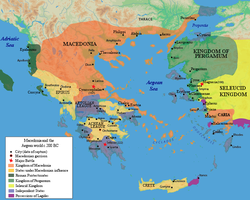
The conquests of Alexander greatly widened the horizons of the Greek world, making the endless conflicts between the cities that had marked the 5th and 4th centuries BC seem petty and unimportant, and spreading Greek culture across Asia.
Image source: Alexander the Great
323 BC
% complete
After Alexander's death, the territories he had conquered experienced sustained Greek cultural influence (Hellenisation) for the next two or three centuries, until the rise of the Roman Empire in the west and the Parthian Empire in the east.
310 BC
% complete
In 310 BC, Cassander had young King Alexander IV and his mother Roxana murdered, ending the Argead dynasty which had ruled Macedon for several centuries and clearing the way for the rival successor kingdoms.
Image source: Alexander IV of Macedon
200 BC - 190 BC
% complete
In the early 2nd century BC, the Galatians became allies of Antiochus the Great, the last Seleucid king trying to regain suzerainty over Asia Minor against rising Roman power.
Image source: Antiochus III the Great
195 BC
% complete
Emporion lost its political independence around 195 BC with the establishment of the Roman province of Hispania Citerior, and by the 1st century BC had become fully Romanized in culture.
Image source: Hispania Citerior
150 BC - 140 BC
% complete
Much of the eastern part of the Seleucid empire was conquered by the Parthians under Mithridates I of Parthia in the mid-2nd century BC, yet the Seleucid kings continued to rule a rump state from Syria until their ultimate overthrow.
Image source: Mithridates I of Parthia
30 BC
% complete
After about two centuries, the remaining Hellenistic successor states were much reduced, culminating in the Roman conquest of Ptolemaic Egypt, traditionally taken as the end of the Hellenistic period.
Image source: War of Actium
300 BC
% complete
The cultural competition among the Hellenistic kingdoms produced seats of learning throughout the Mediterranean, of which the most important was Alexandria in Egypt, which became a major center of scholarship in the 3rd century BC.
Image source: Alexandria
300 BC
% complete
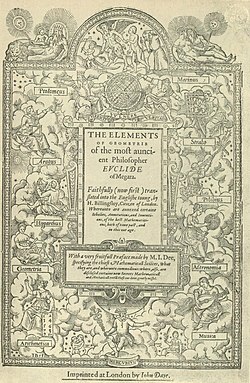
Euclid, whose Elements became the most important textbook in Western mathematics until the 19th century, presented proofs for the Pythagorean theorem, for the infinitude of primes, and for the five Platonic solids.
Image source: Euclid's Elements
150
% complete
A celestial globe based on Hipparchus' star catalog presumably sits atop the broad shoulders of a large 2nd-century Roman statue known as the Farnese Atlas, preserving evidence of Hellenistic astronomy.
Image source: Farnese Atlas
100 - 165
% complete
Appian of Alexandria (late 1st century AD–before 165) wrote a history of the Roman Empire that includes information on some Hellenistic kingdoms, preserving valuable accounts of the period's wars and politics.
Image source: Appian
200
% complete
Justin's (2nd century AD) epitome of Pompeius Trogus' Historiae Philipicae is one of the key surviving sources for the Hellenistic period, along with Photios I of Constantinople's summary of Arrian's Events after Alexander.
Image source: Justin (historian)
1700 - 1800
% complete
The 18th-century terms Baroque and Rococo have sometimes been applied to the art of this complex and individual period, reflecting scholars' attempts to characterize its dramatic and ornamental qualities.
Image source: Hellenistic art
1836
% complete
The idea of a Hellenistic period is attributed to the 19th-century German historian Johann Gustav Droysen, who in his classic work Geschichte des Hellenismus coined the term Hellenistic to define the period when Greek culture spread in the non-Greek world after Alexander's conquest.
Image source: Johann Gustav Droysen
1850 - 1900
% complete
Many 19th-century scholars contended that the Hellenistic period represented a cultural decline from the brilliance of classical Greece, viewing the era through the lens of their own times—a common issue in the study of historical periods.
1912
% complete
Past interpretations of Hellenistic science often downplayed its significance, as found in English classical scholar Francis Cornford, who believed that 'all the most important and original work was done in the three centuries from 600 to 300 BC'.
Image source: F. M. Cornford
1990
% complete
Peter Green writes from the point of view of late-20th-century liberalism, focusing on individualism, the breakdown of convention, experiments, and a postmodern disillusionment with all institutions and political processes.
1998
% complete
Recent interpretations tend to be more generous: mathematician Lucio Russo claims that the scientific method was actually born in the 3rd century BC, largely forgotten during the Roman period and only revived in full during the Renaissance.
Image source: Lucio Russo
1000
% complete
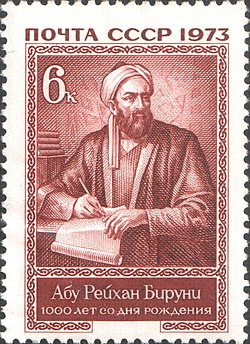
Devices of the sort found in Hellenistic engineering are not found again until the 10th century, when a simpler eight-geared luni-solar calculator incorporated into an astrolabe was described by the Persian scholar Al-Biruni.
Image source: Al-Biruni
30
% complete
Alexander's conquests expanded the influence of Greek culture in Asia, which many centuries later contributed to the spread of Christianity (from Greek Χρῑστῐᾱνισμός), as the Greek language and cultural networks facilitated the new religion's expansion.
Image source: Christianity
Or browse the full history timeline directory, with more than 2,000 topics.
This Hellenistic Period timeline was generated with the help of AI, using information found on the internet.
We work hard to keep these timelines accurate, but mistakes do get through. If you spot one, email us at [email protected] and we'll fix it for future visitors.
Generate yours with AI or build it from scratch, for free.
Export your timeline, add your own events, edit or remove AI-generated events, and much more
No credit card required.
Cancel anytime.
Cancel anytime.
You can create an unlimited number of timelines with up to 10 events on each one, customize how they look, export them to PDF, PNG, PowerPoint, CSV, and Excel, and share them with a link. Paid plans raise the event limit and add features like spreadsheet imports and collaborators.
Yes. You can cancel your subscription from your account page at any time, and you will not be charged again. Your subscription stays active for the rest of the period you already paid for.
Yes. We will email you a reminder before the annual renewal, and we will also email you a receipt.
Yes. You can email us within 15 days of any payment, and we will issue you a full refund.
Check out our pricing docs or send us an email anytime: [email protected].