-
Use Cases
-
Resources
-
Pricing
The Vedic Period (c. 1500–500 BCE) marks the era in ancient Indian history during which the Vedas, the oldest sacred texts of Hinduism, were composed. It is divided into the Early (Rigvedic) Vedic Period, characterized by pastoral tribal society, and the Later Vedic Period, which saw agricultural expansion, social stratification into varnas, and the rise of early kingdoms in the Indian subcontinent. More Less
1900 BCE
% complete
Around 1900 BCE, the urban Indus Valley Civilisation collapsed, marking the end of a major urban phase in the northwestern Indian subcontinent. This created conditions for new groups, including Indo-Aryan peoples, to migrate into the region and begin inhabiting the northern Indus Valley.
Image source: Indus Valley Civilisation
1900 BCE
% complete
Historically, after the collapse of the Indus Valley Civilisation around 1900 BCE, groups of Indo-Aryan peoples migrated into north-western India and started to inhabit the northern Indus Valley, laying the foundations for the later Vedic culture.
Image source: Indo-Aryan migrations
1500 BCE
% complete
At around c. 1500 BCE, Iranian migrations into Iran occurred, closely related in time to the movements of Indo-Aryan peoples into the northern Indian subcontinent. These parallel migrations reflect the wider dispersal of Indo-Iranian speaking groups across the Iranian plateau and South Asia.
Image source: Iranian peoples
1500 BCE
% complete
The Vedic period, or Vedic age, began around 1500 BCE during the late Bronze Age of the history of India. It is defined by the composition of the Vedic literature in the northern Indian subcontinent, between the end of the urban Indus Valley Civilisation and a second urbanisation beginning around 600 BCE.
Image source: Vedic period
1200 BCE - 1000 BCE
% complete
Around c. 1200–1000 BCE, the Aryan culture spread eastward from the north-western subcontinent to the fertile western Ganges Plain. This eastward expansion marked a significant geographic shift of Indo-Aryan settlements deeper into the Indian heartland.
1100 BCE
% complete
Following the final form of the Rigveda after the 12th century BCE, Vedic society — associated with the Kuru-Panchala region though not the only Indo-Aryan people in northern India — transitioned from a semi-nomadic pastoral life to settled agriculture in north-western India.
1500 BCE
% complete
The Vedas, the oldest scriptures of Hinduism, were composed between roughly 1500 and 900 BCE in the northern Indian subcontinent. Their composition defines the Vedic age and preserves the religious thought, rituals, and language of the early Indo-Aryan communities.
Image source: Vedas
1500 BCE
% complete
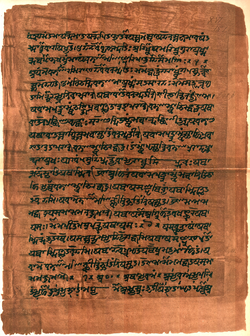
The Rigveda, the earliest of the Vedas, was composed during the early Vedic period. Its hymns provide the principal literary evidence for the society, religion, and geography of the Indo-Aryan tribes of the northern Indian subcontinent in this era.
Image source: Rigveda
1200 BCE - 1100 BCE
% complete
After the 12th century BCE, as the Rigveda had taken its final form, the Vedic society transitioned from semi-nomadic life to settled agriculture in north-western India. The fixed text became the foundation of subsequent ritual and scholarly traditions.
900 BCE - 500 BCE
% complete
Beyond the Rigveda, the corpus of Vedic literature — including the other Vedas and associated texts composed up to about 500 BCE — continued to develop during the Vedic period, documenting evolving rituals, social structures, and philosophy.
900 BCE - 500 BCE
% complete
By around 500 BCE the composition of the Vedic literature had concluded. The canonised texts were transmitted orally through rigorous memorisation traditions, forming the scriptural foundation of early Indian religion and culture.
800 BCE - 700 BCE
% complete
King Janaka's court famously patronised Brahmin sages and philosophers such as Yajnavalkya, Uddalaka Aruni, and Gargi Vachaknavi. This patronage fostered philosophical debate and contributed to the development of later Vedic religious and metaphysical thought.
Image source: Janaka
800 BCE - 700 BCE
% complete
The sage Yajnavalkya was among the philosophers patronised at King Janaka's court in Videha. He is remembered as one of the most influential thinkers of the later Vedic period, associated with profound philosophical dialogues preserved in the Upanishadic literature.
Image source: Yajnavalkya
800 BCE - 700 BCE
% complete
Uddalaka Aruni was another prominent Brahmin sage who benefited from the patronage of King Janaka's court. His teachings on cosmology and the nature of reality are recorded in the Upanishads, reflecting the intellectual flourishing of the later Vedic age.
Image source: Uddālaka Āruṇi
800 BCE - 700 BCE
% complete
Gargi Vachaknavi was a renowned female philosopher who participated in the learned debates at King Janaka's court in Videha. Her questioning of sages such as Yajnavalkya exemplifies the philosophical inquiry characteristic of the later Vedic period.
Image source: Gārgī Vāchaknavī
1450 BCE - 1200 BCE
% complete
The Black and red ware culture, dated to roughly 1450–1200 BCE, produced abstract pottery designs that represent some examples of artistic expression from the period, with finds distributed over a wide area of the northern Indian subcontinent.
Image source: Black and red ware
1450 BCE - 1200 BCE
% complete
The Ochre coloured pottery culture was found in western Uttar Pradesh, including districts such as Badaun and Bisauli. This pottery tradition is associated with the late phase of the Indus tradition and the early Indo-Aryan settlement period in the Ganges-Yamuna doab.
Image source: Ochre Coloured Pottery culture
1200 BCE - 600 BCE
% complete
The Painted Grey Ware culture (c. 1200–600 BCE) is associated with the later Vedic period. Its distinctive pottery did not expand east of the Ganga-Yamuna Doab, and finds have been recovered across a wide area including Mathura.
Image source: Painted Grey Ware culture
1000 BCE - 600 BCE
% complete
In the same archaeological record described by Erdosy, the Kurukshetra district itself displayed a more complex, albeit not yet urbanised, three-tiered settlement hierarchy, indicating emerging social and political complexity before full urbanisation.
Image source: Kurukshetra
1000 BCE - 600 BCE
% complete
According to George Erdosy, archaeological data for the period from 1000 to 600 BCE shows a two-tiered settlement pattern in the Ganges Valley, with some 'modest central places' suggestive of the existence of simple chiefdoms.
1000 BCE
% complete
After 1000 BCE, the use of iron axes and ploughs became widespread, allowing jungles to be cleared with ease. This iron technology enabled agricultural expansion into forested regions and supported the growth of larger settled communities.
1000 BCE
% complete
Around 1000 or 900 BCE corresponds to the rise of the Kuru kingdom, one of the first major political entities of the Vedic period. The Kuru state emerged in the western Ganges Plain and became the political centre of Vedic civilisation.
Image source: Kuru Kingdom
900 BCE
% complete
Around 1000 or 900 BCE, following the establishment of the Kuru kingdom, the political centre shifted eastward from the Kurus to the Panchalas on the Ganges. Panchala remained a prominent power in the middle Ganges region throughout much of the Vedic age.
Image source: Panchala
800 BCE - 600 BCE
% complete
Later, in the 8th or 7th century BCE, the kingdom of Videha emerged as a political center farther to the East, in what is today northern Bihar of India and southeastern Nepal. It reached its prominence under the king Janaka.
Image source: Videha
800 BCE - 700 BCE
% complete
Under King Janaka, Videha reached its prominence. His court provided patronage for Brahmin sages and philosophers such as Yajnavalkya, Uddalaka Aruni, and Gargi Vachaknavi, making it a major intellectual centre of the later Vedic period.
800 BCE - 700 BCE
% complete
During the same period when Videha rose to prominence, Panchala also remained prominent under its king Pravahana Jaivali. His reign illustrates the continued importance of the Panchala realm as a centre of Vedic learning and political power.
Image source: Pravahana Jaivali
600 BCE
% complete
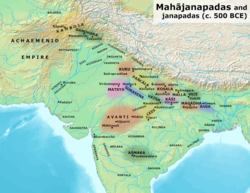
By the 6th century BCE, the political units of the earlier Vedic chiefdoms and kingdoms had consolidated into large kingdoms called Mahajanapadas. This consolidation marked the maturation of state formation in the Indo-Gangetic Plain.
Image source: Mahajanapadas
600 BCE
% complete
A second urbanisation began in the central Indo-Gangetic Plain around 600 BCE, ending the long non-urban interval that followed the decline of the Indus Valley cities. This renewed urban growth coincided with the close of the Vedic period.
Image source: History of India
600 BCE - 500 BCE
% complete
The Achaemenid invasion of Cyrus and Darius I of the Indus valley in the early 6th century BCE marks the beginning of outside influence on the subcontinent. This foreign contact continued through the eras of the Indo-Greeks, Indo-Scythians, and Indo-Parthians.
Image source: Achaemenid conquest of the Indus Valley
500 BCE
% complete
Around 500 BCE, the Vedic period came to an end, giving way to a new era characterised by the Mahajanapadas, renewed urbanisation in the Indo-Gangetic Plain, growing outside influence, and the rise of new religious and philosophical movements.
Or browse the full history timeline directory, with more than 2,000 topics.
This Vedic Period timeline was generated with the help of AI, using information found on the internet.
We work hard to keep these timelines accurate, but mistakes do get through. If you spot one, email us at [email protected] and we'll fix it for future visitors.
Generate yours with AI or build it from scratch, for free.
Export your timeline, add your own events, edit or remove AI-generated events, and much more
No credit card required.
Cancel anytime.
Cancel anytime.
You can create an unlimited number of timelines with up to 10 events on each one, customize how they look, export them to PDF, PNG, PowerPoint, CSV, and Excel, and share them with a link. Paid plans raise the event limit and add features like spreadsheet imports and collaborators.
Yes. You can cancel your subscription from your account page at any time, and you will not be charged again. Your subscription stays active for the rest of the period you already paid for.
Yes. We will email you a reminder before the annual renewal, and we will also email you a receipt.
Yes. You can email us within 15 days of any payment, and we will issue you a full refund.
Check out our pricing docs or send us an email anytime: [email protected].