-
Use Cases
-
Resources
-
Pricing
The Interwar Period refers to the time between the end of World War I in 1918 and the outbreak of World War II in 1939. It was an era of dramatic political, economic, and social change, including the Treaty of Versailles, the Roaring Twenties, the Great Depression, and the rise of fascism, Nazism, militarism, and communism across Europe and Asia. More Less
Nov 11, 1918
% complete
The Armistice of Compiègne ended the fighting of World War I on 11 November 1918, beginning the interwar period. The following years were marked by turmoil as Eastern Europe struggled to recover from the devastation of war and the collapse of the Russian, German, Austro-Hungarian, and Ottoman Empires.
Image source: Armistice of 11 November 1918
Jan 1919
% complete
At the Paris Peace Conference in 1919, Japan's Racial Equality Proposal was rejected, leading to increasing Japanese diplomatic isolation and resentment toward the Western powers.
Image source: Racial Equality Proposal
Nov 1921 - Feb 1922
% complete
Secretary of State Charles Evans Hughes sponsored the Washington Naval Conference of 1921 to determine how many capital ships each major country would be allowed. Britain accepted naval parity with the United States, and the resulting treaty set ratios among the major naval powers.
Image source: Washington Naval Conference
1922
% complete
Forced to choose between alignment with the United States or Japan, Britain opted not to renew the 1902 Anglo-Japanese Alliance in 1922 due to heavy pressure from Canada and the United States, instead signing the Washington Naval Treaty.
Image source: Anglo-Japanese Alliance
Oct 1925
% complete
In October 1925, the Treaty of Locarno was signed by Germany, France, Belgium, Britain, and Italy. It recognised Germany's borders with France and Belgium, easing tensions in Western Europe.
Image source: Locarno Treaties
Sep 1926
% complete
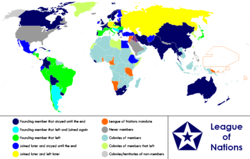
The Locarno agreements paved the way for Germany's admission to the League of Nations in 1926, marking a high point of European reconciliation efforts in the interwar period.
Image source: League of Nations
Jun 1927 - Aug 1927
% complete
Britain played a leading role in the 1927 Geneva Naval Conference on naval disarmament, continuing interwar efforts to limit the naval arms race among the great powers.
Image source: Geneva Naval Conference
Apr 22, 1930
% complete
Britain played a leading role in the 1930 London Conference that produced the London Naval Treaty, adding cruisers and submarines to the list of ship allocations. The conference angered the Imperial Japanese Armed Forces, who demanded parity but were rejected.
Image source: London Naval Treaty
Mar 25, 1936
% complete
The refusal of Japan, Germany, Italy, and the USSR to go along with further naval limitations led to the largely meaningless Second London Naval Treaty of 1936, signalling the collapse of interwar disarmament efforts.
Image source: Second London Naval Treaty
Apr 16, 1938
% complete
After Great Britain signed the Anglo-Italian Easter Accords in 1938, Mussolini and Foreign Minister Galeazzo Ciano issued demands for concessions in the Mediterranean by France, including French Somaliland, Tunisia, and the Suez Canal.
Aug 23, 1939
% complete
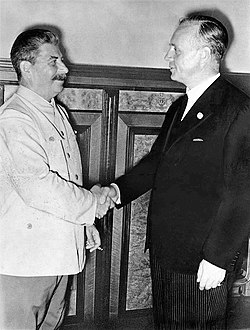
Forming a non-aggression pact with the Soviet Union in August 1939, Germany cleared the way to invade Poland after Poland refused to cede the Free City of Danzig—an invasion that began World War II days later and ended the interwar period.
Image source: Molotov–Ribbentrop Pact
Feb 1919 - Mar 1921
% complete
The newly formed Russian Soviet Federative Socialist Republic declared war on Poland in 1919. The conflict lasted until 1921 and resulted in a Polish victory.
Image source: Polish–Soviet War
Dec 1922
% complete
The Soviet Union was formally established in 1922 under the leadership of Vladimir Lenin, consolidating Bolshevik control over the former territories of the Russian Empire after years of civil war.
Image source: Treaty on the Creation of the Union of Soviet Socialist Republics
Jan 1923
% complete
When Germany defaulted on its reparation payments, French and Belgian troops occupied the heavily industrialised Ruhr district in January 1923, deepening Germany's economic crisis.
Image source: Occupation of the Ruhr
Jan 21, 1924
% complete
Vladimir Lenin's death in 1924 led to a power struggle between various members of the Communist Party, ultimately shaping the future leadership of the Soviet Union.
Image source: Death and state funeral of Vladimir Lenin
Apr 13, 1919
% complete
Mounting tension in British India, particularly in the Punjab region, culminated in the Amritsar Massacre in 1919. The Government of India Act 1919 had failed to satisfy demands for self-rule, fueling growing nationalist sentiment.
Image source: Jallianwala Bagh massacre
1921 - 1926
% complete
Abd el-Krim founded an independent Rif Republic, which operated until 1926 but had no international recognition. Spain and France sent 200,000 soldiers, forcing el-Krim to surrender in 1926; he was exiled until 1947. Morocco became a base from which Spanish Nationalists launched their rebellion in 1936.
Image source: Republic of the Rif
Jul 1921 - Aug 1921
% complete
Spanish forces, facing unrest in Morocco off and on since the 1890s, were massacred at the Battle of Annual in 1921, a humiliating defeat that emboldened Berber resistance leader Abd el-Krim.
Image source: Battle of Annual
Feb 28, 1922
% complete
In 1922, the Kingdom of Egypt was granted formal independence by Britain, though it continued to be a client state following British guidance.
Dec 11, 1931
% complete
The right of the Dominions to set their own foreign policy was recognised in 1923 and formalised by the 1931 Statute of Westminster, granting legislative independence to Canada, Australia, New Zealand, South Africa, and Ireland.
Image source: Statute of Westminster 1931
Oct 3, 1932
% complete
Mandatory Iraq, a British mandate since 1920, gained official independence as the Kingdom of Iraq in 1932 when King Faisal agreed to British terms of a military alliance and an assured flow of oil.
Image source: Kingdom of Iraq
Oct 1922
% complete
In Italy, the National Fascist Party came to power under Benito Mussolini after threatening a March on Rome in October 1922. Mussolini was appointed Prime Minister, beginning two decades of Fascist rule in Italy.
Image source: March on Rome
Jul 24, 1923
% complete
Mussolini resolved the question of sovereignty over the Dodecanese at the 1923 Treaty of Lausanne, which formalised Italian administration of both Libya and the Dodecanese Islands in return for a payment to Turkey, though he failed to extract a mandate over part of Iraq from Britain.
Image source: Treaty of Lausanne
Nov 8, 1923 - Nov 9, 1923
% complete
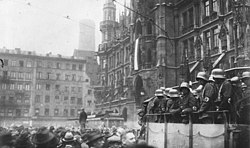
In November 1923, Adolf Hitler attempted an armed coup in Munich known as the Beer Hall Putsch. The failed putsch marked an early episode of Nazi agitation during the Weimar Republic's turmoil.
Image source: Beer Hall Putsch
1924
% complete
A confrontation between Britain and Italy led to the resolution of the question of Jubaland in 1924, when the territory was merged into Italian Somaliland as part of Mussolini's colonial ambitions.
Image source: Oltre Giuba
Jan 30, 1933
% complete
Hitler came to power in January 1933 and inaugurated an aggressive policy designed to give Germany economic and political domination across central Europe. Until August 1939, the Nazis denounced Communists, the Soviet Union, and Jews as their greatest enemies.
Image source: Adolf Hitler's rise to power
Oct 3, 1935 - May 1936
% complete
Italy invaded and occupied Abyssinia (Ethiopia) in the Horn of Africa in 1935–1936, defying the League of Nations. Italy had also demanded mandates over the former German Cameroon and a free hand in Ethiopia in 1932 and 1935 in exchange for supporting the Stresa Front against Germany.
Image source: Second Italo-Ethiopian War
Jul 1936
% complete
In July 1936, Francisco Franco of the Nationalist faction requested Italian support against the ruling Republican faction, guaranteeing friendly future relations and greater Roman influence in Spanish politics.
Image source: International response to the Spanish Civil War
Jul 17, 1936 - Apr 1, 1939
% complete
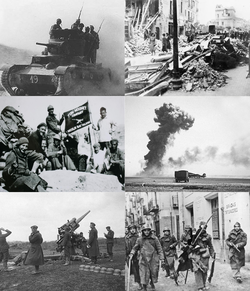
Spain, unstable politically for centuries, was wracked from 1936 to 1939 by one of the bloodiest civil wars of the 20th century. Marked by numerous battles, sieges, and atrocities, it ended when the Nationalists won by overwhelming the Republican forces.
Image source: Spanish Civil War
Nov 6, 1937
% complete
After establishing the Rome-Berlin Axis with Mussolini and signing the Anti-Comintern Pact with Japan, Hitler saw Italy join the pact a year later in 1937, feeling able to take the offensive in foreign policy.
Image source: Anti-Comintern Pact
Mar 12, 1938
% complete
On 12 March 1938, German troops marched into Austria, considered a German state, where an attempted Nazi coup had been unsuccessful in 1934, completing the annexation of Austria into the Reich.
Image source: Anschluss
Sep 30, 1938
% complete
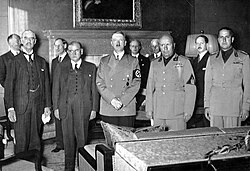
At the Munich Conference of September 1938, Hitler, Mussolini, Chamberlain, and Daladier agreed upon the cession of Sudeten territory to the German Reich by Czechoslovakia—a prime example of appeasement.
Image source: Munich Agreement
Mar 15, 1939
% complete
Barely six months after Munich, Hitler used the quarrel between Slovaks and Czechs as a pretext for taking over the rest of Czechoslovakia as the Protectorate of Bohemia and Moravia in March 1939.
Image source: Protectorate of Bohemia and Moravia
Apr 12, 1939
% complete
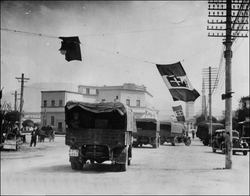
Ahmet Zogu, who had proclaimed himself King of Albania in 1928, failed to create a stable state. In 1939, Italy invaded and annexed Albania as a separate kingdom in personal union with the Italian crown.
Image source: Italian invasion of Albania
1923
% complete
The Weimar Republic suffered a first episode of political and economic turmoil culminating in the German hyperinflation of 1923, which wiped out savings and destabilised German society.
Image source: Hyperinflation in the Weimar Republic
1929 - 1932
% complete
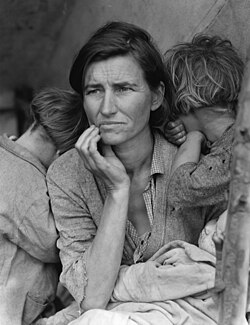
Between 1929 and 1932, worldwide GDP fell by an estimated 15%, compared with less than 1% during the Great Recession of 2008–2009, demonstrating the unprecedented severity of the global downturn.
Image source: Great Depression
Oct 29, 1929
% complete
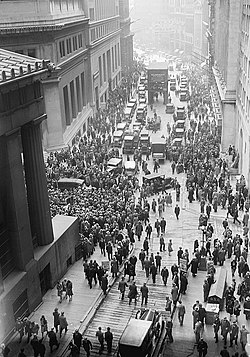
The Great Depression originated in the United States and became worldwide news with the stock market crash of 29 October 1929, known as Black Tuesday. It was the longest, deepest, and most widespread depression of the 20th century, lasting until the late 1930s.
Image source: Wall Street Crash of 1929
Sep 18, 1931
% complete
In September 1931, the Japanese Kwantung Army—acting without government approval—seized control of Manchuria from warlord Zhang Xueliang, defying international opinion and escalating tensions in East Asia.
Image source: Japanese invasion of Manchuria
May 15, 1932
% complete
Prime Minister Inukai Tsuyoshi tried to negotiate with China but was assassinated in the May 15 Incident of 1932, ushering in an era of nationalism and militarism led by the Imperial Japanese Army. The IJA's nationalism ended civilian rule in Japan until after 1945.
Image source: May 15 incident
Oct 2, 1932
% complete
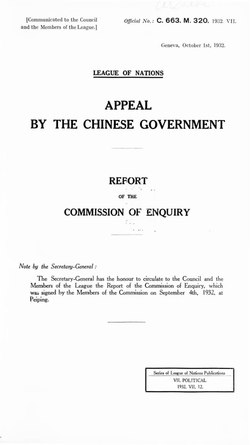
The League of Nations, effectively controlled by Britain and France, issued the Lytton Report in 1932, saying that Japan had genuine grievances but acted illegally in seizing the entire province of Manchuria.
Image source: Lytton Report
Aug 1937
% complete
Large-scale warfare between China and Japan began in August 1937, with naval and infantry attacks focused on Shanghai that quickly spread to other major Chinese cities.
Image source: Second Sino-Japanese War
Dec 1937 - Jan 1938
% complete
Japanese forces committed numerous large-scale atrocities against Chinese civilians, most infamously the Nanjing massacre in December 1937, involving mass murder and mass rape.
Image source: Nanjing Massacre
May 1939 - Aug 1939
% complete
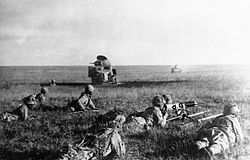
The Japanese Army fared badly in large border battles with the Soviet Red Army in Mongolia at the Battles of Khalkhin Gol in summer 1939, deterring Japan from further attacks northward.
Image source: Battles of Khalkhin Gol
Or browse the full history timeline directory, with more than 2,000 topics.
This Interwar Period timeline was generated with the help of AI, using information found on the internet.
We work hard to keep these timelines accurate, but mistakes do get through. If you spot one, email us at [email protected] and we'll fix it for future visitors.
Generate yours with AI or build it from scratch, for free.
Export your timeline, add your own events, edit or remove AI-generated events, and much more
No credit card required.
Cancel anytime.
Cancel anytime.
You can create an unlimited number of timelines with up to 10 events on each one, customize how they look, export them to PDF, PNG, PowerPoint, CSV, and Excel, and share them with a link. Paid plans raise the event limit and add features like spreadsheet imports and collaborators.
Yes. You can cancel your subscription from your account page at any time, and you will not be charged again. Your subscription stays active for the rest of the period you already paid for.
Yes. We will email you a reminder before the annual renewal, and we will also email you a receipt.
Yes. You can email us within 15 days of any payment, and we will issue you a full refund.
Check out our pricing docs or send us an email anytime: [email protected].