-
Use Cases
-
Resources
-
Pricing
Wyoming's history spans thousands of years of Native American habitation, followed by fur trappers and explorers in the early 1800s, westward expansion along the Oregon Trail, the establishment of the Wyoming Territory in 1868, and statehood in 1890. Known as the 'Equality State,' Wyoming was the first to grant women the right to vote in 1869. More Less
1000 CE
% complete
Large ceremonial blades chipped from obsidian rock formations in what is now Yellowstone National Park have been found in the Hopewell burial mounds of Southern Ohio, indicative of vast continental trading networks since around 1000 years ago.
Image source: Hopewell tradition
1700
% complete
Europeans may have ventured into the northern sections of the state in the 18th century, though documented exploration came later.
1807
% complete
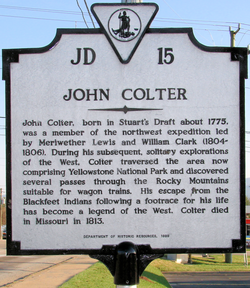
John Colter, a member of the Lewis and Clark Expedition, was probably the first American to enter the region in 1807.
Image source: John Colter
1958 - 1978
% complete
The medicine wheel in the Big Horn Mountains has not been dated accurately due to disruption of the site before the two archaeological excavations of 1958 and 1978.
1809
% complete
The name Wyoming was made famous by the 1809 poem Gertrude of Wyoming by Thomas Campbell.
1867
% complete
The UP reached the town of Cheyenne, which later became the state capital, in 1867.
Image source: Cheyenne, Wyoming
Jul 25, 1868
% complete
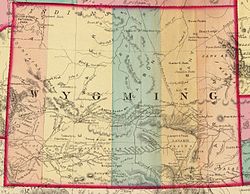
After the arrival of the railroad, the population began to grow steadily in the Wyoming Territory, which was established on July 25, 1868.
Image source: Wyoming Territory
Dec 10, 1869
% complete
On December 10, 1869, Wyoming Territory granted women the right to vote, becoming the first future U.S. state to do so.
Image source: Women's suffrage in Wyoming
1870
% complete
The first time women served on a jury was in Wyoming (Laramie in 1870).
1870
% complete
Wyoming had the first female court bailiff (Mary Atkinson, Laramie, in 1870), and the country's first female justice of the peace (Esther Hobart Morris, South Pass City, in 1870).
1870
% complete
In 1870, roughly three-eighths of Wyoming's population was foreign born, coming primarily from Ireland, Germany and England.
1890
% complete
After 1890, Wyoming pageants and parades, as well as school courses, increasingly told a nostalgic story of Wyoming as rooted in the frontier West.
1924
% complete
In 1924, irregularities over the allocation of naval reserves near Casper resulted in the Teapot Dome Scandal, one of the biggest political scandals in U.S. history.
Image source: Teapot Dome scandal
Nov 1924 - Jan 1925
% complete
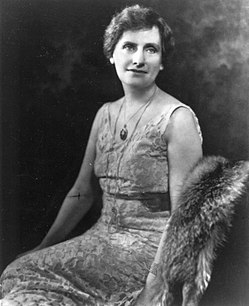
Wyoming became the first state in the Union to elect a female governor, Nellie Tayloe Ross, who was elected in 1924 and took office in January 1925.
Image source: Nellie Tayloe Ross
1810 - 1840
% complete
During the early 19th century, fur trappers known as mountain men flocked to the mountains of western Wyoming in search of beaver.
1812
% complete
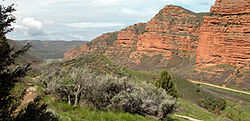
Robert Stuart and a party of five men returning from Astoria, Oregon discovered South Pass in 1812, opening a key route through the Rocky Mountains.
Image source: South Pass (Wyoming)
1824
% complete
In 1824, the first mountain man rendezvous was held in Wyoming. The gatherings continued annually until 1840, with the majority of them held within Wyoming territory.
Image source: Rocky Mountain Rendezvous
1840 - 1859
% complete
Over 350,000 emigrants followed these trails to destinations in Utah, California and Oregon between 1840 and 1859.
Image source: Oregon Trail
1847
% complete
In 1847, Mormon emigrants blazed the Mormon Trail, which mirrors the Oregon Trail, but splits off at South Pass and continues south to Fort Bridger and into Utah.
Image source: Mormon Trail
1850
% complete
In 1850, Jim Bridger located what is now known as Bridger Pass, which was later used by both the Union Pacific Railroad in 1868, and in the 20th century by Interstate 80.
1851
% complete
In 1851, representatives from the United States and American Indian nations signed the first Treaty of Fort Laramie in hopes of ensuring peace and the safety of settlers on the trails.
Image source: Treaty of Fort Laramie (1851)
1859
% complete
In 1859, gold was discovered in Montana, drawing miners north along the Bozeman and Bridger trails through the Powder River Country and Big Horn Basin respectively.
Image source: Gold rush
May 20, 1862
% complete
The Homestead Act of 1862 attracted many new farmers and ranchers to Wyoming, where they congregated along the fertile banks of the rivers. Most land was public domain, open for homesteading and open range grazing.
Image source: Homestead Acts
1864
% complete
Settlers blazed the Bozeman Trail through the hunting grounds of the Powder River Country, which the United States had promised to the tribes in the 1851 treaty.
1865
% complete
As encounters between settlers and natives grew more serious in 1865, Major General Grenville M. Dodge led military campaigns against Native American resistance in the region.
Image source: Powder River Expedition (1865)
1866
% complete
In 1866, Nelson Story Sr. drove approximately 1000 head of Texas Longhorns to Montana through Wyoming along the Bozeman Trail—the first major cattle drive from Texas into Montana.
Image source: Nelson Story
1868
% complete
The second Treaty of Fort Laramie in 1868 ended the war by closing the Powder River Country to whites.
Image source: Treaty of Fort Laramie (1868)
1873
% complete
The Wyoming Stock Growers Association is a historic American cattle organization created in 1873, dominated by large cattle operators on the open range.
1876
% complete
Violation of the Treaty of Fort Laramie by miners in the Black Hills led to the Black Hills War in 1876, which was fought mainly along the border of Wyoming and Montana.
Image source: Great Sioux War of 1876
Sep 2, 1885
% complete
In 1885 tensions at a Union Pacific mine in Rock Springs resulted in the Rock Springs massacre, one of the largest race riots in U.S. history, when white miners drove out Chinese miners employed by the Union Pacific Coal Company.
Image source: Rock Springs massacre
Apr 1892
% complete
Tensions rose to a boiling point in April 1892 as an armed conflict known as the Johnson County War, also called the War on Powder River, took place in Johnson, Natrona and Converse counties between large cattle operators and smaller ranchers and homesteaders.
Image source: Johnson County War
1869
% complete
The Cook–Folsom–Peterson Expedition in 1869 confirmed the stories of the mountain men about the wonders of the Yellowstone region.
Image source: Cook–Folsom–Peterson Expedition
1870
% complete
The Washburn-Langford-Doane Expedition in 1870 further confirmed the stories of the mountain men about the Yellowstone region.
Image source: Washburn–Langford–Doane Expedition
1871
% complete
In 1871, Ferdinand Vandeveer Hayden led a formal geological survey of the area, the result of which ultimately convinced Congress to set aside the region.
Image source: Hayden Geological Survey of 1871
Mar 1, 1872
% complete
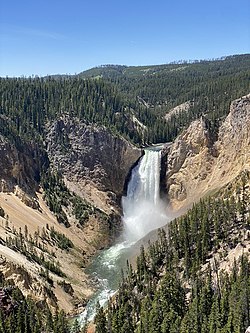
Yellowstone National Park became the world's first National Park in 1872.
Image source: Yellowstone National Park
1891
% complete
Wyoming is also home to the nation's first national forest, Shoshone National Forest, created in 1891.
Image source: Shoshone National Forest
1906
% complete
Wyoming is home to the nation's first national monument, Devils Tower, created in 1906.
Image source: Devils Tower
1917
% complete
In 1917, administration of Yellowstone National Park was transferred to the new National Park Service.
Image source: National Park Service
Or browse the full history timeline directory, with more than 2,000 topics.
This History of Wyoming timeline was generated with the help of AI, using information found on the internet.
We work hard to keep these timelines accurate, but mistakes do get through. If you spot one, email us at [email protected] and we'll fix it for future visitors.
Generate yours with AI or build it from scratch, for free.
Export your timeline, add your own events, edit or remove AI-generated events, and much more
No credit card required.
Cancel anytime.
Cancel anytime.
You can create an unlimited number of timelines with up to 10 events on each one, customize how they look, export them to PDF, PNG, PowerPoint, CSV, and Excel, and share them with a link. Paid plans raise the event limit and add features like spreadsheet imports and collaborators.
Yes. You can cancel your subscription from your account page at any time, and you will not be charged again. Your subscription stays active for the rest of the period you already paid for.
Yes. We will email you a reminder before the annual renewal, and we will also email you a receipt.
Yes. You can email us within 15 days of any payment, and we will issue you a full refund.
Check out our pricing docs or send us an email anytime: [email protected].