
-
Resources
-
Pricing
The Selma to Montgomery Marches were a series of civil rights demonstrations in Alabama in 1965 that challenged voter suppression and helped lead to the Voting Rights Act. More Less
Build a timeline like this one in minutes, for free. Start Yours →
Mar 7, 1965
An estimated 525 to 600 civil rights marchers headed southeast from Selma on U.S. Highway 80, beginning the first Selma to Montgomery march.
Image source: Selma to Montgomery marches
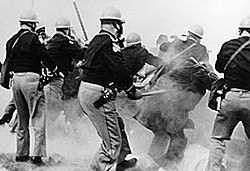
Mar 7, 1965
The marchers crossed toward the Edmund Pettus Bridge while attempting to proceed along the highway toward Montgomery.
Image source: Edmund Pettus Bridge
Mar 7, 1965
State troopers and county possemen confronted the unarmed protesters after they crossed the Edmund Pettus Bridge.
Mar 7, 1965
The officers charged the marchers with batons and tear gas, ending the first attempt to march from Selma toward Montgomery.
Mar 7, 1965
The first march was stopped before reaching Montgomery, making the violence at the bridge a nationally visible episode in the voting-rights campaign.
Mar 9, 1965
The second march proceeded from Selma toward the Edmund Pettus Bridge during the continuing campaign for voting rights.
Image source: Selma to Montgomery marches
Mar 9, 1965
James Bevel, Martin Luther King Jr., Diane Nash, and others organized a second march for Tuesday, March 9.
Mar 9, 1965
The organizers continued to use nonviolent direct action as they sought a federally protected route from Selma to Montgomery.
Mar 11, 1965
Following the death of James Reeb, a white Unitarian minister who had come to support the Selma campaign, pressure for federal action intensified.
Image source: James Reeb
Mar 17, 1965
Civil rights organizers and supporters continued working toward a march between Selma and Montgomery under federal protection.
Mar 20, 1965
The 54-mile route along U.S. Highway 80 remained the central focus of the campaign for voting rights.
Mar 21, 1965
The movement prepared for the third and successful Selma to Montgomery march after the earlier marches had been blocked or halted.
Mar 8, 1965
The assault on the marchers intensified national attention on Selma and increased pressure for federal voting-rights legislation.
Mar 11, 1965
Reeb’s death made the violence surrounding the voting-rights campaign a national political crisis.
Mar 12, 1965
The campaign continued pressing for federal protection and authorization to complete the route between Selma and Montgomery.
Mar 13, 1965
Events in Selma continued receiving national attention as organizers and supporters called for voting-rights protections.
Mar 15, 1965
Johnson presented a bill to Congress that would become the Voting Rights Act of 1965.
Image source: Voting Rights Act of 1965
Mar 15, 1965
The memorial service became a prominent national symbol of the violence and sacrifice surrounding the Selma voting-rights campaign.
Mar 15, 1965
President Lyndon B. Johnson delivered a historic, nationally televised address to a joint session of Congress and urged lawmakers to pass voting-rights legislation.
Mar 15, 1965
Johnson used the national crisis created by the Selma marches and Bloody Sunday to demand federal voting-rights protections.
Mar 16, 1965
Following Johnson’s address, Congress began considering the proposed voting-rights legislation prompted by the Selma campaign.
Mar 18, 1965
The national response to Selma continued as the administration and Congress pursued legislation to protect African Americans’ right to vote.
Mar 10, 1965
Civil rights leaders and organizations continued coordinating support for the Selma campaign after the first two marches.
Mar 10, 1965
The Medical Committee for Human Rights, organized with SNCC support during the Mississippi Summer Project, provided medical assistance connected with the movement.
Mar 13, 1965
Bevel, King, Nash, and other organizers continued coordinating the campaign and planning the next attempt to reach Montgomery.
Mar 14, 1965
Supporters gathered in Selma in advance of the memorial service and the continuing voting-rights campaign.
Mar 15, 1965
A memorial service for James Reeb was held at Brown’s Chapel AME Church.
Image source: Brown Chapel A.M.E. Church (Selma, Alabama)
Mar 15, 1965
Martin Luther King Jr. attended the memorial service for James Reeb in Selma.
Mar 15, 1965
Civil rights supporters prepared for a memorial service at Brown’s Chapel AME Church after Reeb’s death.
Mar 19, 1965
Organizers continued preparations for the movement’s effort to travel the 54-mile highway from Selma to Montgomery.
Build a timeline like this one in minutes, for free. Start Yours →
Or browse the full history timeline directory, with more than 2,500 topics.
This Selma to Montgomery Marches timeline was generated with the help of AI, using information found on the internet.
We work hard to keep these timelines accurate, but mistakes do get through. If you spot one, email us at [email protected] and we'll fix it for future visitors.
Generate yours with AI or build it from scratch, for free.
Export your timeline, add your own events, edit or remove AI-generated events, and much more
No credit card required.
15-day money-back guarantee.
You can create an unlimited number of timelines with up to 10 events on each one, customize how they look, export them to PDF, PNG, PowerPoint, CSV, and Excel, and share them with a link. Timelines made with Timeline Maker AI keep every event the generator created, and you can add up to 5 events of your own. Paid plans remove the event limit, add spreadsheet imports and hide Preceden's branding, and the higher-priced plan also adds collaborators, a custom logo and a custom domain.
Yes. You can cancel your subscription from your account page at any time, and you will not be charged again. Your subscription stays active for the rest of the period you already paid for.
Yes. We email you a reminder 15 days before your annual renewal, and we email you a receipt after every payment.
Yes. You can email us within 15 days of any payment, and we will issue you a full refund.
Check out our pricing docs or send us an email anytime: [email protected].