-
Use Cases
-
Resources
-
Pricing
Mars rovers are robotic vehicles designed to travel across the surface of Mars, conducting scientific research and transmitting valuable data back to Earth. Since NASA's first successful rover, Sojourner, landed in 1997 as part of the Pathfinder mission, a series of increasingly sophisticated rovers—including Spirit, Opportunity, Curiosity, and Perseverance—have transformed our understanding of Mars' geology, climate, and potential for past life. More Less
1971
% complete
The Soviet Mars 2 mission carried the PrOP-M rover, intended to be the first rover on Mars. However, the Mars 2 landing failed in 1971, destroying the Prop-M rover along with the lander, marking an early setback for Mars rover exploration.
Image source: Mars 2
Dec 2, 1971
% complete
The Soviet Mars 3 lander touched down successfully on December 2, 1971, carrying the small PrOP-M rover. Although communications were lost shortly after landing, it represented one of the earliest attempts to place a rover on the Martian surface.
Jul 4, 1997
% complete
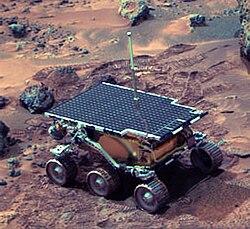
On July 4, 1997, the Sojourner rover landed successfully on Mars as part of the Mars Pathfinder mission. It became the first successful robotically operated Mars rover, managed by NASA's Jet Propulsion Laboratory.
Image source: Sojourner (rover)
Sep 27, 1997
% complete
Communications with the Sojourner rover were lost on September 27, 1997, ending its pioneering mission after roughly three months of operations on the Martian surface.
Jun 10, 2003
% complete
Spirit (MER-A), part of NASA's Mars Exploration Rover program, launched on June 10, 2003, beginning its journey toward Mars to search for evidence of past water activity on the red planet.
Image source: Spirit (rover)
Jul 7, 2003
% complete
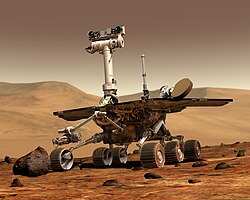
Opportunity (MER-B), the second of NASA's Mars Exploration Rovers, launched on July 7, 2003, heading for Meridiani Planum to study Martian geology and search for signs of ancient water.
Image source: Opportunity (rover)
Jan 4, 2004
% complete
Spirit (MER-A) landed successfully on Mars on January 4, 2004, beginning a mission that would far exceed its planned 90-day duration and continue operating until 2010.
Jan 25, 2004
% complete
Opportunity (MER-B) landed on Mars on January 25, 2004, three weeks after its twin Spirit. The rover would go on to become the longest-operating Mars rover, exploring Meridiani Planum for over 14 years.
Mar 22, 2010
% complete
The last communication received from the Spirit rover came on March 22, 2010, after the rover became trapped in soft soil and could not orient its solar panels to survive the Martian winter.
May 25, 2011
% complete
After more than a year of listening for signals, NASA ceased attempts to re-establish communication with Spirit on May 25, 2011, formally concluding the rover's remarkable six-year mission.
Nov 26, 2011
% complete
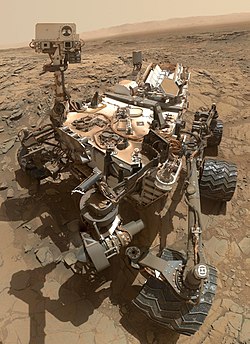
Curiosity, the centerpiece of NASA's Mars Science Laboratory (MSL) mission, launched on November 26, 2011, carrying advanced scientific instruments to assess whether Mars was ever habitable.
Image source: Curiosity (rover)
Aug 6, 2012
% complete
Curiosity landed on August 6, 2012, at the Aeolis Palus plain near Aeolis Mons (informally 'Mount Sharp') in Gale Crater, using an unprecedented sky crane maneuver to touch down safely.
Jan 24, 2016
% complete
On January 24, 2016, NASA reported that ongoing studies by Opportunity and Curiosity would be searching for evidence of ancient life, including biospheres based on autotrophic, chemotrophic or chemolithoautotrophic microorganisms, as well as ancient water and fluvio-lacustrine environments that may have been habitable.
Image source: Life on Mars
Jun 10, 2018
% complete
Opportunity sent its last status on June 10, 2018, when a global 2018 Mars dust storm blocked the sunlight needed to recharge its batteries, silencing the rover after more than 14 years of operation.
Feb 13, 2019
% complete
After hundreds of attempts to reactivate the rover, NASA declared the Opportunity mission complete on February 13, 2019. The rover had set longevity records at 5,352 sols (5,498 Earth days; 15 Earth years or 8 Martian years) and covered 45.16 km (28.06 mi).
Jul 30, 2020
% complete
Perseverance, the newest American Mars rover, launched with the Mars 2020 mission on July 30, 2020, carrying instruments to seek signs of ancient life and collect samples for future return to Earth.
Image source: Perseverance (rover)
Feb 18, 2021
% complete
On February 18, 2021, Perseverance successfully landed on Mars, becoming the fifth successful NASA rover and beginning its search for signs of ancient microbial life in Jezero Crater. It remains active as of August 11, 2026.
May 2021
% complete
As of May 2021, there have been six successful robotically operated Mars rovers: five managed by NASA's Jet Propulsion Laboratory — Sojourner (1997), Spirit (2004–2010), Opportunity (2004–2018), Curiosity (2012–present), and Perseverance (2021–present) — plus China's Zhurong (2021–2022).
2000 - 2010
% complete
The Astrobiology Field Laboratory was proposed during the 2000-2010 period as a follow-on to the Mars Science Laboratory. The concept envisioned a rover dedicated to astrobiology research on Mars, though the mission was never flown.
Image source: Astrobiology Field Laboratory
2017
% complete
Since 2017, Team Tumbleweed has been developing a series of Tumbleweed Rovers, wind-driven spherical rovers designed to explore Mars cheaply and in large numbers.
Image source: Mars rover
2022
% complete
The JAXA Melos rover was supposed to be launched in 2022 as part of Japan's Mars exploration plans. However, JAXA has not given an update on the project since 2015, leaving its status uncertain.
Image source: Milos
2030
% complete
ISRO has proposed a Mars rover as part of the Mars Lander Mission, its second Mars mission, planned for 2030, which would make India another nation to operate a rover on Mars.
Image source: Chairman of the Indian Space Research Organisation
2034
% complete
Team Tumbleweed, the research organization developing wind-driven spherical rovers since 2017, aims to land a swarm of 90 Tumbleweed rovers on the Martian surface by 2034.
Jul 23, 2020
% complete
China's Zhurong rover launched with the Tianwen-1 CNSA Mars mission on July 23, 2020, marking China's first attempt to operate a rover on the surface of Mars.
Image source: Zhurong (rover)
May 14, 2021
% complete
On May 14, 2021, China's Zhurong rover landed in the southern region of Utopia Planitia, becoming the first non-American rover to successfully operate on Mars and making China the second nation to do so.
May 22, 2021
% complete
Eight days after landing, Zhurong deployed onto the surface of Utopia Planitia on May 22, 2021, beginning its exploration of the Martian terrain.
Jun 1, 2021
% complete
On June 1, 2021, while operating in Utopia Planitia, Zhurong dropped a remote selfie camera, which captured images of the rover on the Martian surface.
2022
% complete
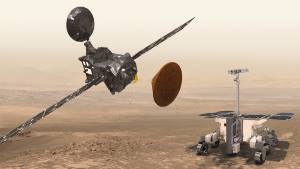
Due to the suspension of cooperation with Roscosmos following the planned September 2022 launch window, ESA's ExoMars rover Rosalind Franklin is delayed until at least 2028.
Image source: ExoMars
Mar 2022
% complete
In March 2022, ESA's ExoMars rover Rosalind Franklin was confirmed technically ready for launch, with plans to launch in September 2022 in cooperation with Roscosmos.
Image source: Rosalind Franklin (rover)
May 20, 2022
% complete
Since May 20, 2022, the Zhurong rover was deactivated due to approaching sandstorms and the Martian winter, entering hibernation in hopes of reactivating when conditions improved.
Apr 25, 2023
% complete
On April 25, 2023, mission designer Zhang Rongqiao announced that the buildup of dust from the last inactivation was greater than planned, indicating the Zhurong rover could be inactive 'forever'.
Or browse the full history timeline directory, with more than 2,000 topics.
This Mars Rovers timeline was generated with the help of AI, using information found on the internet.
We work hard to keep these timelines accurate, but mistakes do get through. If you spot one, email us at [email protected] and we'll fix it for future visitors.
Generate yours with AI or build it from scratch, for free.
Export your timeline, add your own events, edit or remove AI-generated events, and much more
No credit card required.
Cancel anytime.
Cancel anytime.
You can create an unlimited number of timelines with up to 10 events on each one, customize how they look, export them to PDF, PNG, PowerPoint, CSV, and Excel, and share them with a link. Paid plans raise the event limit and add features like spreadsheet imports and collaborators.
Yes. You can cancel your subscription from your account page at any time, and you will not be charged again. Your subscription stays active for the rest of the period you already paid for.
Yes. We will email you a reminder before the annual renewal, and we will also email you a receipt.
Yes. You can email us within 15 days of any payment, and we will issue you a full refund.
Check out our pricing docs or send us an email anytime: [email protected].