-
Use Cases
-
Resources
-
Pricing
The Cassini Mission was a joint NASA, ESA, and ASI robotic spacecraft mission that studied Saturn and its moons from 2004 to 2017. Launched in 1997, Cassini delivered the Huygens probe to Titan and revolutionized our understanding of the Saturn system before ending with a deliberate plunge into Saturn's atmosphere during its Grand Finale. More Less
1982
% complete
In 1982, a joint working group of American and European scientists proposed a flagship mission to send an orbiter and probe to Saturn. The concept, named after astronomers Giovanni Cassini and Christiaan Huygens, would eventually become one of the most ambitious planetary science missions ever undertaken.
1988
% complete
NASA, the European Space Agency (ESA), and later the Italian Space Agency (ASI) formalized their partnership for the Cassini–Huygens mission. NASA would build the orbiter, ESA the Huygens lander destined for Titan, and ASI key components including the high-gain antenna.
1990
% complete
Engineers at NASA's Jet Propulsion Laboratory began building the Cassini orbiter, one of the largest and most complex interplanetary spacecraft ever constructed. At over six tons fueled, it carried twelve scientific instruments designed to study Saturn, its rings, moons, and magnetosphere.
Image source: Cassini–Huygens
1994
% complete
The Cassini mission faced repeated threats of cancellation in the U.S. Congress due to its multi-billion-dollar cost and controversy over its plutonium power source. Strong international commitments and advocacy from the scientific community kept the program alive.
1997
% complete
Activists protested the launch due to Cassini's 32.7 kilograms of plutonium-238 used in its radioisotope thermoelectric generators, fearing contamination in the event of a launch accident or during its planned Earth flyby. NASA maintained that risks were minimal.
Image source: Cassini–Huygens
Oct 15, 1997
% complete
The Cassini–Huygens spacecraft launched aboard a Titan IVB/Centaur rocket from Cape Canaveral Air Force Station in Florida. The massive spacecraft began its seven-year journey to Saturn, requiring gravity assists because no rocket could send it directly.
Apr 26, 1998 - Jun 24, 1999
% complete
Cassini performed two gravity-assist flybys of Venus, first on April 26, 1998, and again on June 24, 1999, gaining velocity for its long journey toward the outer solar system while testing its instruments.
Aug 18, 1999
% complete
Cassini swung past Earth at an altitude of about 1,171 kilometers, gaining the final boost needed to reach Jupiter and beyond. Despite protests over the plutonium aboard, the flyby proceeded flawlessly.
Dec 30, 2000
% complete
Cassini flew by Jupiter at a distance of about 9.7 million kilometers, conducting an extensive joint observation campaign with the Galileo spacecraft. It captured detailed images of Jupiter's atmosphere, storms, and magnetosphere.
2001
% complete
During cruise and approach, Cassini's instruments refined understanding of Saturn's ring system, setting the stage for detailed studies of the F ring and its shepherd moons Prometheus and Pandora after arrival.
Image source: Rings of Saturn
Jun 11, 2004
% complete
Just before orbital insertion, Cassini flew within about 2,068 kilometers of Saturn's outer moon Phoebe, revealing it to be a heavily cratered, icy body likely captured from the Kuiper Belt, providing clues about the early solar system.
Image source: Phoebe (moon)
Jul 1, 2004
% complete
After a seven-year journey, Cassini fired its main engine for 96 minutes and became the first spacecraft to orbit Saturn. It began a four-year prime mission studying the planet, its rings, and its many moons.
Jul 2, 2004
% complete
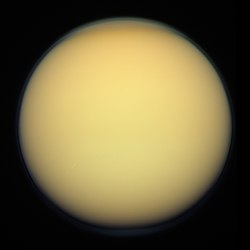
Cassini's first targeted flyby of Titan pierced its hazy atmosphere with radar and infrared instruments, revealing bright and dark surface regions and fueling anticipation for the Huygens landing.
Image source: Titan (moon)
Dec 25, 2004
% complete
The ESA-built Huygens probe detached from the Cassini orbiter and began its three-week coast toward Titan, carrying instruments to study the moon's atmosphere and surface during descent.
Image source: Huygens (spacecraft)
Jan 14, 2005
% complete
Huygens descended through Titan's thick nitrogen atmosphere under parachute and landed safely, becoming the most distant landing ever made by a spacecraft. It returned images of a landscape shaped by methane rain and rivers, plus evidence of liquid hydrocarbons on the surface.
Mar 12, 2005
% complete
Cassini discovered plumes of water vapor and ice particles erupting from cracks near Enceladus's south pole, dubbed 'tiger stripes.' The finding revealed a small moon with active geology and hinted at a subsurface ocean.
Jan 3, 2007
% complete
Radar observations confirmed large lakes of liquid methane and ethane near Titan's north pole, making it the only world besides Earth known to have stable liquids on its surface.
Image source: Lakes and rivers of Titan
Apr 2008
% complete
With the successful completion of its four-year prime mission, NASA approved a two-year Equinox Mission extension through September 2010, allowing continued study of Saturn's seasonal changes.
Feb 2010
% complete
NASA extended Cassini's mission again through 2017, covering half a Saturn year and enabling observations of the planet's northern summer solstice, completing a full seasonal cycle begun at arrival.
Dec 2010
% complete
Cassini observed a massive storm erupting in Saturn's northern hemisphere, eventually encircling the entire planet. It was the largest storm observed on Saturn since 1990 and provided insights into the planet's atmospheric dynamics.
Image source: Great White Spot
2014
% complete
Gravity measurements and plume analysis confirmed that Enceladus harbors a global subsurface ocean of salty liquid water beneath its icy crust, making it one of the most promising places to search for life beyond Earth.
Image source: Enceladus
Aug 17, 2015
% complete
Cassini made its final close flyby of Dione at about 474 kilometers, capturing detailed views of the icy moon's wispy terrain and confirming tenuous oxygen exosphere detections.
Image source: Dione (moon)
Oct 28, 2015
% complete
On its deepest dive yet, Cassini passed just 49 kilometers above Enceladus's south pole, flying directly through the plume to sample its composition, yielding key data on the moon's ocean chemistry.
Sep 28, 2016
% complete
Analysis of Cassini data revealed molecular hydrogen in Enceladus's plumes, indicating hydrothermal reactions between rock and water on the seafloor — a potential energy source for microbial life.
Nov 29, 2016
% complete
NASA announced the Grand Finale: a series of daring orbits between Saturn and its rings before Cassini's deliberate destruction, chosen to protect potentially habitable moons like Enceladus and Titan from contamination.
2017
% complete
Grand Finale measurements quantified 'ring rain' — material from the rings raining into Saturn's atmosphere — suggesting the rings are younger than previously thought and may dissipate within tens to hundreds of millions of years.
Apr 22, 2017
% complete
Cassini's last flyby of Titan used the moon's gravity to reshape its orbit, sending it plunging toward Saturn for the final phase of the mission while returning farewell radar views of Titan's seas.
Apr 26, 2017 - Sep 15, 2017
% complete
During 22 orbits, Cassini repeatedly threaded the gap between Saturn's cloud tops and its innermost rings, measuring the planet's gravity field, magnetic environment, and ring mass — surviving dust impacts thanks to its high-gain antenna shield.
Sep 15, 2017
% complete
After nearly 20 years in space and 13 at Saturn, Cassini deliberately entered Saturn's atmosphere, transmitting science data until signal loss at 11:55 UTC. Its controlled destruction prevented contaminating Enceladus or Titan with Earth microbes.
2018
% complete
Cassini's discoveries of ocean worlds at Enceladus and Titan directly inspired follow-up concepts such as Dragonfly, NASA's planned rotorcraft mission to Titan, cementing Cassini's status as one of the most scientifically productive missions in history.
Or browse the full history timeline directory, with more than 2,000 topics.
This Cassini Mission timeline was generated with the help of AI, using information found on the internet.
We work hard to keep these timelines accurate, but mistakes do get through. If you spot one, email us at [email protected] and we'll fix it for future visitors.
Generate yours with AI or build it from scratch, for free.
Export your timeline, add your own events, edit or remove AI-generated events, and much more
No credit card required.
Cancel anytime.
Cancel anytime.
You can create an unlimited number of timelines with up to 10 events on each one, customize how they look, export them to PDF, PNG, PowerPoint, CSV, and Excel, and share them with a link. Paid plans raise the event limit and add features like spreadsheet imports and collaborators.
Yes. You can cancel your subscription from your account page at any time, and you will not be charged again. Your subscription stays active for the rest of the period you already paid for.
Yes. We will email you a reminder before the annual renewal, and we will also email you a receipt.
Yes. You can email us within 15 days of any payment, and we will issue you a full refund.
Check out our pricing docs or send us an email anytime: [email protected].