-
Use Cases
-
Resources
-
Pricing
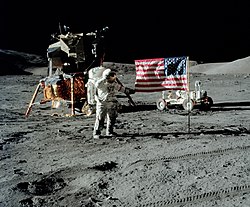
The Apollo Program was NASA's third human spaceflight program, dedicated to landing humans on the Moon and returning them safely to Earth. Conceived during the Cold War space race, it achieved its goal with Apollo 11 in July 1969, when Neil Armstrong and Buzz Aldrin became the first humans to walk on the lunar surface. Over the course of the program, six successful crewed Moon landings were completed, dramatically advancing science, technology, and human exploration of space. More Less
1958
% complete
Even before NASA was formally established, engineers at the National Advisory Committee for Aeronautics (NACA) began studying advanced spacecraft designs for a possible crewed lunar mission, laying early technical groundwork for what would become the Apollo program.
Image source: Apollo program
Oct 1, 1958
% complete
The National Aeronautics and Space Administration began operations on October 1, 1958, absorbing NACA and taking charge of the United States' civilian space efforts. NASA would soon adopt the Apollo lunar program as its flagship endeavor in the race against the Soviet Union.
Image source: NASA
Oct 7, 1958
% complete
NASA announced Project Mercury, America's first human spaceflight program. While focused on orbital flight rather than the Moon, Mercury developed critical technologies, training methods, and operational experience that directly fed into Apollo.
Image source: Project Mercury
Jul 28, 1960
% complete
NASA formally announced plans for Project Apollo, a follow-on to Mercury intended to conduct advanced crewed missions, including flights around the Moon. The program's initial goals were modest compared to what it would ultimately achieve after Kennedy's challenge.
May 25, 1961
% complete
In an address to Congress just weeks after Alan Shepard's suborbital flight, President John F. Kennedy proposed landing an American astronaut on the Moon and returning him safely before the end of the 1960s, transforming Apollo into a national priority.
Image source: We choose to go to the Moon
Nov 1961
% complete
NASA selected Houston, Texas as the site for its new Manned Spacecraft Center (later renamed the Johnson Space Center), which became the lead center for designing, testing, and operating the Apollo spacecraft and managing crewed missions.
Image source: Johnson Space Center
Nov 28, 1961
% complete
NASA awarded North American Aviation the contract to build the Apollo Command/Service Module, the spacecraft that would carry astronauts to lunar orbit and back to Earth, serving as the mothership for the Lunar Module throughout each mission.
Image source: Apollo command and service module
Jan 10, 1962
% complete
NASA chose the massive three-stage Saturn C-5 rocket, later known simply as the Saturn V, to launch Apollo lunar missions. Developed under Wernher von Braun's team at Marshall Space Flight Center, it remains the most powerful rocket ever flown.
Image source: Saturn V
Jul 11, 1962
% complete
After intense debate among competing mission architectures, NASA selected Lunar Orbit Rendezvous (LOR), championed by John Houbolt. This decision required a separate lightweight lunar module that would meet the command module in lunar orbit, shaping the design of both Apollo spacecraft.
Image source: Lunar orbit rendezvous
Sep 12, 1962
% complete
President Kennedy delivered his famous speech at Rice University in Houston, Texas, declaring that America chose to go to the Moon in that decade not because it was easy, but because it was hard. The speech galvanized public support for Apollo.
Nov 7, 1962
% complete
Grumman Aircraft Engineering Corporation won the contract to build the Apollo Lunar Module, the two-stage vehicle designed solely to operate in space and land two astronauts on the lunar surface. Its development proved one of the program's greatest engineering challenges.
Image source: Apollo Lunar Module
Jan 27, 1967
% complete
During a launch pad test at Cape Kennedy, a flash fire swept through the pure-oxygen atmosphere of the Apollo 1 command module, killing astronauts Gus Grissom, Ed White, and Roger Chaffee. The tragedy forced sweeping redesigns of the spacecraft and safety procedures.
Image source: Apollo 1
Feb 26, 1966
% complete
The AS-201 mission launched an uncrewed Block I Apollo Command/Service Module atop a Saturn IB rocket on a suborbital trajectory, providing the first flight test of the spacecraft's heat shield, propulsion systems, and guidance equipment.
Image source: AS-201
Jul 5, 1966
% complete
AS-203 placed an uncrewed S-IVB second stage into Earth orbit without a spacecraft attached, allowing engineers to study liquid hydrogen behavior in weightlessness, data crucial for verifying the restart capability needed for trans-lunar injection burns.
Image source: AS-203
Aug 25, 1966
% complete
AS-202 flew an uncrewed Command/Service Module on a suborbital arc reaching over 11,000 miles downrange, testing heat shield performance during a high-speed reentry and validating systems ahead of planned crewed flights.
Image source: AS-202
Nov 9, 1967
% complete
Apollo 4 marked the maiden flight of the mighty Saturn V, sending an uncrewed Command/Service Module to a record altitude before a dramatic high-speed reentry. The flawless all-up test validated the entire launch vehicle and spacecraft combination.
Image source: Apollo 4
Jan 22, 1968
% complete
Launched on a Saturn IB, Apollo 5 carried the first Lunar Module into space for uncrewed testing. Despite a computer abort during ascent, controllers successfully demonstrated the descent and ascent engine firings essential for lunar landing operations.
Image source: Apollo 5
Apr 4, 1968
% complete
The second Saturn V flight suffered multiple engine failures and pogo oscillations during ascent, preventing the spacecraft from reaching its planned trajectory. Despite the problems, the mission provided valuable data that led to fixes enabling subsequent crewed flights.
Image source: Apollo 6
Oct 11, 1968 - Oct 22, 1968
% complete
Wally Schirra, Donn Eisele, and Walter Cunningham spent nearly eleven days in Earth orbit aboard the redesigned Block II Command/Service Module, thoroughly testing every system and restoring confidence in the Apollo program after the fatal 1967 fire.
Image source: Apollo 7
Dec 21, 1968 - Dec 27, 1968
% complete
Frank Borman, Jim Lovell, and Bill Anders became the first humans to leave Earth's gravitational influence, orbiting the Moon ten times on Christmas Eve and broadcasting the famous 'Earthrise' image and a reading from Genesis back to a global audience.
Image source: Apollo 8
Mar 3, 1969 - Mar 13, 1969
% complete
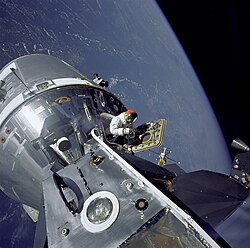
Jim McDivitt, Rusty Schweickart, and David Scott conducted the first crewed flight of the complete Apollo stack, including the Lunar Module. They tested rendezvous, docking, and the spacesuit life support backpack, proving all systems ready for a lunar attempt.
Image source: Apollo 9
May 18, 1969 - May 26, 1969
% complete
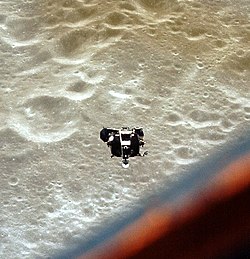
Tom Stafford, John Young, and Gene Cernan flew the full lunar mission profile, with the Lunar Module Snoopy descending to within about 50,000 feet of the lunar surface before returning safely, clearing the way for the first landing attempt.
Image source: Apollo 10
Apr 11, 1970 - Apr 17, 1970
% complete
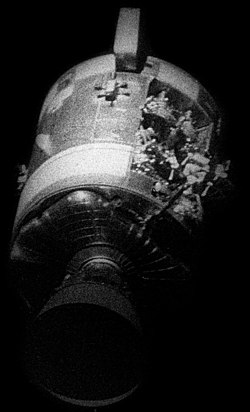
An oxygen tank exploded en route to the Moon, crippling the service module and forcing Jim Lovell, Jack Swigert, and Fred Haise to use the Lunar Module as a lifeboat. Through heroic improvisation by crew and Mission Control, all three returned safely in a 'successful failure.'
Image source: Apollo 13
Jul 16, 1969 - Jul 24, 1969
% complete
Neil Armstrong and Buzz Aldrin landed the Eagle Lunar Module in the Sea of Tranquility on July 20, 1969, while Michael Collins orbited above. Armstrong's 'one small step' fulfilled Kennedy's goal, watched live by hundreds of millions worldwide.
Image source: Apollo 11
Nov 14, 1969 - Nov 24, 1969
% complete
Pete Conrad and Alan Bean executed a pinpoint landing in the Ocean of Storms, touching down within walking distance of the robotic Surveyor 3 probe. They retrieved parts of the old spacecraft and deployed the first Apollo Lunar Surface Experiments Package.
Image source: Apollo 12
Jan 31, 1971 - Feb 9, 1971
% complete
Alan Shepard, America's first man in space, returned to fly again and commanded Apollo 14 to a successful landing in the hilly Fra Mauro region originally targeted by Apollo 13. He famously hit two golf balls on the lunar surface.
Image source: Apollo 14
Jul 26, 1971 - Aug 7, 1971
% complete
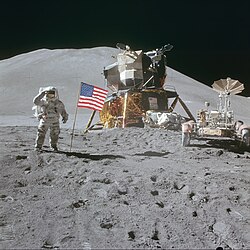
Dave Scott and Jim Irwin explored the Hadley-Apennine region using the first Lunar Roving Vehicle, traveling over 17 miles across the surface. They collected the 'Genesis Rock,' believed to be a sample of the Moon's ancient primordial crust.
Image source: Apollo 15
Apr 16, 1972 - Apr 27, 1972
% complete
John Young and Charlie Duke landed in the lunar highlands near the crater Descartes, conducting extensive rover traverses and discovering that the area's geology differed from expectations, revealing widespread impact breccias rather than volcanic rocks.
Image source: Apollo 16
Dec 7, 1972 - Dec 19, 1972
% complete
Gene Cernan and geologist Harrison Schmitt spent over 22 hours exploring the Taurus-Littrow valley, collecting a record amount of samples including orange volcanic soil. Cernan became the last human to walk on the Moon, closing out the Apollo lunar era.
Image source: Apollo 17
May 14, 1973 - Jul 11, 1979
% complete
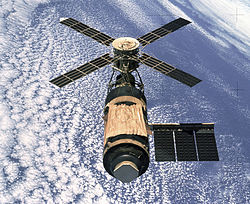
America's first space station, Skylab, was built from a converted Saturn V third stage and serviced by crews launched on Saturn IB rockets using Apollo Command/Service Modules, extending Apollo technology into long-duration orbital research.
Image source: Skylab
Jul 15, 1975 - Jul 24, 1975
% complete
In the final Apollo mission, an American Apollo spacecraft docked in orbit with a Soviet Soyuz capsule, marking the first international human spaceflight and a symbolic end to the Space Race between the two superpowers.
Image source: Apollo–Soyuz
Or browse the full history timeline directory, with more than 2,000 topics.
This Apollo Program timeline was generated with the help of AI, using information found on the internet.
We work hard to keep these timelines accurate, but mistakes do get through. If you spot one, email us at [email protected] and we'll fix it for future visitors.
Generate yours with AI or build it from scratch, for free.
Export your timeline, add your own events, edit or remove AI-generated events, and much more
No credit card required.
Cancel anytime.
Cancel anytime.
You can create an unlimited number of timelines with up to 10 events on each one, customize how they look, export them to PDF, PNG, PowerPoint, CSV, and Excel, and share them with a link. Paid plans raise the event limit and add features like spreadsheet imports and collaborators.
Yes. You can cancel your subscription from your account page at any time, and you will not be charged again. Your subscription stays active for the rest of the period you already paid for.
Yes. We will email you a reminder before the annual renewal, and we will also email you a receipt.
Yes. You can email us within 15 days of any payment, and we will issue you a full refund.
Check out our pricing docs or send us an email anytime: [email protected].