-
Use Cases
-
Resources
-
Pricing
Oct 1957
% complete
The Space Race began with the 1957 launch of the Soviet satellite Sputnik 1. Americans were shocked when the Soviet Union placed the first satellite into orbit in October 1957, leading to a growing fear that the US was falling into a 'missile gap'.
Image source: Sputnik 1
Jan 31, 1958
% complete
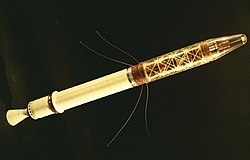
After the successful launch of the Explorer 1 satellite in 1958, crewed spaceflight became the next goal for the United States.
Image source: Explorer 1
Oct 1, 1958
% complete
The National Aeronautics and Space Administration was created on October 1, 1958, with Hugh Dryden, last Director of NACA, serving as Deputy. The agency achieved its first goal of launching a satellite into space, Pioneer 1, in 1958.
Image source: NASA
Oct 7, 1958
% complete
Project Mercury was officially approved on October 7, 1958, becoming the first human spaceflight program of the United States.
Image source: Project Mercury
Dec 17, 1958
% complete
Project Mercury was publicly announced on December 17, 1958, revealing America's first human spaceflight program to the world.
May 1959
% complete
President Eisenhower at first hesitated to give the project top national priority (DX rating under the Defense Production Act), which meant that Mercury had to wait in line behind military projects for materials; however, this rating was granted in May 1959, a little more than a year and a half after Sputnik was launched.
May 1963
% complete
When Mercury ended in May 1963, both nations had sent six people into space, but the Soviets led the US in total time spent in space.
Nov 1958
% complete
After bidding by potential contractors had been completed, NASA selected the design submitted as 'C' in November 1958. The Mercury spacecraft design was modified three times by NASA between 1958 and 1959.
1959
% complete
The Little Joe rocket used solid-fuel propellant and was originally designed in 1958 by NACA for suborbital crewed flights, but was redesigned for Project Mercury to simulate an Atlas-D launch.
Image source: Little Joe (rocket)
Jan 1959
% complete
In January 1959, McDonnell Aircraft Corporation was chosen to be prime contractor for the Mercury spacecraft.
Jul 1959
% complete
After a design failed a test flight in July 1959, a final configuration, 'D', emerged for the Mercury spacecraft.
Feb 1961
% complete
An inquiry on the subject was made in February 1961 by a student, but NASA responded by stating that 'the first space man is not expected to have "to go"'. It would take until the third flight in February 1962 before a dedicated urine collection device was installed.
Dec 1958
% complete
At the end of 1958, various ideas for the selection pool were discussed privately within the national government and the civilian space program, and also among the public at large. By late 1958, NASA officials decided to move forward with test pilots being the heart of their selection pool.
Apr 12, 1961
% complete
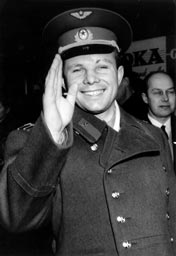
The Soviet Union put the first human, cosmonaut Yuri Gagarin, into a single orbit aboard Vostok 1 on April 12, 1961, beating the United States in the race to put a person into space.
Image source: Vostok 1
May 5, 1961
% complete
Alan Shepard became the first American in space by making a suborbital flight on May 5, 1961, just three weeks after Gagarin's orbital flight.
Image source: Mercury-Redstone 3
Jul 21, 1961
% complete
Gus Grissom became the second American in space on Mercury-Redstone 4 on July 21, 1961. Grissom went on to participate in the Gemini and Apollo programs, but died in January 1967 during a pre-launch test for Apollo 1.
Image source: Mercury-Redstone 4
Aug 1961
% complete
Soviet cosmonaut Gherman Titov followed Gagarin with a day-long orbital flight in August 1961, further extending the Soviet lead in crewed spaceflight.
Image source: Vostok 2
1962
% complete
Deke Slayton was grounded in 1962 due to a heart condition, but remained with NASA and was appointed senior manager of the Astronaut Office and later additionally assistant director of Flight Crew Operations at the beginning of Project Gemini.
Image source: Deke Slayton
1962
% complete
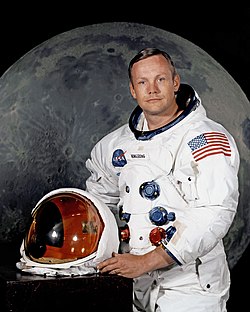
Civilian NASA X-15 pilot Neil Armstrong had been disqualified from Mercury, though he had been selected by the US Air Force in 1958 for its Man in Space Soonest program, which was replaced by Mercury. Armstrong became NASA's first civilian astronaut in 1962 when he was selected for NASA's second group, and became the first man on the Moon in 1969.
Image source: Neil Armstrong
Feb 20, 1962
% complete
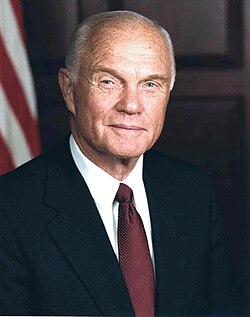
John Glenn became the first American to orbit the Earth on Mercury-Atlas 6 on February 20, 1962, making three orbits around the Earth and reaching the US orbital goal. From Cape Canaveral, 75,000 people watched the first American orbital flight being launched.
Image source: Mercury-Atlas 6
May 24, 1962
% complete
Scott Carpenter was the second American astronaut in orbit and flew on Mercury-Atlas 7 on May 24, 1962.
Image source: Mercury-Atlas 7
Oct 3, 1962
% complete
Wally Schirra flew aboard Sigma 7 on Mercury-Atlas 8 on October 3, 1962. In December 1965, Schirra flew on Gemini 6A, achieving the first ever space rendezvous with sister spacecraft Gemini 7.
Image source: Mercury-Atlas 8
May 15, 1963 - May 16, 1963
% complete
Gordon Cooper made the last flight of Project Mercury with Mercury-Atlas 9 on May 15, 1963, ending with a day-long, 22 orbit flight concluding on May 16, 1963.
Image source: Mercury-Atlas 9
1960
% complete
Most missions followed the spacecraft from the Mercury Space Flight Network, a chain of 18 stations placed around the equator, which was based on a network used for satellites and made ready in 1960.
1965
% complete
Mission Control Center was moved from Cape Canaveral to Houston in 1965. Data from Mercury spacecraft were processed at the Goddard Space Center by a redundant pair of transistorized IBM 7090 computers and relayed to the Mercury Control Center at Cape Canaveral; other computers included an IBM 709 at Cape Canaveral, another IBM 709 in Bermuda, and a Burroughs-GE system providing Atlas radio guidance.
Image source: Mission control center
1960
% complete
The design combining the symbol of Mercury with the number 7 was first issued to the Mercury astronauts in 1960 as a lapel pin.
1964
% complete
In 1964, a monument commemorating Project Mercury was unveiled near Launch Complex 14 at Cape Canaveral, featuring a metal logo combining the symbol of Mercury with the number 7.
Image source: Cape Canaveral Launch Complex 14
Jan 1967
% complete
Grissom died in January 1967 during a pre-launch test for Apollo 1. Other than Grissom, the other six Mercury astronauts survived past retirement and died between 1993 and 2016.
Image source: Apollo 1
Mar 13, 1972
% complete
On March 13, 1972, after doctors confirmed he no longer had a coronary condition, Slayton returned to flight status and the next year was assigned to the Apollo–Soyuz Test Project, which successfully flew in 1975 with Slayton as the docking module pilot. After the ASTP, he managed the Space Shuttle Program's Approach and Landing Tests before retiring from NASA in 1982.
1974 - 1999
% complete
Glenn quit NASA in 1964, when he came to the conclusion that he likely would not be selected for any Apollo missions, and was later elected to the US Senate, serving from 1974 to 1999.
Image source: John Glenn
1983
% complete
On film the program was portrayed in The Right Stuff, a 1983 adaptation of Tom Wolfe's 1979 book of the same name, in the 1998 HBO miniseries From the Earth to the Moon, in the 2016 film Hidden Figures, and the 2020 Disney+ series The Right Stuff.
Image source: The Right Stuff (film)
1998
% complete
During his Senate tenure, John Glenn returned to space in 1998 as a Payload Specialist aboard STS-95.
Image source: STS-95
Or browse the full history timeline directory, with more than 2,000 topics.
This Mercury Program timeline was generated with the help of AI, using information found on the internet.
We work hard to keep these timelines accurate, but mistakes do get through. If you spot one, email us at [email protected] and we'll fix it for future visitors.
Generate yours with AI or build it from scratch, for free.
Export your timeline, add your own events, edit or remove AI-generated events, and much more
No credit card required.
Cancel anytime.
Cancel anytime.
You can create an unlimited number of timelines with up to 10 events on each one, customize how they look, export them to PDF, PNG, PowerPoint, CSV, and Excel, and share them with a link. Paid plans raise the event limit and add features like spreadsheet imports and collaborators.
Yes. You can cancel your subscription from your account page at any time, and you will not be charged again. Your subscription stays active for the rest of the period you already paid for.
Yes. We will email you a reminder before the annual renewal, and we will also email you a receipt.
Yes. You can email us within 15 days of any payment, and we will issue you a full refund.
Check out our pricing docs or send us an email anytime: [email protected].