-
Use Cases
-
Resources
-
Pricing
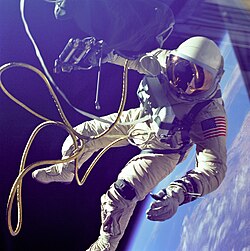
The Gemini Program was NASA's second human spaceflight program, running ten crewed missions between 1965 and 1966. Designed to bridge the gap between Project Mercury and the Apollo Program, Gemini developed and perfected critical techniques needed for a Moon landing, including orbital rendezvous, docking, extravehicular activity (spacewalks), and long-duration flight. More Less
1960
% complete
The Apollo program was conceived in early 1960 as a three-man spacecraft to follow Project Mercury, setting the stage for the development of intermediate capabilities that would eventually be addressed by the Gemini program.
Image source: Apollo program
1961 - 1966
% complete
Gemini was conceived in 1961 and concluded in 1966. Its chief designer, Jim Chamberlin, also made detailed plans for cislunar and lunar landing missions in late 1961.
Image source: Project Gemini

1961
% complete
In 1961, NASA selected McDonnell Aircraft, which was the prime contractor for the Project Mercury capsule, to build the Gemini capsule, the first of which was delivered in 1963.
Feb 1961
% complete
Jim Chamberlin, head of engineering at the Space Task Group (STG), was assigned in February 1961 to start working on a bridge program between Mercury and Apollo, which would become Project Gemini.
Mar 1961
% complete
Jim Chamberlin presented two initial versions of a two-man spacecraft, then designated Mercury Mark II, at a NASA retreat at Wallops Island in March 1961.
May 25, 1961
% complete
Following President Kennedy's May 25, 1961 speech committing the nation to a crewed Moon landing, it became evident to NASA officials that a follow-on to the Mercury program was required to develop certain spaceflight capabilities in support of Apollo.
Jul 1961
% complete
Scale models of the proposed two-man spacecraft were shown in July 1961 at the McDonnell Aircraft Corporation's offices in St. Louis.
Dec 7, 1961
% complete
NASA approved the two-man / two-vehicle program rechristened Project Gemini (Latin for "twins"), in reference to the third constellation of the Zodiac with its twin stars Castor and Pollux, on December 7, 1961.
Dec 22, 1961
% complete
McDonnell Aircraft was contracted to build the Gemini spacecraft on December 22, 1961, formalizing its role as prime contractor.
1963
% complete
The first Gemini capsule built by McDonnell Aircraft was delivered in 1963, marking a key milestone in the transition from design to flight hardware.
1963
% complete
What other Mercury astronauts dubbed "Gusmobile" was so designed around Grissom's 5'6" body that, when NASA discovered in 1963 that 14 of 16 astronauts would not fit in the spacecraft, the interior had to be redesigned.
1963
% complete
Blue Gemini was canceled in 1963 by Secretary of Defense Robert McNamara, who decided the NASA Gemini flights could conduct necessary military experiments.
Jan 1967
% complete
In January 1967, the fatal Apollo 1 fire demonstrated that pressurizing a spacecraft with pure oxygen created an extremely dangerous fire hazard, influencing spacecraft safety practices after Gemini.
Image source: Apollo 1
1962
% complete
The Titan II debuted in 1962 as the Air Force's second-generation ICBM to replace the Atlas, and it was adapted to serve as the launch vehicle for the Gemini spacecraft.
Image source: LGM-25C Titan II
1962
% complete
Fifteen Titan IIs were ordered in 1962 so the serial is "62-12XXX", but only "12XXX" is painted on the Titan II.
Jul 30, 1964
% complete
The order for the last three of the 15 launch vehicles was canceled on July 30, 1964, and they were never built.
Oct 1, 1963 - Dec 31, 1963
% complete
In late 1963, Slayton selected Shepard and Stafford for Gemini 3, McDivitt and White for Gemini 4, and Schirra and Young for Gemini 5 (which was to be the first Agena rendezvous mission).
Jan 1964 - Jul 1964
% complete
John Glenn had retired from NASA in January 1964, and Scott Carpenter, who was blamed by some in NASA management for the problematic reentry of Aurora 7, was on leave to participate in the Navy's SEALAB project and was grounded from flight in July 1964 due to an arm injury sustained in a motorbike accident.
1965 - 1966
% complete
Ten Gemini crews and 16 individual astronauts flew low Earth orbit (LEO) missions during 1965 and 1966, demonstrating rendezvous, docking, EVA, and long-duration endurance capabilities needed for Apollo.
Jun 3, 1965
% complete
On Gemini 4, Ed White became the first American to make an extravehicular activity (EVA, or "spacewalk") on June 3, 1965. Gus Grissom, acting as Houston capsule communicator, is heard on flight recordings pronouncing the call sign "Jeh-mih-nee 4".
Image source: Gemini 4
Aug 21, 1965 - Aug 29, 1965
% complete
Gemini 5 (August 21–29, 1965) demonstrated the 8-day endurance necessary for an Apollo lunar mission with the first use of fuel cells to generate its electrical power.
Image source: Gemini 5
Dec 1965
% complete
Gemini 6A accomplished the first space rendezvous with its sister craft Gemini 7 in December 1965, with Gemini 7 setting a 14-day endurance record for its flight.
Image source: Gemini 6A
Sep 1966
% complete
Gemini 11 set a crewed Earth orbital altitude record of 739.2 nautical miles (1,369.0 km) in September 1966, using the Agena target vehicle's propulsion system. This record stood until broken by Polaris Dawn in September 2024 and again by Artemis II in April 2026.
Image source: Gemini 11
Apr 1964
% complete
In April 1964, the first of two Gemini missions was flown without a crew to test systems and the heat shield.
Image source: Gemini (language model)
Jan 1965
% complete
In January 1965, the second uncrewed Gemini mission was flown to further test systems and the heat shield ahead of crewed flights.
1965
% complete
NASA's public affairs office issued a statement in 1965 declaring "Jeh'-mih-nee" the "official" pronunciation of the program's name.
1967
% complete
Two Gemini capsules (codenamed "Jupiter" instead of "Gemini") are featured in the plot of the 1967 James Bond film You Only Live Twice.
1968
% complete
Grissom wrote in his posthumous 1968 book Gemini! that the realization of Project Mercury's end and the unlikelihood of his having another flight in that program prompted him to focus all his efforts on the upcoming Gemini program.
1968
% complete
A modified one-man Gemini capsule is used to send an astronaut (played by James Caan) to the Moon in the 1968 film Countdown.
Image source: Countdown (1967 film)
1969
% complete
MOL was canceled by Secretary of Defense Melvin Laird in 1969, when it was determined that uncrewed spy satellites could perform the same functions much more cost-effectively.
Image source: Manned Orbiting Laboratory
Jan 1969
% complete
In January 1969, a NASA report to the US Congress estimating the costs for Mercury, Gemini, and Apollo included $1.2834 billion for Gemini: $797.4 million for spacecraft, $409.8 million for launch vehicles, and $76.2 million for support. From 1962 to 1967, Gemini cost $1.3 billion in 1967 dollars ($9.31 billion in 2024).
Aug 1969
% complete
Big Gemini (or "Big G") was another proposal by McDonnell Douglas made in August 1969. In 1969, Lukas Bingham proposed a "Big Gemini" that could have been used to shuttle up to 12 astronauts to the planned space stations in the Apollo Applications Project (AAP).
Image source: Big Gemini
Or browse the full history timeline directory, with more than 2,000 topics.
This Gemini Program timeline was generated with the help of AI, using information found on the internet.
We work hard to keep these timelines accurate, but mistakes do get through. If you spot one, email us at [email protected] and we'll fix it for future visitors.
Generate yours with AI or build it from scratch, for free.
Export your timeline, add your own events, edit or remove AI-generated events, and much more
No credit card required.
Cancel anytime.
Cancel anytime.
You can create an unlimited number of timelines with up to 10 events on each one, customize how they look, export them to PDF, PNG, PowerPoint, CSV, and Excel, and share them with a link. Paid plans raise the event limit and add features like spreadsheet imports and collaborators.
Yes. You can cancel your subscription from your account page at any time, and you will not be charged again. Your subscription stays active for the rest of the period you already paid for.
Yes. We will email you a reminder before the annual renewal, and we will also email you a receipt.
Yes. You can email us within 15 days of any payment, and we will issue you a full refund.
Check out our pricing docs or send us an email anytime: [email protected].