-
Use Cases
-
Resources
-
Pricing
2000 BCE - 500 CE
The Maritime Jade Road existed for at least 3,000 years, with peak production from 2000 BCE to 500 CE. Its jade exchange system predates both the mainland Silk Road and the later Maritime Silk Road.
Image source: Philippine jade culture
1900 BCE - 1800 BCE
Records from the 19th century BCE attest to an Assyrian merchant colony at Kanesh in Cappadocia, in modern Turkey. The colony demonstrates the early organization of long-distance commercial networks linking merchants, settlements, and production regions.
Image source: Kültepe
1500 BCE
Southeast Asian communities established trade routes with Southern India and Sri Lanka as early as 1500 BCE. The exchanges moved materials, boat technologies, cultigens, and cultural practices, connecting India, Southeast Asia, and China.
1000 BCE - 600 BCE
Earlier Austronesian spice-trade networks connected Island Southeast Asia with Sri Lanka and Southern India. These networks developed from older Maritime Jade Road exchanges and helped establish enduring sea lanes across the region.
Image source: Maritime Silk Road
500 CE - 1000 CE
The Maritime Jade Road network began to wane during its final centuries, from 500 to 1000 CE. Its decline preceded the later prominence of other maritime commercial systems.
800 CE - 999 CE
Before the 10th century, Southeast Asian traders primarily used the maritime routes, although Tamil and Persian traders also sailed them. This period highlights the central role of Austronesian seafarers in regional exchange.
300 BCE - 200 CE
The incense trade flourished from South Arabia to the Mediterranean between roughly the 3rd century BCE and the 2nd century CE. Aromatic goods moved through interconnected desert, coastal, and maritime routes.
200 BCE
By making use of maritime trade routes, Romans made bulk commodity trade possible in the 2nd century BCE. Sea transport allowed larger quantities of goods to move than overland routes could normally support.
Image source: Maritime transport
100 BCE
In the 1st century BCE, Gerrha, inhabited by Chaldean exiles from Babylon, controlled incense routes across Arabia to the Mediterranean and dominated the trade in aromatics to Babylon.
1 CE
According to Milo Kearney, South Arabs responded to Roman activity with pirate attacks on Roman ships in the Gulf of Aden. The episode illustrates the competition and insecurity surrounding strategic maritime corridors.
600 CE - 1000 CE
Between the 6th and 10th centuries, Callawaya herbalists traded tropical plants while specialized merchants dealt in copper in the Peruvian valley of Chincha. These exchanges show the development of specialized commodity networks beyond Eurasia.
600 CE - 800 CE
Indian commercial connections with Southeast Asia proved vital to merchants of Arabia and Persia during the 7th and 8th centuries. These links extended the older maritime networks that connected the Indian Ocean with island Southeast Asia.
850 CE - 1400 CE
Indian spice exports appear in works by Ibn Khurdadhbeh around 850, Ishak bin Imaran in 907, al-Ghafiqi around 1150, and Al-Kalkashandi in the 14th century. These references document the continuing importance of Indian Ocean commerce.
Image source: Spice trade
900 CE - 999 CE
China began building its own fleets during the Song dynasty in the 10th century. Chinese participation expanded direct state involvement in the maritime trade route, continuing until the end of the Colonial Era and the collapse of the Qing dynasty.
1 CE - 100 CE
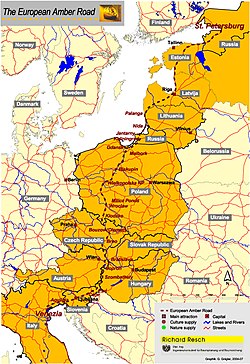
Towns along the Amber Road began to rise steadily during the 1st century CE, despite troop movements under Titus Flavius Vespasianus and his son Titus Flavius Domitianus.
Image source: Amber Road
200 CE - 299 CE
During the 3rd century, the Danube River became the principal artery of trade, eclipsing the Amber Road and other commercial routes. River transport reshaped the balance between inland and long-distance commerce.
Image source: Danube
700 CE - 1500 CE
From the 8th through the 15th century, Venetian and Genoese merchants held a monopoly over European trade with the Middle East. Their position connected Mediterranean commerce with Asian goods arriving through maritime and overland routes.
Image source: Italian city-states
1000 CE
Around the year 1000, European economic growth and insecurity on mainland trading routes encouraged the development of major commercial routes along the Mediterranean coast.
1000 CE - 1199 CE
Shortly before the 12th century, Germans played a relatively modest role in northern European trade. The subsequent growth of Hanseatic commerce formed another major regional network linking ports and inland markets.
Image source: Hanseatic League
1200 CE - 1299 CE
The 13th-century traveler and pilgrim Burchard of Mount Zion referred to the Via Maris as a route leading along the shore of the Sea of Galilee. His account preserves evidence of a long-used regional corridor.
1300 CE - 1399 CE
Struggles and disturbances continued until the 14th century, when Mande merchants traded with the Hausa between Lake Chad and the Niger. The commerce connected West African inland markets across broad regional routes.
1350 CE - 1375 CE
During the third quarter of the 14th century, Hanseatic trade faced economic conflict with Flanders and hostilities with Denmark. These pressures challenged the league's commercial position in northern Europe.
1453 CE
Venetian merchants had distributed Asian goods through Europe until the rise of the Ottoman Empire and the fall of Constantinople in 1453. The change barred Europeans from important combined land-and-sea routes and encouraged new maritime searches.
Image source: Fall of Constantinople
1540 CE - 1545 CE
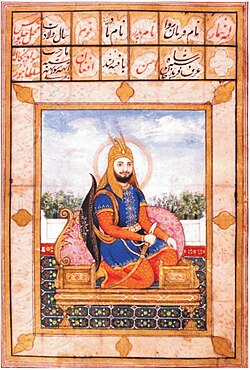
Emperor Sher Shah widened and realigned roads to connect with other routes and provided approximately 1,700 roadside inns through his empire. The improvements supported movement, administration, and commerce across South Asia.
Image source: Sher Shah Suri
1630 CE
One historical interpretation dates the dissolution of the Hansa to 1630 and concludes that the organization was almost entirely forgotten by the end of the 18th century.
1800 CE - 1809 CE
Scholar Georg Friedrich Sartorius published the first monograph about the Hanseatic community in the early years of the 19th century, helping revive scholarly interest in the historic trading network.
1849 CE - 1886 CE
During the first 37 years of British rule after the occupation of Punjab in 1849, bridges, pathways, and newer inns were constructed. These works strengthened overland links that complemented maritime commerce.
1860 CE
International free trade became visible in 1860 with the Anglo-French commercial treaty. The trend gained further momentum after World War II, creating a broader environment for global maritime exchange.
Image source: Free trade
1869 CE
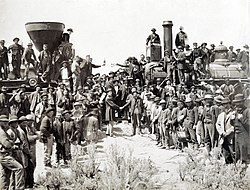
Efficient rail routes helped unify the United States, and the first transcontinental railroad was completed in 1869. Rail connectivity integrated inland markets with ports and international maritime trade.
Image source: First transcontinental railroad
1900 CE - 1920 CE
Railroads reached maturity in the early 20th century, carrying most land freight and passenger traffic in industrialized countries. They became essential links between production centers, ports, and long-distance trade routes.
Image source: History of rail transport
1948 CE - 1995 CE
New international trade organizations and agreements emerged, including GATT in 1948, the Benelux Economic Union in 1948, the European Economic Community in 1957, EFTA in 1959, Mercosur in 1991, and the World Trade Organization in 1995.
1950 CE - 1960 CE
By the mid-20th century, railroads had lost their preeminent position as road transport, automobiles, and aviation expanded. The shift altered how maritime ports connected to inland consumers and suppliers.
1993 CE
In 1993, the governments of Canada, Mexico, and the United States approved the North American Free Trade Agreement. The agreement strengthened continental supply chains connected to maritime ports.
Image source: North American Free Trade Agreement
1998 CE
In 1998, international express delivery through cargo airlines reached US$20 billion, and 50 pure cargo-service companies operated internationally. Air freight increasingly complemented maritime shipping for time-sensitive goods.
Image source: Air cargo
2013 CE
The 21st Century Maritime Silk Road is a current Chinese government project intended to expand and intensify trade along maritime routes. It represents a modern extension of the long history of Asian sea-based exchange.
Or browse the full history timeline directory, with more than 2,500 topics.
This Maritime Jade Road timeline was generated with the help of AI, using information found on the internet.
We work hard to keep these timelines accurate, but mistakes do get through. If you spot one, email us at [email protected] and we'll fix it for future visitors.
Generate yours with AI or build it from scratch, for free.
Export your timeline, add your own events, edit or remove AI-generated events, and much more
No credit card required.
Cancel anytime.
Cancel anytime.
You can create an unlimited number of timelines with up to 10 events on each one, customize how they look, export them to PDF, PNG, PowerPoint, CSV, and Excel, and share them with a link. Paid plans raise the event limit and add features like spreadsheet imports and collaborators.
Yes. You can cancel your subscription from your account page at any time, and you will not be charged again. Your subscription stays active for the rest of the period you already paid for.
Yes. We will email you a reminder before the annual renewal, and we will also email you a receipt.
Yes. You can email us within 15 days of any payment, and we will issue you a full refund.
Check out our pricing docs or send us an email anytime: [email protected].