
-
Resources
-
Pricing
Mississippian Culture refers to diverse, complex societies that flourished across the eastern and southeastern United States, known for agriculture, trade, ceremonial centers, and monumental earthworks. More Less
Build a timeline like this one in minutes, for free. Start Yours →
800 - 1000
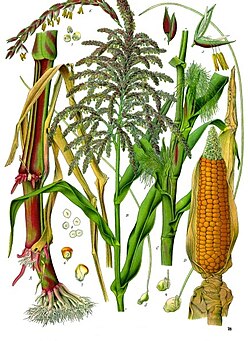
Maize de Ocho, the primary strand of flint corn, arrived during the Late Woodland and Emergent Mississippian periods, around 800 to 1000.
Image source: Maize
900 - 1600
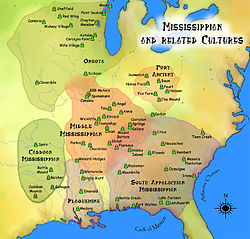
The Mississippian period was an archaeological cultural era in the Southern United States and adjacent Eastern Woodlands, spanning the end of the 10th century through the 16th century.
Image source: Mississippian culture
900 - 1000
The latter part of the Late Woodland period, between approximately 900 and 1000, is identified as the transition to the Emergent Mississippian or Terminal Late Woodland period.
900 - 1100
The Medieval Climate Anomaly ended around the early 1100s, contributing to environmental changes that affected Mississippian political conditions.
Image source: Medieval Warm Period
1400 - 1600
The Late Mississippian period was marked by paramount chiefdoms that were less elaborate than earlier centers but territorially larger.
1000 - 1100
Major construction at Cahokia primarily occurred during the Edelhardt phase from 1000 to 1050 and the Lohmann phase from 1050 to 1100.
Image source: Cahokia
1000 - 1300
Several Early Fort Ancient sites contained a disproportionately high amount of non-local remains during this period, with possible origins in Tennessee or the Central Mississippi valley.
Image source: Fort Ancient
1050
Cahokia was founded around 1050 and became the largest and most influential urban center of the Mississippian world.
1050 - 1150
Cahokia's growing monumental center emerged during the 11th and early 12th centuries, with its expansion perhaps related to astronomical events such as Halley's Comet or SN 1054.
1050 - 1150
Cahokians briefly established missionary outposts as far as 500 miles north of Cahokia, extending their influence across the Midwest.
1050 - 1100
Between 1050 and 1100, Cahokian outposts reached as far as 900 kilometers north, including Trempealeau Mounds, Aztalan, and the Apple River valley.
Image source: Trempealeau, Wisconsin
1075 - 1100
Towards the end of the 11th century, Cahokian expansion also began moving southward.
1100 - 1275
Migration from the Nashville area contributed to the development and population of Etowah in Georgia.
Image source: Etowah Indian Mounds
1100
Groups of Central Mississippian travelers likely migrated to Georgia and occupied the Macon Plateau after 1100.
Image source: Ocmulgee Mounds National Historical Park
1124
Including downtown Cahokia near Collinsville and the East St. Louis precinct, the urban center likely peaked around 1124 with at least 22,400 people and possibly several thousand more in St. Louis.
1150 - 1300
Migration from the Central Mississippi valley was principally directed toward Mississippian mound centers such as Prather and Angel.
Image source: Angel Mounds
1150 - 1300
Several thousand Central Mississippians moved to other regions linked with Cahokia, including Angel on the Ohio and Etowah in the Appalachians, helping initiate the Middle Mississippian period.
1150 - 1275
Environmental and political instability contributed to an exodus of roughly half of Cahokia's population toward the Nashville area, likely ancestral to the Koasati people; immigration there peaked around 1275.
1150 - 1275
The end of the Medieval Climate Anomaly triggered a dry spell in Illinois, including two droughts between 1150 and 1200 and a third around 1275, bringing considerable political instability.
1200
Moundville became a monumental center of arts and earthen architecture, reaching its population peak around 1200 after population movements from the countryside beginning around 1120.
Image source: Moundville Archaeological Site
1200 - 1400
The Commerce Quarry and Petroglyph site likely preserves a literal map of natural geography created during the Middle Mississippian period.
1200 - 1300
Formerly a Cahokian mission, Angel's religious leaders developed a vast network of hinterland sites across western Kentucky, reaching its peak in the early 14th century.
1200 - 1400
An engraved shell from Spiro is believed to represent a sociogram map comparable in style to a deerskin map given by a Catawba leader to South Carolina governor Francis Nicholson in 1721 and to a Chickasaw deerskin map given to the French.
Image source: Spiro Mounds
1250
By 1250, ritual copper objects once largely monopolized by Cahokia had spread to Moundville, Etowah, Ocmulgee, and Lake Jackson, with some objects coming directly from Cahokia.
1300 - 1450
A quarter of Angel-phase households between 1300 and 1450 aligned with the Angel Axis, although only 5 percent of households at Angel itself occupied this position.
1300
Around 1300, the Mississippian world experienced an influx of religious concepts from the west, notably the Datura Ritual Complex, as elites drew in increasingly exotic trade goods.
1300
By 1300, nucleated ceremonial capitals such as Moundville had declined substantially in residential population in favor of the elite.
1400
The Nashville-area Thruston Tablet, created around 1400, likely narrates the story of the Hero Twins.
Image source: Mississippian period (archaeology)
1539 - 1543
Records of Hernando de Soto's expedition from 1539 to 1543 provide evidence of Spanish contacts with Mississippians as the expedition traveled through villages of the Southeast.
Image source: Hernando de Soto
1539 - 1561
De Soto's expedition and the later expedition of Tristán de Luna y Arellano involved Spanish troops camping for weeks or months in some locations, while chroniclers recorded no illness outbreaks among nearby Native people.
1561 - 1700
More recent research suggests that Native populations in the more interior regions of the Southeast might not have experienced epidemics brought by European contact until the late seventeenth century.
1567
At Joara near Morganton, North Carolina, Mississippian people interacted with the Spanish Juan Pardo expedition, which built Fort San Juan there in 1567.
Image source: Joara
1567 - 1568
Spanish soldiers occupied Fort San Juan for approximately 18 months before Native inhabitants killed them and destroyed the fort. Sixteenth-century Spanish artifacts from the site mark the first European colonization in the interior of what became the United States.
Image source: Fort San Juan (Joara)
1776
In 1776, Bernard Romans recorded Creek hieroglyphics describing an ambush against the Choctaw; William Bartram later described similar Creek hieroglyphics on walls and tattooed on government officials.
Image source: Muscogee
1800 - 1900
Some groups, including the late nineteenth-century Cherokee, maintained oral traditions linking them to the mound-building past.
1830
Among 19th-century Muscogee Creeks, a group of copper plates carried along the Trail of Tears were regarded as some of the tribe's most sacred items.
1894
The idea that mound builders were a people distinct from Native Americans was rigorously debunked by Cyrus Thomas in 1894.
1950 - 1960
The term chiefdom derives from mid-20th-century works by Elman Service and Kalervo Oberg, although the two scholars used the concept with distinct meanings.
Image source: Chiefdom
1950
Since the mid-20th century, scholars have commonly described Mississippian polities as chiefdoms.
1960 - 2000
Several scholars have argued that Service's model subtly perpetuates racist ideas from the 19th century by treating European-style states as superior and other political organizations as incomplete steps toward European statehood.
Build a timeline like this one in minutes, for free. Start Yours →
Or browse the full history timeline directory, with more than 3,000 topics.
This Mississippian Culture timeline was generated with the help of AI, using information found on the internet.
We work hard to keep these timelines accurate, but mistakes do get through. If you spot one, email us at [email protected] and we'll fix it for future visitors.
Generate yours with AI or build it from scratch, for free.
Export your timeline, add your own events, edit or remove AI-generated events, and much more
No credit card required.
15-day money-back guarantee.
You can create an unlimited number of timelines with up to 10 events on each one, customize how they look, export them to PDF, PNG, PowerPoint, CSV, and Excel, and share them with a link. Timelines made with Timeline Maker AI keep every event the generator created, and you can add up to 5 events of your own. Paid plans remove the event limit, add spreadsheet imports and hide Preceden's branding, and the higher-priced plan also adds collaborators, a custom logo and a custom domain.
Yes. You can cancel your subscription from your account page at any time, and you will not be charged again. Your subscription stays active for the rest of the period you already paid for.
Yes. We email you a reminder 15 days before your annual renewal, and we email you a receipt after every payment.
Yes. You can email us within 15 days of any payment, and we will issue you a full refund.
Check out our pricing docs or send us an email anytime: [email protected].