-
Use Cases
-
Resources
-
Pricing
Mother Teresa (1910–1997) was an Albanian-Indian Roman Catholic nun and missionary who founded the Missionaries of Charity in Calcutta, India. Devoting her life to serving the poorest of the poor, she built a global religious congregation, received the Nobel Peace Prize in 1979, and was canonized as Saint Teresa of Calcutta by the Catholic Church in 2016. More Less
Aug 26, 1910
% complete
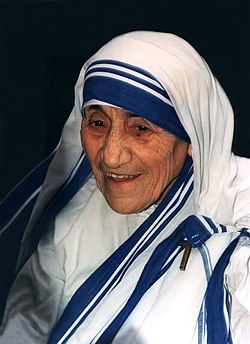
Anjezë Gonxhe Bojaxhiu, later known as Mother Teresa, was born on 26 August 1910 into a Kosovar Albanian family in Skopje, then part of the Ottoman Empire and now the capital of North Macedonia.
Image source: Mother Teresa
1919
% complete
When Anjezë was eight years old, her father, who was involved in Albanian-community politics in Ottoman Macedonia, was probably poisoned after visiting Belgrade for a political meeting, an act attributed to Serbian agents.
1928
% complete
At age 18, Anjezë left home in 1928 to join the Sisters of Loreto at Loreto Abbey in Rathfarnham, Ireland, to learn English with the intent of becoming a missionary in India.
Aug 15, 1928
% complete
Her resolve to pursue a religious life strengthened on 15 August 1928 as she prayed at the shrine of the Black Madonna of Vitina-Letnice, where she often went on pilgrimages.
1929
% complete
She arrived in India in 1929 and began her novitiate in Darjeeling, in the lower Himalayas, where she learned Bengali and taught at St. Teresa's school.
May 24, 1931
% complete
On 24 May 1931, she took her first religious vows as a nun with the Sisters of Loreto.
1934
% complete
Her family lived in Skopje until 1934, when they moved to Tirana.
May 14, 1937
% complete
Teresa took her solemn vows on 14 May 1937 while teaching at the Loreto convent school in Entally, eastern Calcutta, adopting the style of 'Mother' as part of Loreto custom. She served there for nearly twenty years.
1943 - Aug 1946
% complete
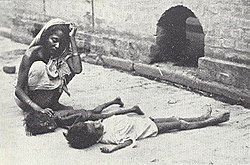
The Bengal famine of 1943 brought misery and death to Calcutta, and Direct Action Day in August 1946 began a period of Muslim-Hindu violence that shaped the city's suffering.
Image source: Bengal famine of 1943
1944
% complete
In 1944, Mother Teresa was appointed headmistress of the Loreto convent school in Entally, where she served for nearly twenty years overall.
Sep 10, 1946
% complete
On 10 September 1946, while travelling by train to the Loreto convent in Darjeeling for her annual retreat, Teresa experienced what she described as 'the call within the call' to serve the poor of India for Jesus.
1948
% complete
She began missionary work with the poor in 1948, replacing her traditional Loreto habit with a simple white cotton sari with a blue border.
1950
% complete
In 1950, Mother Teresa established the Missionaries of Charity, a religious congregation initially dedicated to serving 'the poorest of the poor' in the slums of Calcutta, choosing a white sari with two blue borders as its habit.
Image source: Missionaries of Charity
Oct 7, 1950
% complete
On 7 October 1950, Mother Teresa received Vatican permission for the diocesan congregation, which would become the Missionaries of Charity.
1952
% complete
In 1952, Mother Teresa opened her first hospice with help from Calcutta officials, providing care for those dying in poverty.
1955
% complete
As the Missionaries of Charity took in an increasing number of homeless children, Mother Teresa opened Nirmala Shishu Bhavan, the Children's Home of the Immaculate Heart, in 1955 as a haven for orphans and homeless youth.
1963
% complete
The Missionaries of Charity Brothers was founded in 1963, expanding the order's religious branches.
1965
% complete
Mother Teresa expanded the congregation abroad, opening a house in Venezuela in 1965 with five sisters.
1981 - 1984
% complete
Responding to requests by many priests, Mother Teresa founded the Corpus Christi Movement for Priests in 1981 and, with Joseph Langford, the Missionaries of Charity Fathers in 1984, combining the vocational aims of her order with the resources of the priesthood.
Image source: Corpus Christi (2019 film)
1962
% complete
In 1962, Mother Teresa received both the Padma Shri from India and the Ramon Magsaysay Award for Peace and International Understanding, given for work in South or East Asia.
Image source: Ramon Magsaysay Award
1969
% complete
She received the Jawaharlal Nehru Award for International Understanding in 1969, one of several Indian honours bestowed upon her.
1971
% complete
Pope Paul VI gave Mother Teresa the inaugural Pope John XXIII Peace Prize in 1971, commending her work with the poor, her display of Christian charity and her efforts for peace.
Image source: Pope Paul VI
Apr 1976
% complete
In April 1976, Mother Teresa visited the University of Scranton, where she received the La Storta Medal for Human Service, and she also received the Albert Schweitzer International Prize in 1975 and the Pacem in Terris Award in 1976.
1978
% complete
Among other civilian awards, Mother Teresa received the Balzan Prize for promoting humanity, peace and brotherhood among peoples in 1978.
1979
% complete
In 1979, Mother Teresa received the Nobel Peace Prize 'for work undertaken in the struggle to overcome poverty and distress, which also constitutes a threat to peace'.
1980
% complete
Mother Teresa later received other Indian awards, including the Bharat Ratna, India's highest civilian award, in 1980.
1983
% complete
The United Kingdom and the United States bestowed a number of awards on Mother Teresa, culminating in the Order of Merit in 1983 and honorary citizenship of the United States on 16 November 1996.
Image source: Order of Merit
1994
% complete
Mother Teresa's Albanian homeland gave her the Golden Honour of the Nation in 1994, but her acceptance of this and the Haitian Legion of Honour was controversial.
Nov 16, 1996
% complete
On 16 November 1996, Mother Teresa was granted honorary citizenship of the United States. By then the Missionaries of Charity operated 517 missions in over 100 countries.
1969
% complete
Mother Teresa was catapulted to fame via Malcolm Muggeridge's 1969 BBC documentary Something Beautiful for God; he released a book of the same name in 1971.
1971 - 1973
% complete
In 1971, Mother Teresa visited Belfast with four of her sisters during the Troubles. Reportedly under pressure from senior clergy who believed 'the missionary traffic should be in other direction', she and her sisters abruptly left the city in 1973 despite local welcome and support.
1982
% complete
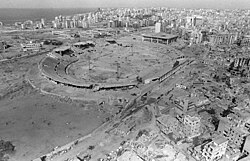
At the height of the Siege of Beirut in 1982, Mother Teresa rescued 37 children trapped in a front-line hospital by brokering a temporary cease-fire between the Israeli army and Palestinian guerrillas. That year she was also appointed an honorary Companion of the Order of Australia.
Image source: Siege of Beirut
1983
% complete
Mother Teresa had a heart attack in Rome in 1983 while visiting Pope John Paul II. Following a second attack in 1989, she received a pacemaker.
1984
% complete
Mother Teresa Women's University, in Kodaikanal, was established in 1984 as a public university by the government of Tamil Nadu.
Image source: Mother Teresa Women's University
1988
% complete
Mother Teresa visited Armenia after the devastating 1988 earthquake and met with Soviet Premier Nikolai Ryzhkov.
1991
% complete
In 1991, Mother Teresa returned to Albania for the first time, opening a Missionaries of Charity Brothers home in Tirana. That same year, the Senate of Serampore College (University) awarded her an honorary Doctorate of Divinity, and after pneumonia in Mexico she suffered additional heart problems.
1994
% complete
Christopher Hitchens' 1994 documentary Hell's Angel argued that Mother Teresa urged the poor to accept their fate while the rich were portrayed as favoured by God. Also in 1994, she argued that sexual abuse allegations against Jesuit priest Donald McGuire were untrue; McGuire was convicted in 2006 and again in 2009.
Image source: Hell's Angel (TV programme)
Mar 13, 1997
% complete
On 13 March 1997, Mother Teresa resigned as head of the Missionaries of Charity, which by then had grown from 13 members in Calcutta to more than 4,000 sisters managing orphanages, AIDS hospices and charity centres worldwide.
2009
% complete
In 2009, the Memorial House of Mother Teresa was opened in her hometown of Skopje, North Macedonia.
Image source: Memorial House of Mother Teresa
Sep 5, 1997
% complete
Mother Teresa died on 5 September 1997 at the age of 87. After her death, the Holy See began the process of beatification, and Brian Kolodiejchuk was appointed postulator by the Diocese of Calcutta.
Apr 21, 1999
% complete
The group investigating Mother Teresa's life found no obstacle to her canonisation and issued its nihil obstat on 21 April 1999. That same year, she headed Gallup's List of Most Widely Admired People of the 20th Century.
2002
% complete
In 2002 the Vatican recognised as a miracle the healing of a tumour in the abdomen of Monica Besra, an Indian woman, after the application of a locket containing Teresa's picture.
Oct 19, 2003
% complete
Mother Teresa was beatified on 19 October 2003 and was known by Catholics as 'Blessed'.
Sep 4, 2016
% complete
On 4 September 2016, Pope Francis canonised Mother Teresa at a ceremony in St. Peter's Square, and she became known as Saint Teresa of Calcutta.
Image source: Mother Teresa & Me
Sep 6, 2017
% complete
On 6 September 2017, about 500 people attended a Mass at the Cathedral of the Most Holy Rosary where Dominique Gomes read the decree instituting Mother Teresa as co-patron of the Roman Catholic Archdiocese of Calcutta alongside St Francis Xavier, who had been named first patron saint of Calcutta in 1986.
Image source: Archdiocese of Calcutta
Or browse the full history timeline directory, with more than 2,000 topics.
This Mother Teresa timeline was generated with the help of AI, using information found on the internet.
We work hard to keep these timelines accurate, but mistakes do get through. If you spot one, email us at [email protected] and we'll fix it for future visitors.
Generate yours with AI or build it from scratch, for free.
Export your timeline, add your own events, edit or remove AI-generated events, and much more
No credit card required.
Cancel anytime.
Cancel anytime.
You can create an unlimited number of timelines with up to 10 events on each one, customize how they look, export them to PDF, PNG, PowerPoint, CSV, and Excel, and share them with a link. Paid plans raise the event limit and add features like spreadsheet imports and collaborators.
Yes. You can cancel your subscription from your account page at any time, and you will not be charged again. Your subscription stays active for the rest of the period you already paid for.
Yes. We will email you a reminder before the annual renewal, and we will also email you a receipt.
Yes. You can email us within 15 days of any payment, and we will issue you a full refund.
Check out our pricing docs or send us an email anytime: [email protected].