-
Use Cases
-
Resources
-
Pricing
The New Deal was a series of programs, public work projects, financial reforms, and regulations enacted by President Franklin D. Roosevelt between 1933 and 1939 in response to the Great Depression. It fundamentally expanded the role of the federal government in the American economy and established lasting institutions such as Social Security, the FDIC, and the SEC. More Less
Oct 29, 1929
% complete
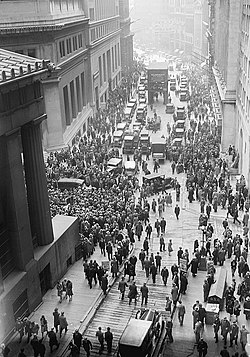
The Wall Street Crash of 1929, culminating on Black Tuesday, wiped out billions of dollars in wealth and marked the beginning of the Great Depression. The collapse shattered confidence in the American economy, leading to bank failures, mass unemployment, and widespread poverty that would set the stage for sweeping federal intervention under the New Deal.
Image source: Wall Street Crash of 1929
Nov 8, 1932
% complete
Franklin D. Roosevelt defeated incumbent Herbert Hoover in a landslide, promising a 'New Deal for the American people.' His victory reflected public demand for bold federal action to combat the Great Depression and ushered in an era of unprecedented government involvement in the economy.
Image source: 1932 United States presidential election
Mar 4, 1933 - Jun 16, 1933
% complete
Roosevelt's first hundred days in office saw an extraordinary burst of legislative activity as Congress passed fifteen major bills aimed at relief, recovery, and reform. This period established the template for the New Deal and fundamentally transformed the relationship between the federal government and the American economy.
Image source: First 100 days of Franklin D. Roosevelt's presidency
Mar 6, 1933 - Mar 13, 1933
% complete
Roosevelt declared a national four-day bank holiday shortly after his inauguration, closing all banks to halt panic-driven withdrawals. The pause allowed federal examiners to assess banks' solvency before reopening them, helping restore trust in the financial system.
Mar 9, 1933
% complete
Passed just days after Roosevelt took office, the Emergency Banking Act gave the federal government power to regulate banking transactions and reopen solvent banks. Following Roosevelt's reassuring first 'fireside chat,' public confidence returned and deposits flowed back into the banking system.
Image source: Emergency Banking Act of 1933
Apr 5, 1933
% complete
Through Executive Order 6102, Roosevelt required Americans to turn in gold coins and certificates, effectively taking the United States off the gold standard. This allowed the dollar to be devalued and gave the government greater flexibility to fight deflation and stimulate economic recovery.
Image source: Executive Order 6102
May 27, 1933
% complete
The Securities Act of 1933 required companies issuing stock to disclose accurate financial information to investors, aiming to prevent the kind of fraud and speculation that contributed to the 1929 crash. It marked the beginning of federal regulation of the securities industry.
Jun 6, 1934
% complete
The Securities Exchange Act of 1934 established the Securities and Exchange Commission (SEC) to regulate stock exchanges and protect investors from manipulation and fraud. The SEC remains a cornerstone of American financial regulation today.
Jun 27, 1934
% complete
The National Housing Act of 1934 created the Federal Housing Administration (FHA) to insure mortgages made by private lenders, making homeownership more accessible. The FHA revolutionized home financing, though its practices also contributed to discriminatory redlining in many cities.
Image source: Federal Housing Administration
Jan 6, 1936
% complete
In Schechter Poultry Corp. v. United States, the Supreme Court unanimously ruled the National Industrial Recovery Act unconstitutional, and weeks later invalidated the Agricultural Adjustment Act. These decisions challenged the constitutional foundations of key New Deal programs and provoked Roosevelt's later court-packing plan.
Image source: A.L.A. Schechter Poultry Corp. v. United States
Feb 5, 1937
% complete
Frustrated by Supreme Court rulings against New Deal legislation, Roosevelt proposed adding up to six new justices to the Court. The controversial plan failed in Congress but coincided with a shift in the Court's jurisprudence, often called 'the switch in time that saved nine.'
Image source: Judicial Procedures Reform Bill of 1937
Aug 1, 1937 - Jun 1, 1938
% complete
A sharp recession struck in 1937 after cuts in federal spending and tightening of monetary policy, undoing much of the recovery achieved since 1933. Unemployment surged again, prompting Roosevelt to return to deficit spending with a new round of relief spending in 1938.
Image source: Recession of 1937–1938
Mar 31, 1933 - Jun 30, 1942
% complete
The Civilian Conservation Corps (CCC) put unemployed young men to work on conservation projects across the country, including planting trees, building trails, and fighting forest fires. Over its nine-year existence, the CCC employed roughly three million men and left a lasting legacy in America's parks and forests.
Image source: Civilian Conservation Corps
May 12, 1933 - Dec 31, 1935
% complete
The Federal Emergency Relief Administration (FERA), led by Harry Hopkins, provided direct grants to states to fund relief efforts for the unemployed. FERA distributed hundreds of millions of dollars for food, clothing, shelter, and work programs during the darkest years of the Depression.
Image source: Federal Emergency Relief Administration
May 12, 1933
% complete
The Agricultural Adjustment Act sought to raise farm prices by paying farmers to reduce production of crops and livestock. While it helped stabilize agricultural incomes, the destruction of crops and animals amid widespread hunger proved controversial, and the Supreme Court struck down the original act in 1936.
Jun 16, 1933
% complete
The National Industrial Recovery Act (NIRA) authorized industry codes governing wages, prices, and working conditions, and created the Public Works Administration. Intended to boost recovery through cooperation between government and business, it was declared unconstitutional by the Supreme Court in 1935.
Nov 8, 1933 - Mar 31, 1934
% complete
The Civil Works Administration (CWA) was a short-lived but massive emergency work program that employed over four million people during the winter of 1933–34. Workers built roads, schools, and parks, providing crucial income during a brutal winter before the program was folded into other agencies.
Image source: Civil Works Administration
May 1, 1935 - Sep 1, 1937
% complete
The Resettlement Administration, headed by Rexford Tugwell, assisted poor farmers by relocating struggling families to better land and funding rural rehabilitation projects. Its documentary photography unit, including Dorothea Lange and Walker Evans, produced iconic images of Depression-era hardship.
Image source: Resettlement Administration
May 6, 1935 - Jun 30, 1943
% complete
The Works Progress Administration (WPA), led by Harry Hopkins, became the largest New Deal employment agency, putting millions of Americans to work building roads, bridges, schools, and public buildings. Its Federal Arts, Theater, Music, and Writers' projects also supported artists and enriched American culture.
Image source: Works Progress Administration
Sep 1, 1937 - Dec 31, 1946
% complete
The Farm Security Administration (FSA) replaced the Resettlement Administration, continuing efforts to combat rural poverty through loans, resettlement camps for migrant workers, and health services. Its photography program produced some of the most powerful documentary images in American history.
Image source: Farm Security Administration
Feb 16, 1938
% complete
After the Supreme Court invalidated the original AAA, Congress passed a revised version that paid farmers to conserve soil rather than destroy crops. The act introduced price supports and crop insurance concepts that continue to shape American farm policy.
Image source: Agricultural Adjustment Act
Sep 1, 1939 - Dec 31, 1943
% complete
With the outbreak of World War II in Europe and America's eventual entry into the conflict, national attention shifted from domestic reform to war mobilization. Wartime production finally ended the Great Depression, and many New Deal agencies were phased out or absorbed into the war effort by 1943.
Image source: New Deal
May 18, 1933
% complete
The Tennessee Valley Authority (TVA) was created as a federally owned corporation to provide electricity, flood control, and economic development to the impoverished Tennessee Valley. Building dams and generating affordable power, the TVA modernized one of the nation's poorest regions and became a model of regional planning.
Image source: Tennessee Valley Authority
Jul 1, 1933 - Mar 31, 1943
% complete
Headed by Interior Secretary Harold Ickes, the Public Works Administration funded large-scale infrastructure projects including dams, bridges, schools, and hospitals. Its investments, totaling over $6 billion, provided jobs and built lasting public assets across the nation.
Image source: Public Works Administration
May 11, 1935
% complete
The Rural Electrification Administration (REA) brought electricity to millions of rural Americans who had been bypassed by private utility companies. By financing cooperatives to build power lines, the REA transformed rural life, enabling modern appliances, lighting, and improved farming methods.
Image source: Rural Utilities Service
Jul 5, 1935
% complete
The National Labor Relations Act, known as the Wagner Act, guaranteed workers the right to organize unions and bargain collectively, and created the National Labor Relations Board to enforce these rights. It sparked a dramatic surge in union membership and reshaped American labor relations.
Aug 14, 1935
% complete
The Social Security Act created a system of old-age pensions, unemployment insurance, and aid to dependent children and the disabled. Signed by Roosevelt after his 'fireside chat' promising security, it remains one of the most enduring and significant legacies of the New Deal.
Nov 3, 1936
% complete
Roosevelt won reelection in one of the most lopsided victories in American history, carrying 46 of 48 states. The result was widely interpreted as a popular endorsement of the New Deal and gave Roosevelt a mandate to continue and expand his programs.
Image source: 1936 United States presidential election
Jun 25, 1938
% complete
The Fair Labor Standards Act established a federal minimum wage, mandated overtime pay, and banned oppressive child labor. Often called the last major piece of New Deal legislation, it fundamentally improved conditions for millions of American workers.
Aug 2, 1939
% complete
The Hatch Act restricted political campaign activities by federal employees, responding to allegations that New Deal relief programs had been used for political purposes. It sought to ensure that government workers were not pressured to participate in partisan politics.
Or browse the full history timeline directory, with more than 2,000 topics.
This New Deal timeline was generated with the help of AI, using information found on the internet.
We work hard to keep these timelines accurate, but mistakes do get through. If you spot one, email us at [email protected] and we'll fix it for future visitors.
Generate yours with AI or build it from scratch, for free.
Export your timeline, add your own events, edit or remove AI-generated events, and much more
No credit card required.
Cancel anytime.
Cancel anytime.
You can create an unlimited number of timelines with up to 10 events on each one, customize how they look, export them to PDF, PNG, PowerPoint, CSV, and Excel, and share them with a link. Paid plans raise the event limit and add features like spreadsheet imports and collaborators.
Yes. You can cancel your subscription from your account page at any time, and you will not be charged again. Your subscription stays active for the rest of the period you already paid for.
Yes. We will email you a reminder before the annual renewal, and we will also email you a receipt.
Yes. You can email us within 15 days of any payment, and we will issue you a full refund.
Check out our pricing docs or send us an email anytime: [email protected].