-
Use Cases
-
Resources
-
Pricing
The Oslo Accords were a pair of landmark agreements between Israel and the Palestine Liberation Organization (PLO), negotiated secretly in Oslo, Norway, in 1993. The first accord established mutual recognition and laid out a framework for Palestinian self-governance in parts of the West Bank and Gaza Strip, while the second, signed in 1995, expanded Palestinian autonomy. Although they marked the first direct face-to-face agreement between Israeli and Palestinian leaders, the accords ultimately failed to achieve a final peace settlement. More Less
Sep 17, 1978
% complete
The Oslo Accords were based on the 1978 Camp David Accords and show considerable similarity with them. Like Camp David, the Oslo Accords merely aimed at an interim agreement that allowed first steps toward a broader peace.
Image source: Camp David Accords
Jan 1993 - Sep 1993
% complete
The Oslo process began in 1993 with secret talks between Israel and the PLO. Norwegian mediators facilitated a back channel, and Waage later found 'not a single scrap of paper' from January to September 1993, as participants kept documents privately.
Sep 9, 1993
% complete
In their Letters of Mutual Recognition of September 9, 1993, days before the signing of the Oslo I Accord, each party agreed to accept the other as a negotiation partner.
Sep 13, 1993
% complete
The Oslo I Accord was signed in Washington, D.C., in 1993, establishing an interim framework between Israel and the PLO, including start of negotiations on a final settlement to be concluded before May 4, 1999.
Oct 1, 1993
% complete
After the Oslo Accords were signed in 1993, an international conference was held in Washington, D.C., following up on the agreements.
Oct 1993
% complete
Under Oslo I Annex II, several matters had to be agreed upon within two months from October 1993. Permanent status negotiations would start no later than May 1996, two years after the Gaza–Jericho Agreement, and be concluded before May 1999.
May 4, 1994
% complete
The Gaza–Jericho Agreement, also known as the Cairo Agreement, was signed in 1994. It created the Palestinian Authority (PA or PNA) and began the five-year interim period that ended on May 4, 1999.
Aug 29, 1994
% complete
This agreement was signed on August 29, 1994 at the Erez Crossing, further implementing arrangements under the Gaza–Jericho framework between Israel and the Palestinians.
Image source: Gaza–Jericho Agreement
Oct 14, 1994
% complete
In 1994, Arafat and Rabin were awarded the Nobel Peace Prize, along with Shimon Peres, honoring their roles in reaching the Oslo Accords.
Oct 26, 1994
% complete
When an Israel–Jordan peace treaty was concluded on October 26, 1994, it was concluded without the Palestinians, marking a separate track in the Middle East peace process.
Image source: Israel–Jordan peace treaty
Aug 27, 1995
% complete
This agreement was signed on August 27, 1995 at Cairo, advancing implementation of the Oslo process ahead of the formal signing of the Oslo II Accord in Taba.
Image source: Oslo II Accord
Sep 28, 1995
% complete
The Oslo II Accord was signed in Taba, Egypt, in 1995. It expanded Palestinian autonomy, dividing the West Bank into Areas A, B, and C, and set out further redeployments of Israeli forces.
May 1996
% complete
Per Oslo I Article V, permanent status negotiations about remaining issues were to start no later than May 1996, two years after the signing of the Gaza–Jericho Agreement, and be concluded before May 1999.
Mar 1998
% complete
By March 1998, none of the further withdrawals required under the Oslo II Accord's scheduled redeployments had occurred, leaving the process stalled.
Oct 1998
% complete
In October 1998, the parties signed the Wye River Memorandum, promising resumption of the redeployments, but only the first stage was implemented.
Image source: Wye River Memorandum
May 4, 1999
% complete
The interim period ended on May 4, 1999, five years after the signing of the Gaza–Jericho Agreement, without a comprehensive peace agreement having been reached.
Image source: Oslo I Accord
Jul 2000
% complete
At the 2000 Camp David Summit, the United States tried to save the Accords by reviving the negotiations. The summit failed, and Shlomo Ben-Ami later described how Oslo had made the PLO a collaborator in cutting short an authentically democratic struggle for Palestinian independence.
Image source: 2000 Camp David Summit
1993
% complete
A permanent 'general closure' on the occupied territories was enforced in 1993, regulating access to Jerusalem and Israel and making travel between the West Bank and the Gaza Strip nearly impossible. The UN estimates this comprehensive closure was in place for 353 complete days between March 1993 and June 1997.
2001
% complete
In 2001, the Norwegian Ministry of Foreign Affairs, which had been at the heart of the Oslo process, commissioned Waage to produce an official, comprehensive history of the Norwegian-mediated back channel negotiations.
2020
% complete
According to the Organization for Economic Cooperation and Development, aid to Palestinians totaled over $40 billion between 1994 and 2020, much of it tied to state-building under the Oslo framework.
2023
% complete
Acknowledging their shortcomings, in a 2023 editorial for The Washington Post, Dennis Ross and David Makovsky emphasized the Accords' strengths and noted regular collaboration between Israel and the PA on security and economic matters, noting the PA retained a degree of control over close to 40 percent of the West Bank.
Jan 1, 1994 - Dec 31, 1994
% complete
In 1994, Hamas killed around 55 Israelis and injured over 150 in an effort to derail the peace process, stating its attacks were part of jihad against Israel's occupation as well as retaliation for the Cave of the Patriarchs Massacre.
Nov 4, 1995
% complete
Far-right Israelis opposed the Oslo Accords, and Israeli prime minister Yitzhak Rabin was assassinated in 1995 by a right-wing Israeli extremist for signing them.
Image source: Assassination of Yitzhak Rabin
May 29, 1996
% complete
According to Ronen Bergman, the Hamas bombing campaign and failure of Israeli intelligence to prevent it contributed to the defeat of Peres and Labor in the 1996 general election and victory of Netanyahu's Likud party, which opposed the Oslo Accords. Shlaim highlights Netanyahu's largely successful attempts to undermine the accords after his 1996 election.
Sep 2000
% complete
A number of agreements were reached until the Oslo process ended after the failure of the Camp David Summit in 2000 and the outbreak of the Second Intifada. During the Intifada, military coordination was intermittent and did not function effectively in 2000–2006.
Image source: Second Intifada
2002
% complete
During the Second Intifada, in 2002, the Israeli military re-occupied many of the areas previously turned over to Palestinian control under the Oslo Accords.
1994
% complete
In 1994, an electric fence was constructed around the Gaza Strip as part of Israel's security measures accompanying the closure regime on the territories.
May 1994
% complete
Following the Gaza–Jericho Agreement and prior to the first Palestinian Authority elections, Israel withdrew in 1994 from Jericho and from most of the Gaza Strip, handing control to Palestinian authorities.
1996
% complete
Military intelligence coordination between Israeli and Palestinian security forces officially began in 1996 as part of the security arrangements established by the Oslo Accords.
Jan 1997
% complete
In accordance with the Hebron Protocol, Israel withdrew from 80% of Hebron in January 1997, handing Area H-1 over to Palestinian control as stipulated in the Oslo framework.
Image source: Protocol Concerning the Redeployment in Hebron
2016
% complete
A security analysis presented to the Israeli government by Shin Bet in 2016 praised the security cooperation. According to the IDF, Palestinian security forces were responsible for about 40% of arrests of terrorism suspects in the West Bank in early 2016.
May 2020
% complete
Following the announcement that Israel will unilaterally annex territories in May 2020, the Palestinian Authority ceased security coordination with Israel.
Nov 2020
% complete
In August 2020, the annexation process was put on hold following the Israel–United Arab Emirates normalization agreement, and in November 2020 security cooperation between Israel and the Palestinian Authority was restored.
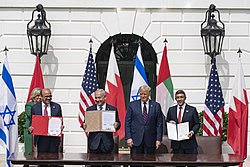
Image source: Abraham Accords
Jan 26, 2023
% complete
Immediately following an Israeli military raid on Jenin on January 26, 2023 in which 10 Palestinians were killed, the Palestinian Authority suspended security coordination with Israel.
Feb 5, 2023
% complete
On February 5, 2023, Osama Qawasmeh, member of the Political Committee of the PLO, said the leadership's decisions were irreversible and in force regarding relations with Israel and action at international institutions, citing unsustainability of the status quo.
Jan 20, 1996
% complete
When the Oslo I Accord was signed in 1993, neither a government nor a parliament existed for the Palestinian territories. The first elections for the Palestinian Legislative Council (PLC) were held on January 20, 1996.
Image source: 1996 Palestinian general election
Or browse the full history timeline directory, with more than 2,000 topics.
This Oslo Accords timeline was generated with the help of AI, using information found on the internet.
We work hard to keep these timelines accurate, but mistakes do get through. If you spot one, email us at [email protected] and we'll fix it for future visitors.
Generate yours with AI or build it from scratch, for free.
Export your timeline, add your own events, edit or remove AI-generated events, and much more
No credit card required.
Cancel anytime.
Cancel anytime.
You can create an unlimited number of timelines with up to 10 events on each one, customize how they look, export them to PDF, PNG, PowerPoint, CSV, and Excel, and share them with a link. Paid plans raise the event limit and add features like spreadsheet imports and collaborators.
Yes. You can cancel your subscription from your account page at any time, and you will not be charged again. Your subscription stays active for the rest of the period you already paid for.
Yes. We will email you a reminder before the annual renewal, and we will also email you a receipt.
Yes. You can email us within 15 days of any payment, and we will issue you a full refund.
Check out our pricing docs or send us an email anytime: [email protected].