
-
Use Cases
-
Resources
-
Pricing
This timeline covers the discovery of Pluto by Clyde Tombaugh in 1930, its decades as the ninth planet, its controversial reclassification as a dwarf planet in 2006, and NASA's New Horizons mission, which performed the first close flyby of Pluto on July 14, 2015, revealing a surprisingly active and geologically diverse world. More Less
Mar 15, 1905
% complete
Astronomer Percival Lowell began a systematic search for a hypothetical ninth planet, dubbed 'Planet X', whose gravity he believed was perturbing the orbits of Uranus and Neptune. He built the Lowell Observatory in Flagstaff, Arizona, for this purpose and spent years photographing the sky, though he died in 1916 without finding it.
Image source: Percival Lowell
Feb 18, 1930
% complete
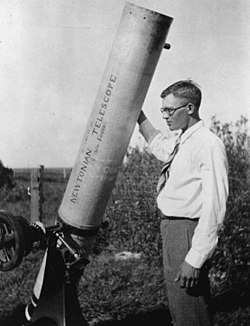
Young astronomer Clyde Tombaugh, working at Lowell Observatory, discovered Pluto by comparing photographic plates taken in January 1930. The discovery of a new planet beyond Neptune made headlines worldwide, and Tombaugh became celebrated as the discoverer of the ninth planet.
Image source: Clyde Tombaugh
Mar 24, 1930
% complete
Following an international naming contest, the new planet was named Pluto at the suggestion of Venetia Burney, an 11-year-old English schoolgirl. The name honored the Roman god of the underworld and also echoed the initials of Percival Lowell.
Image source: Pluto
Jun 22, 1978
% complete
Astronomer James Christy at the U.S. Naval Observatory noticed a bulge on photographic images of Pluto, revealing its largest moon, Charon. The discovery allowed scientists to calculate Pluto's mass for the first time and revealed that Charon is remarkably large relative to Pluto, making them nearly a double system.
Image source: Charon (moon)
Aug 29, 1985
% complete
When Pluto passed in front of a star, observers detected that starlight dimmed gradually rather than abruptly, indicating Pluto possessed a tenuous atmosphere of nitrogen and other gases. This surprising finding reshaped scientific expectations about the distant dwarf planet.
Image source: Atmosphere of Pluto
Jun 1, 1994
% complete
The Hubble Space Telescope captured the first images resolving surface features on Pluto, revealing bright and dark patches across its face. Though blurry compared to later spacecraft views, these maps provided the first hints of geological diversity on Pluto's surface.
Image source: Geology of Pluto
Jul 20, 2011
% complete
Astronomers using the Hubble Space Telescope discovered a small fourth moon orbiting Pluto, later named Kerberos. Its presence raised questions about how such a tiny body could remain in a stable orbit among Pluto's growing family of satellites.
Image source: Kerberos (moon)
Jul 7, 2012
% complete
Hubble observations revealed yet another tiny moon around Pluto, named Styx. With five known moons, Pluto's complex satellite system prompted mission planners to search carefully for debris hazards that could threaten New Horizons during its high-speed flyby.
Image source: Styx (moon)
Sep 13, 2000
% complete
NASA cancelled its planned Pluto Kuiper Express mission due to rising costs and shifting priorities, disappointing planetary scientists who warned that Pluto's atmosphere might freeze out as it moved away from the Sun. Public outcry over the cancellation helped spur a competition for a cheaper alternative mission.
Image source: Pluto Kuiper Express
Nov 29, 2001
% complete
After a competitive proposal process, NASA selected New Horizons, led by principal investigator Alan Stern of the Southwest Research Institute, as the first mission to Pluto under its New Frontiers program. The spacecraft would carry seven scientific instruments to study Pluto and its moons.
Mar 1, 2005
% complete
Engineers at the Johns Hopkins Applied Physics Laboratory completed assembly and testing of the New Horizons spacecraft. Weighing about 478 kilograms, the compact probe was designed to endure nearly a decade of travel through deep space and conduct rapid flyby science at Pluto.
Jan 19, 2006
% complete
An Atlas V rocket lifted off carrying New Horizons, which achieved the fastest launch speed ever for a spacecraft departing Earth. A small portion of Clyde Tombaugh's ashes was aboard, symbolically sending Pluto's discoverer past his planet.
Feb 28, 2007
% complete
New Horizons swept past Jupiter, using the giant planet's gravity to boost its speed toward Pluto while cutting three years off the journey. During the encounter, the spacecraft conducted extensive observations of Jupiter and its moons, including volcanic Io and the Great Red Spot.
Image source: New Horizons
Dec 6, 2014
% complete
Mission operators woke New Horizons from its final hibernation period as it began the active approach phase to Pluto. After more than nine years and nearly 5 billion kilometers of travel, the spacecraft's instruments were powered up and tested ahead of the historic encounter.
Jan 25, 2015
% complete
New Horizons took its first long-range reconnaissance images of Pluto using LORRI, its long-range camera. Though Pluto appeared as only a few pixels, these images confirmed the spacecraft was on course and marked the start of continuous observation of the Pluto system.
Jul 14, 2015
% complete
New Horizons streaked past Pluto at about 50,000 km/h, passing within roughly 12,500 kilometers of its surface. It collected thousands of images and measurements during the encounter, completing humanity's initial reconnaissance of the classical solar system planets and transforming Pluto from a point of light into a world.
Oct 22, 2015
% complete
With the Pluto encounter complete, mission controllers fired New Horizons' thrusters to adjust its trajectory toward a newly selected target in the Kuiper Belt. The maneuver set the stage for an extended mission exploring objects even farther from the Sun.
Oct 25, 2016
% complete
The last bits of data stored on New Horizons' recorders from the Pluto encounter reached Earth, marking the complete delivery of the flyby dataset. Over fifteen months, the spacecraft transmitted tens of gigabits of information that kept scientists busy analyzing Pluto for years.
Aug 24, 2006
% complete
Just months after New Horizons launched, the International Astronomical Union adopted a formal definition of 'planet' requiring an object to clear its orbital neighborhood. Pluto, sharing its zone with Kuiper Belt objects, was reclassified as a dwarf planet, sparking worldwide debate and public affection for the former ninth planet.
Image source: IAU definition of planet
Apr 14, 2015
% complete
As New Horizons closed in, its images revealed a striking bright region near Pluto's pole, suggesting a vast nitrogen ice cap. The feature hinted at dynamic seasonal processes and built anticipation for the detailed geology the flyby would reveal.
Image source: Sputnik Planitia
Jul 2015
% complete
Spectra from New Horizons' Ralph instrument confirmed frozen methane and nitrogen ices across Pluto's surface before closest approach. These early results showed Pluto's surface chemistry was far more varied than anticipated, foreshadowing dramatic discoveries to come.
Jul 15, 2015
% complete
Images downlinked after the flyby unveiled a vast bright region shaped like a heart, later named Tombaugh Regio. The feature captivated the public and proved to be an enormous plain of nitrogen ice, becoming the iconic image of the mission.
Image source: Tombaugh Regio
Jul 24, 2015
% complete
Data revealed Sputnik Planitia, the left lobe of Pluto's heart, is filled with churning nitrogen ice glaciers that flow like Earth's glaciers despite temperatures near minus 230 degrees Celsius. Evidence of convection cells showed the surface is geologically young and actively resurfaced.
Oct 8, 2015
% complete
Analysis of flyby data showed Pluto's atmosphere contains hazes that appear blue in color imagery, produced when sunlight breaks apart nitrogen and methane molecules. Scientists also identified exposed water ice regions on the surface, adding to Pluto's surprising complexity.
Oct 15, 2015
% complete
Close-up images of Charon disclosed a massive canyon system estimated to be up to four times deeper than the Grand Canyon, along with a reddish polar cap nicknamed Mordor Macula. The findings suggested Charon once had internal oceans that froze and fractured its crust.
Nov 16, 2016
% complete
Research based on New Horizons data suggested Pluto may harbor a liquid water ocean beneath its icy shell, potentially explaining the orientation of Sputnik Planitia. The possibility of a hidden ocean raised intriguing questions about habitability in the outer solar system.
Aug 30, 2016
% complete
Using Hubble-discovered candidates, NASA approved 2014 MU69, later named Arrokoth, as the next destination for New Horizons. The ancient Kuiper Belt object promised a pristine record of the solar system's formation, preserved in the deep freeze beyond Neptune.
Image source: 486958 Arrokoth
Jan 1, 2019
% complete
New Horizons flew past the Kuiper Belt object Arrokoth at a distance of about 3,500 kilometers, the most distant planetary flyby ever conducted. Images revealed a bilobed, snowman-shaped contact binary, providing unprecedented insight into how planetesimals formed in the early solar system.
Nov 12, 2019
% complete
The object visited by New Horizons received its official name, Arrokoth, meaning 'sky' in the Powhatan/Algonquian language. The name replaced the provisional nickname Ultima Thule following controversy over the term's historical associations.
Feb 13, 2020
% complete
Analyses published in Science concluded that Arrokoth's two lobes merged slowly and gently from a collapsing cloud of pebbles, supporting streaming instability models of planetesimal formation. The pristine object offered a fossil record of the solar nebula's earliest building blocks.
Or browse the full history timeline directory, with more than 2,000 topics.
This Pluto and New Horizons timeline was generated with the help of AI, using information found on the internet.
We work hard to keep these timelines accurate, but mistakes do get through. If you spot one, email us at [email protected] and we'll fix it for future visitors.
Generate yours with AI or build it from scratch, for free.
Export your timeline, add your own events, edit or remove AI-generated events, and much more
No credit card required.
Cancel anytime.
Cancel anytime.
You can create an unlimited number of timelines with up to 10 events on each one, customize how they look, export them to PDF, PNG, PowerPoint, CSV, and Excel, and share them with a link. Paid plans raise the event limit and add features like spreadsheet imports and collaborators.
Yes. You can cancel your subscription from your account page at any time, and you will not be charged again. Your subscription stays active for the rest of the period you already paid for.
Yes. We will email you a reminder before the annual renewal, and we will also email you a receipt.
Yes. You can email us within 15 days of any payment, and we will issue you a full refund.
Check out our pricing docs or send us an email anytime: [email protected].