-
Use Cases
-
Resources
-
Pricing
711 - 718
% complete
Berber and Arab forces under Tariq ibn Ziyad crossed the Strait of Gibraltar in 711, defeating the Visigothic king Roderic at the Battle of Guadalete. Within a few years most of the Iberian Peninsula fell under Muslim rule, establishing Al-Andalus and setting the stage for centuries of conflict between Christian and Muslim powers.
Image source: Muslim conquest of Spain
722
% complete
The Visigothic nobleman Pelagius (Pelayo) defeated a Muslim force in the mountains of Asturias, an event traditionally regarded as the beginning of the Reconquista. The victory led to the establishment of the Kingdom of Asturias, the first independent Christian state on the peninsula.
Image source: Battle of Covadonga
722
% complete
Following the victory at Covadonga, Pelagius established the Kingdom of Asturias in northern Spain. It became a refuge for Christians fleeing Muslim rule and served as the nucleus from which later Christian kingdoms such as León and Castile would emerge.
Image source: Kingdom of Asturias
756
% complete
Abd al-Rahman I, a survivor of the overthrown Umayyad dynasty, seized power in Al-Andalus and founded an independent emirate centered on Córdoba. The emirate consolidated Muslim control over most of Iberia for two centuries.
Image source: Emirate of Córdoba
778
% complete
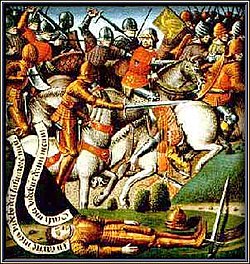
Charlemagne intervened in northeastern Iberia, briefly taking Pamplona before his rearguard was destroyed by Basque forces at Roncevaux Pass. The episode, immortalized in the Song of Roland, marked Frankish involvement in Iberian affairs and inspired later campaigns south of the Pyrenees.
Image source: Battle of Roncevaux Pass
791 - 842
% complete
Alfonso II 'the Chaste' expanded the Kingdom of Asturias southward, repopulating Galicia and León, and forged ties with the Carolingian Empire. His reign strengthened Christian resistance and set precedents for later territorial expansion.
Image source: Alfonso II of Asturias
801
% complete
After capturing Barcelona, Charlemagne established the Spanish March, a buffer zone of counties along the southern slopes of the Pyrenees. These counties, including Barcelona, gradually became autonomous and formed the basis of Catalonia.
Image source: Spanish March
813
% complete
The reputed discovery of the apostle Saint James's remains at Compostela transformed the site into one of Europe's greatest pilgrimage centers. Santiago Matamoros ('Saint James the Moor-slayer') became a symbol of the Christian struggle against Muslim rule.
Image source: Santiago de Compostela Cathedral
824
% complete
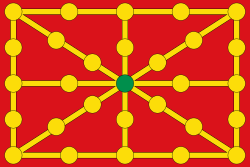
Following the defeat of a Frankish expedition at the Second Battle of Roncesvalles, Íñigo Arista established the Kingdom of Pamplona (later Navarre). It became one of the key Christian realms of northern Iberia.
Image source: Kingdom of Navarre
844
% complete
Norse raiders attacked and briefly occupied Seville, prompting the Emir Abd ar-Rahman II to build fortifications and a fleet. The raids were a significant external shock to Al-Andalus during its early consolidation.
Image source: Viking raid on Seville
912 - 961
% complete
Abd al-Rahman III crushed internal rebellions, proclaimed himself caliph in 929, and made Córdoba one of the largest and most cultured cities in Europe. His military campaigns checked Christian advances from the north.
Image source: Abd al-Rahman III
977 - 1002
% complete
The powerful vizier Almanzor led dozens of successful raids against León, Castile, Navarre, and Barcelona, including the sack of Santiago de Compostela in 997. His death in 1002 after the Battle of Calatañazor heralded the fragmentation of Córdoba.
Image source: Almanzor
1009 - 1031
% complete
A devastating civil war shattered the Caliphate of Córdoba, which formally abolished itself in 1031. Al-Andalus fragmented into numerous taifa kingdoms, giving the Christian north a decisive strategic advantage.
Image source: Fitna of al-Andalus
1037 - 1065
% complete
Ferdinand I conquered León in 1037, uniting it with Castile, and forced several taifa kingdoms to pay tribute. He styled himself 'Emperor of Spain,' marking a new phase of Christian assertiveness.
Image source: Ferdinand I of León
May 25, 1085
% complete
Alfonso VI took the ancient Visigothic capital of Toledo with minimal resistance, thanks to collaboration from its Mozarabic inhabitants. The conquest was a landmark of the Reconquista, opening central Spain to Christian settlement.
Image source: Siege of Toledo (1085)
1086 - 1094
% complete
Invited by threatened taifa rulers, the Almoravids from North Africa crossed into Iberia and defeated Alfonso VI of Castile at the Battle of Sagrajas in 1086. They subsequently absorbed the taifas, reunifying Muslim Iberia and halting Christian expansion.
Image source: Almoravid dynasty
1094
% complete
The Castilian knight Rodrigo Díaz de Vivar, known as El Cid, captured Valencia and ruled it until his death in 1099. His exploits became legendary through the epic poem Cantar de Mio Cid as a symbol of the Reconquista.
Image source: El Cid
1111
% complete
The Council of Burgos extended the ecclesiastical Peace and Truce of God to the Iberian kingdoms, channeling aristocratic violence toward the warfront against al-Andalus and framing frontier warfare in religious terms.
Image source: Peace and Truce of God
Dec 18, 1118
% complete
Known as 'the Battler,' Alfonso I captured Zaragoza, the great taifa capital of the Ebro valley. The conquest pushed Aragonese power deep into former Muslim territory and attracted crusaders from across Europe.
Image source: Alfonso V of Aragon
1146 - 1172
% complete
The Almohads from Morocco replaced the declining Almoravids and took control of al-Andalus by 1172. Their rigorous regime temporarily revived Muslim fortunes and posed a grave threat to the Christian kingdoms.
Image source: Almohad Caliphate
1179
% complete
Papal bull Manifestis Probatum recognized Afonso Henriques as king, confirming Portugal's independence from León. Portugal had been carved out largely through Reconquista warfare against the Muslims of the western peninsula.
Image source: History of Portugal
Jul 16, 1212
% complete
A coalition of Castile, Aragon, Navarre, and Portugal crushed the Almohad army of Muhammad al-Nasir. Often called the most important battle of the Reconquista, it broke Almohad power and opened Andalusia to Christian conquest.
Image source: Battle of Las Navas de Tolosa
Sep 1229 - Oct 1229
% complete
Jaime I launched a naval expedition that seized the Balearic island of Majorca from Muslim rule, followed by Ibiza and Formentera. This opened the western Mediterranean to Catalan-Aragonese trade and expansion.
Image source: Conquest of Majorca
Jun 29, 1236
% complete
Castile's King Ferdinand III, later canonized, captured Córdoba, the former capital of the caliphate. The city's Great Mosque was converted into a cathedral, symbolizing the Christian reconquest of al-Andalus's heartland.
Image source: Ferdinand III of Castile
1238 - 1245
% complete
Jaime I 'the Conqueror' captured the city of Valencia in 1238 after years of campaigning, creating a new Christian kingdom on the Mediterranean. He went on to conquer Murcia's hinterland in cooperation with Castile.
Image source: James I of Aragon
1248
% complete
After a prolonged siege involving a Castilian fleet, Ferdinand III took Seville, the greatest city of al-Andalus. With its fall, only the Nasrid Emirate of Granada remained under Muslim control.
Image source: Siege of Seville
1246
% complete
By the Treaty of Jaén, Muhammad I founded the Nasrid Emirate of Granada as a tributary vassal of Castile, securing over two centuries of survival for the last Muslim state in Iberia.
Image source: Muhammad I of Granada
Oct 30, 1340
% complete
A combined Castilian-Portuguese army under Alfonso XI decisively defeated the Marinids of Morocco and their Granadan allies near Tarifa. The victory ended large-scale African intervention in Iberia for good.
Image source: Battle of Río Salado
1348 - 1350
% complete
The bubonic plague devastated both Christian kingdoms and Granada, killing perhaps a third of the population. It stalled the Reconquista for decades and disrupted settlement and economic life across the peninsula.
Image source: Black Death in Spain
Feb 1482
% complete
The Catholic Monarchs Ferdinand and Isabella, having unified their crowns and completed internal pacification, began a ten-year campaign against the Emirate of Granada, using artillery and systematic sieges to take Muslim strongholds one by one.
Image source: Granada War
Aug 19, 1487
% complete
After a brutal siege, Ferdinand and Isabella captured Málaga, Granada's principal port. Its fall cut off the emirate from reinforcement and resupply by sea and demonstrated the effectiveness of the new royal artillery.
Image source: Siege of Málaga (1487)
Jan 2, 1492
% complete
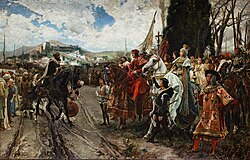
Boabdil, the last Nasrid sultan, surrendered the city of Granada to Ferdinand and Isabella, ending nearly eight centuries of Muslim rule in Iberia. Later that year, the Alhambra Decree ordered the expulsion of Jews, and Columbus sailed west, inaugurating a new era for unified Christian Spain.
Or browse the full history timeline directory, with more than 2,000 topics.
This Reconquista timeline was generated with the help of AI, using information found on the internet.
We work hard to keep these timelines accurate, but mistakes do get through. If you spot one, email us at [email protected] and we'll fix it for future visitors.
Generate yours with AI or build it from scratch, for free.
Export your timeline, add your own events, edit or remove AI-generated events, and much more
No credit card required.
Cancel anytime.
Cancel anytime.
You can create an unlimited number of timelines with up to 10 events on each one, customize how they look, export them to PDF, PNG, PowerPoint, CSV, and Excel, and share them with a link. Paid plans raise the event limit and add features like spreadsheet imports and collaborators.
Yes. You can cancel your subscription from your account page at any time, and you will not be charged again. Your subscription stays active for the rest of the period you already paid for.
Yes. We will email you a reminder before the annual renewal, and we will also email you a receipt.
Yes. You can email us within 15 days of any payment, and we will issue you a full refund.
Check out our pricing docs or send us an email anytime: [email protected].