-
Use Cases
-
Resources
-
Pricing
The Viking Invasions of England were a series of raids and settlements by Norse warriors that began with the attack on Lindisfarne in 793 AD. Over the following centuries, Vikings conquered large territories, established the Danelaw, and clashed with Anglo-Saxon kingdoms. The period saw pivotal figures such as Alfred the Great, who resisted Viking expansion, and ended with Cnut's North Sea Empire and finally the Norman Conquest in 1066, which had Norse roots. More Less
789
% complete
Three ships of Norsemen landed at Portland on the Dorset coast, killing the king's reeve who mistook them for merchants. This is often recorded as the first Viking contact with Anglo-Saxon England.
Image source: Isle of Portland
Jun 8, 793
% complete
Vikings attacked the monastery at Lindisfarne in Northumbria, an event often considered the beginning of the Viking Age. The sacking of the famous religious community shocked Christian Europe and marked the start of sustained Scandinavian raids on England.
Image source: Lindisfarne
794
% complete
A Viking fleet struck the monastery of Jarrow, near Lindisfarne, shortly after the earlier attack. The raid was less successful, as local resistance killed several leaders, but it demonstrated that Norse raiders intended to continue targeting wealthy English monasteries.
Image source: Jarrow
795
% complete
Norse raiders attacked Iona Abbey, a major center of Celtic Christianity, continuing their pattern of plundering isolated monastic communities around the British Isles.
Image source: Iona Abbey
835
% complete
Viking raiders sacked the Isle of Sheppey in Kent, one of the first recorded large-scale raids on southern England during the reign of King Egbert of Wessex.
Image source: Isle of Sheppey
836
% complete
King Egbert of Wessex fought Danish raiders at Carhampton in Somerset. The battle ended inconclusively, showing that Viking forces were becoming a persistent threat to Wessex.
Image source: Carhampton
865
% complete
A massive Viking force led by the sons of Ragnar Lothbrok, including Ivar the Boneless and Halfdan Ragnarsson, landed in East Anglia. Unlike previous raiders, they came to conquer rather than merely plunder.
866
% complete
The Great Heathen Army captured York, capital of Northumbria, exploiting civil conflict between rival Northumbrian kings. The city became the center of Viking power in northern England.
Image source: Great Heathen Army
869
% complete
The Great Army defeated the East Anglians and killed King Edmund, who was later venerated as a saint and martyr. East Anglia fell under Viking control.
Image source: Edmund the Martyr
870
% complete
The Great Heathen Army established a fortified camp at Reading, using it as a base for campaigns against the kingdom of Wessex under King Alfred the Great.
Image source: Reading, Berkshire
871
% complete
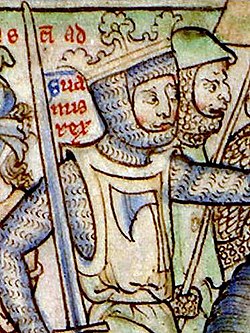
Despite Alfred's success at Ashdown, the West Saxons suffered defeats at Basing and Marton (Meretun) in 871, a year of nine battles that left both sides exhausted.
Image source: Alfred the Great
874
% complete
The Great Army drove King Burgred of Mercia into exile and installed Ceolwulf II as a puppet ruler, effectively bringing Mercia under Viking domination.
Image source: Mercia
878
% complete
Following his defeat, Guthrum agreed to peace terms, accepted baptism with Alfred as his godfather, and withdrew his army from Wessex, establishing a boundary between English and Viking territories.
Image source: Treaty of Wedmore
880 - 899
% complete
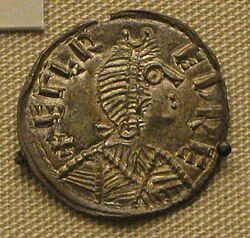
Alfred constructed a network of fortified towns called burhs and built a fleet of warships, creating defensive systems that made future Viking conquests of Wessex far more difficult.
Image source: Burghal Hidage
885
% complete
A Danish army besieged Rochester in Kent but failed to take the town, partly due to Alfred's timely relief efforts, demonstrating the improving defenses of Alfred's Wessex.
Image source: Rochester, Kent
885 - 886
% complete
The great Viking siege of Paris drew many Scandinavian warriors to Francia, temporarily reducing pressure on England and giving Alfred time to strengthen his kingdom's defenses.
Image source: Siege of Paris (885–886)
886
% complete
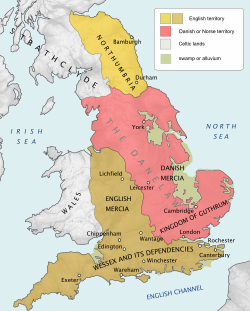
The Treaty of Alfred and Guthrum formalized the division of England, recognizing Danish control over much of northern and eastern England — the region known as the Danelaw, where Danish law and customs prevailed.
Image source: Danelaw
910 - 918
% complete
Building on victories such as the Battle of Tettenhall, Edward the Elder and his sister Aethelflaed of Mercia systematically conquered Danish-held territories, extending English control across the Danelaw.
Image source: Edward the Elder
Aug 5, 910
% complete
An allied Mercian and West Saxon army destroyed a invading Northumbrian Viking force at Tettenhall, killing three Viking kings and crippling Danish military power in northern England.
927
% complete
King Athelstan expelled the last Viking king of York, Guthfrith, and took control of Northumbria, becoming the first king to rule all of England.
Image source: Æthelstan
937
% complete
Athelstan defeated a coalition of Olaf Guthfrithson of Dublin, Constantine of Scotland, and Owen of Strathclyde at Brunanburh, preserving the unity of England against combined Norse and Celtic forces.
Image source: Battle of Brunanburh
947 - 954
% complete
The Norwegian king Erik Bloodaxe twice ruled the Viking Kingdom of York before being expelled and killed in 954, ending independent Scandinavian rule in northern England.
Image source: Eric Bloodaxe
980 - 1013
% complete
Fresh fleets of Danish raiders resumed attacks on England during Aethelred's reign. The king responded with heavy taxation (the Danegeld) and payments of tribute, which only encouraged further raids.
Image source: Æthelred the Unready
Nov 13, 1002
% complete
King Aethelred ordered the killing of Danes living in England, allegedly including Gunhilde, sister of Sweyn Forkbeard of Denmark. The massacre provoked Sweyn's invasions and years of devastating warfare.
1013
% complete
After years of campaigning, Sweyn Forkbeard of Denmark forced Aethelred into exile and was acknowledged as king of all England, though he died just weeks after his conquest in early 1014.
Image source: Sweyn Forkbeard
1016
% complete
Following the death of Edmund Ironside, Cnut the Great completed the Danish conquest of England, founding a North Sea empire that included Denmark, Norway, and parts of Sweden alongside England.
Image source: Cnut
Jun 8, 1042
% complete
The death of Harthacnut, Cnut's son and the last Danish king of England, restored the native English line with Edward the Confessor, ending nearly three decades of Danish rule.
Image source: Harthacnut
Sep 20, 1066
% complete
Norwegian king Harald Hardrada, allied with Tostig Godwinson, invaded northern England and defeated Earl Morcar's forces at Fulford near York, in what proved to be the last major Viking invasion of England.
Image source: Battle of Fulford
Sep 25, 1066
% complete
King Harold Godwinson marched north and crushed Harald Hardrada's army at Stamford Bridge, killing both Hardrada and Tostig. This decisive victory ended the era of Viking invasions of England, weeks before Harold himself fell to William of Normandy.
Image source: Battle of Stamford Bridge
Or browse the full history timeline directory, with more than 2,000 topics.
This Viking Invasions of England timeline was generated with the help of AI, using information found on the internet.
We work hard to keep these timelines accurate, but mistakes do get through. If you spot one, email us at [email protected] and we'll fix it for future visitors.
Generate yours with AI or build it from scratch, for free.
Export your timeline, add your own events, edit or remove AI-generated events, and much more
No credit card required.
Cancel anytime.
Cancel anytime.
You can create an unlimited number of timelines with up to 10 events on each one, customize how they look, export them to PDF, PNG, PowerPoint, CSV, and Excel, and share them with a link. Paid plans raise the event limit and add features like spreadsheet imports and collaborators.
Yes. You can cancel your subscription from your account page at any time, and you will not be charged again. Your subscription stays active for the rest of the period you already paid for.
Yes. We will email you a reminder before the annual renewal, and we will also email you a receipt.
Yes. You can email us within 15 days of any payment, and we will issue you a full refund.
Check out our pricing docs or send us an email anytime: [email protected].