-
Use Cases
-
Resources
-
Pricing
Suleiman the Magnificent, also known as Suleiman the Lawgiver, was the tenth and longest-reigning Sultan of the Ottoman Empire, ruling from 1520 to 1566. Under his leadership, the Ottoman Empire reached the height of its political, military, and cultural power. He expanded the empire into Hungary, the Middle East, and North Africa, reformed the legal system, oversaw architectural masterpieces designed by Mimar Sinan, and fostered a golden age of Ottoman art and literature. More Less
Nov 6, 1494
% complete
Suleiman was born in Trabzon on the southern coast of the Black Sea to Şehzade Selim (later Selim I), probably on 6 November 1494, although this date is not known with absolute certainty. His mother was Hafsa Sultan, a concubine convert to Islam of unknown origins.
Sep 30, 1520
% complete
After succeeding his father Selim I on 30 September 1520, Suleiman entered Constantinople and ascended to the throne as the tenth Ottoman sultan, beginning a reign that would last until 1566.
1521
% complete
Upon succeeding his father, Suleiman began a series of military conquests, which eventually led to a revolt led by the Ottoman-appointed governor of Damascus in 1521.
Sep 6, 1566
% complete
On 6 September 1566, Suleiman died before an Ottoman victory at the siege of Szigetvár in Hungary at the age of 71. His Grand Vizier Sokollu Mehmed Pasha kept his death secret during the retreat for the enthronement of Selim II, his and Hürrem's son, who succeeded him.
Image source: Suleiman the Magnificent
1514
% complete
Ibrahim, originally a Christian from Parga (in Epirus) who had been captured during the 1499–1503 Ottoman–Venetian War, was most likely given as a slave to Suleiman in 1514. He would become Suleiman's closest companion and advisor.
Image source: Pargalı Ibrahim Pasha
1523
% complete
Ibrahim Pasha rose to Grand Vizier in 1523 and commander-in-chief of all the armies, becoming one of the most powerful figures in the Ottoman Empire under Suleiman.
1534
% complete
In 1534, Suleiman broke with Ottoman tradition by marrying Hürrem, an influential woman from his Imperial Harem known in the West as Roxelana. She became the first Haseki sultan, helped usher in the 'Sultanate of Women' period, and was the only woman with whom he had a monogamous relationship during his entire reign.
Image source: Hürrem Sultan
1534
% complete
Hafsa Sultan, Suleiman's mother and a concubine convert to Islam of unknown origins, died in 1534.
Image source: Hafsa Sultan
1543
% complete
When his young son Mehmed died in 1543, Suleiman composed a moving chronogram to commemorate the year: 'Peerless among princes, my Sultan Mehmed,' in which the Arabic Abjad numerals total 955, equivalent to 1543 AD in the Islamic calendar.
Image source: Şehzade Mosque
1553 - 1554
% complete
In late 1553 or 1554, on the suggestion of his favorite doctor and dentist, the Spanish Jew Moses Hamon, the Sultan issued a firman formally denouncing blood libels against the Jews, protecting Jewish subjects of his empire for centuries to come.
1553
% complete
By 1552, when the campaign against Persia had begun with Rüstem appointed commander-in-chief, intrigues against Mustafa, Suleiman's eldest surviving son by Mahidevran Hatun, began. Mustafa was executed in 1553.
Image source: Şehzade Mustafa (son of Suleiman the Magnificent)
1559
% complete
With the aid of his father's army, Selim defeated his brother Bayezid in Konya in 1559, leading Bayezid to seek refuge with the Safavids along with his four sons.
Image source: Selim II
1561
% complete
In return for large amounts of gold, the Shah allowed a Turkish executioner to strangle Bayezid and his four sons in 1561, clearing the path for Selim's succession to the throne five years later.
Image source: Şehzade Bayezid
Aug 28, 1521
% complete
Suleiman encircled Belgrade on 28 August 1521 with 250,000 Turkish soldiers and over 100 ships. The city fell to him that year, marking an early triumph of his reign against the Christian powers of Central Europe.
Image source: Siege of Belgrade (1521)
1522
% complete
In 1522, Suleiman captured Rhodes from the Knights Hospitaller, removing a major Christian naval power from the eastern Mediterranean early in his reign.
Image source: Siege of Rhodes (1522)
Aug 29, 1526
% complete
As relations between Hungary and the Ottoman Empire deteriorated, Suleiman resumed his campaign in Central Europe and on 29 August 1526 defeated Louis II of Hungary at the Battle of Mohács, breaking the strength of the Kingdom of Hungary.
Image source: Battle of Mohács
Sep 1529
% complete
Reacting in 1529, Suleiman marched through the valley of the Danube and regained control of Buda; in the following autumn his forces laid siege to Vienna. With a reinforced garrison of 16,000 men, the Austrians inflicted the first defeat on Suleiman, sowing the seeds of a bitter Ottoman–Habsburg rivalry that lasted until the 20th century.
Image source: Siege of Vienna (1529)
1532
% complete
His second attempt to conquer Vienna failed in 1532, as Ottoman forces were delayed by the siege of Güns and failed to reach Vienna.
Image source: Siege of Kőszeg
1533
% complete
In 1533 the Treaty of Constantinople was signed by Ferdinand I, in which he acknowledged Ottoman suzerainty and recognised Suleiman as his 'father and suzerain'. He also agreed to pay an annual tribute and accepted the Ottoman grand vizier as his brother and equal in rank.
1541 - 1544
% complete
In 1541, the Habsburgs attempted to lay siege to Buda but were repulsed, and more Habsburg fortresses were captured by the Ottomans in two consecutive campaigns in 1541 and 1544. In 1542, after Ferdinand's repeated sieges of Buda and Pest, Suleiman went to Edirne on 17 November 1542 to prepare for a new campaign.
Apr 23, 1543
% complete
On 23 April 1543, Suleiman set out on another campaign against Hungary, continuing his efforts to secure Ottoman dominance in Central Europe.
May 1, 1566
% complete
Suleiman set out on his 13th expedition, the Siege of Szigetvár, on 1 May 1566, at the age of 72, after an absence of approximately 13 years from campaigning in Hungary.
Image source: Siege of Szigetvár
1526
% complete
Payroll registers that survive testify to the breadth of Suleiman's patronage of the arts; the earliest documents, dating from 1526, list 40 societies with over 600 members.
1532
% complete
In 1532, during the Ottoman-Habsburg rivalry, Suleiman wanted to show his superiority in every field, so he had a four-tiered crown made by Venetian merchants for 115,000 ducats through the Italian chief treasurer Alvise Gritti and with the encouragement of Makbul İbrahim Pasha.
1538 - 1588
% complete
The master architect of the classical period, Mimar Sinan, served as the chief court architect (mimarbaşi) from 1538 until his death in 1588, shaping the architectural legacy of Suleiman's era.
Image source: Mimar Sinan
1545 - 1548
% complete
The Şehzade Mosque complex, commissioned by Suleiman, was dedicated to Şehzade Mehmed, his son who died in 1543. The mosque complex was built between 1545 and 1548.
1550 - 1557
% complete
In 1550, through Mimar Sinan, Suleiman began construction for the Süleymaniye complex, a monumental religious and charitable complex dedicated to him. Construction finished in 1557.
Image source: Süleymaniye Mosque
1526 - 1543
% complete
From 1526 until 1543, Suleiman stationed over 900 Turkish soldiers to fight alongside the Somali Adal Sultanate led by Ahmad ibn Ibrahim al-Ghazi during the Conquest of Abyssinia.
1535
% complete
In 1535, Charles V led a Holy League of 26,700 soldiers against Ottoman positions in the Mediterranean, part of the ongoing struggle between the Ottomans and the Habsburgs for control of the sea.
1538
% complete
Aden in Yemen was captured by the Ottomans in 1538, providing an Ottoman base for raids against Portuguese possessions on the western coast of the Mughal Empire. Ottoman ships had been sailing in the Indian Ocean since 1518.
Sep 1538
% complete
Sailing on, the Ottomans failed against the Portuguese at the siege of Diu in September 1538, but then returned to Aden, where they fortified the city with 100 pieces of artillery.
Image source: Siege of Diu (1538)
1541
% complete
In 1541, the Spaniards led an unsuccessful expedition to Algiers, a key Ottoman stronghold in North Africa.
Image source: Battle of Algiers (1541)
1542
% complete
In 1542, facing a common Habsburg enemy during the Italian Wars, Francis I sought to renew the Franco-Ottoman alliance. In early 1542, Polin successfully negotiated details: the Ottomans promised 60,000 troops against Ferdinand's territories and 150 galleys against Charles, while France promised to attack Flanders, harass Spanish coasts, and send 40 galleys for operations in the Levant.
Image source: Franco-Ottoman alliance
Aug 1551
% complete
In August 1551, Ottoman naval commander Turgut Reis attacked and captured Tripoli, which had been a possession of the Knights of Malta since 1530. In 1553, Turgut Reis was nominated commander of Tripoli by Suleiman, making the city an important center for piratical raids and the capital of the Ottoman province of Tripolitania.
Image source: Dragut
1560
% complete
In 1560, a powerful naval force was sent to recapture Tripoli, but that force was defeated in the Battle of Djerba, securing Ottoman dominance in the central Mediterranean.
Image source: Battle of Djerba
1564
% complete
In 1564, Suleiman received an embassy from Aceh, a sultanate on Sumatra in modern Indonesia, requesting Ottoman support against the Portuguese, reflecting the empire's far-reaching diplomatic ties across the Indian Ocean world.
Image source: Ottoman expeditions to Aceh
May 18, 1565 - Sep 8, 1565
% complete
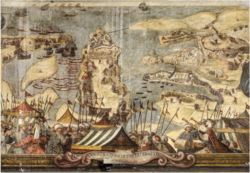
When the Knights Hospitallers were re-established as the Knights of Malta in 1530, their actions against Muslim navies drew the ire of the Ottomans. The Ottomans invaded Malta in 1565, undertaking the Great Siege of Malta, which began on 18 May and lasted until 8 September, and is portrayed vividly in the frescoes of Matteo Perez d'Aleccio.
Image source: Great Siege of Malta
1533
% complete
In 1533, Suleiman ordered Pargalı Ibrahim Pasha to lead an army into eastern Asia Minor where he retook Bitlis and occupied Tabriz without resistance. Suleiman joined Ibrahim in 1534.
1535
% complete
In 1535 Suleiman made a grand entrance into Baghdad, consolidating Ottoman control over Mesopotamia following his campaign against the Safavid Shah.
1548 - 1549
% complete
Attempting to defeat the Shah once and for all, Suleiman embarked upon a second campaign against Persia in 1548–1549.
1553
% complete
In 1553, Suleiman began his third and final campaign against the Safavid Shah, culminating two years later in a peace settlement.
1555
% complete
In 1555, a settlement known as the Peace of Amasya was signed between the Ottomans and the Safavids, defining the borders of the two empires after decades of conflict.
Image source: Peace of Amasya
Or browse the full history timeline directory, with more than 2,000 topics.
This Suleiman the Magnificent timeline was generated with the help of AI, using information found on the internet.
We work hard to keep these timelines accurate, but mistakes do get through. If you spot one, email us at [email protected] and we'll fix it for future visitors.
Generate yours with AI or build it from scratch, for free.
Export your timeline, add your own events, edit or remove AI-generated events, and much more
No credit card required.
Cancel anytime.
Cancel anytime.
You can create an unlimited number of timelines with up to 10 events on each one, customize how they look, export them to PDF, PNG, PowerPoint, CSV, and Excel, and share them with a link. Paid plans raise the event limit and add features like spreadsheet imports and collaborators.
Yes. You can cancel your subscription from your account page at any time, and you will not be charged again. Your subscription stays active for the rest of the period you already paid for.
Yes. We will email you a reminder before the annual renewal, and we will also email you a receipt.
Yes. You can email us within 15 days of any payment, and we will issue you a full refund.
Check out our pricing docs or send us an email anytime: [email protected].