-
Use Cases
-
Resources
-
Pricing
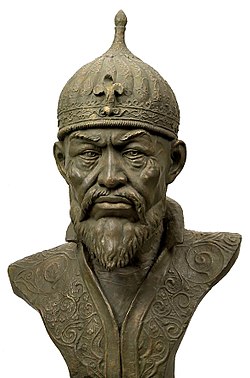
Tamerlane, also known as Timur (1336–1405), was a Turco-Mongol conqueror and founder of the Timurid Empire. Rising to power in Transoxiana (modern Uzbekistan), he led brutal military campaigns across Persia, Mesopotamia, the Caucasus, India, Anatolia, and Syria, becoming one of history's most formidable conquerors while also fostering a cultural renaissance in his capital, Samarkand. More Less
1325
% complete
Timur, later known as Tamerlane, was born in the 1320s into the Turkicized Mongol confederation of the Barlas in Transoxiana (now in Uzbekistan). Later Timurid dynastic histories claim a birthdate of 8 April 1336, but most sources from his lifetime suggest a birthdate in the late 1320s.
1335
% complete
After the death of Abu Sa'id, ruler of the Ilkhanate, in 1335, there was a power vacuum in Persia. Some scholars suspect the claimed 1336 birthdate for Timur was intended to link him to the legacy of Abu Sa'id Bahadur Khan, the last ruler of the Ilkhanate and descendant of Hulegu Khan.
Image source: Timur
1360
% complete
By about 1360, Timur had gained prominence as a military leader whose troops were mostly Turkic tribesmen of the region. Around this time he returned to his birthplace following the death of his father on 12 March 1360, suggesting concern over his estate.
1363
% complete
Around 1363, it is believed that Timur tried to steal a sheep from a shepherd but was shot by two arrows, one in his right leg and another in his right hand, where he lost two fingers. These injuries contributed to his famous lameness, earning him the name Tamerlane.
1370
% complete
By around 1370, Timur had gained control of the western Chagatai Khanate. Husayn surrendered to Timur and was later assassinated, which allowed Timur to be formally proclaimed sovereign at Balkh.
1368
% complete
In 1368, the Yuan dynasty collapsed and was succeeded by the Ming dynasty. This shift set the stage for Timur's later diplomatic friction with China, as the Ming emperors eventually demanded his submission as a subject.
Image source: Ming dynasty
1394
% complete
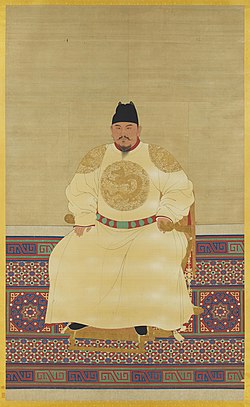
In 1394, the Hongwu Emperor's ambassadors presented Timur with a letter addressing him as a subject. Neither the next ambassador, Chen Dewen (1397), nor the delegation announcing the accession of the Yongle Emperor fared any better.
Image source: Hongwu Emperor
1401
% complete
In 1401, the Arab historian Ibn Khaldun personally met Timur in Damascus. Practically all of Timur's contemporaries identified him as a Mongol, including Ibn Khaldun, Ibn Arabshah, and Ruy González de Clavijo.
Image source: Ibn Khaldun
Aug 1401
% complete
In August 1401, Byzantine John VII Palaiologos, regent during his uncle's absence in the West, sent a Dominican friar to Timur to pay his respects and propose paying tribute to him instead of the Turks once Timur defeated them.
Image source: John VII Palaiologos
1402
% complete
At the time of the Battle of Ankara in 1402, two Spanish ambassadors were already with Timur: Pelayo de Sotomayor and Fernando de Palazuelos, reflecting growing European interest in relations with the conqueror.
Jul 30, 1402
% complete
On 30 July 1402, Timur sent a letter to Charles VI of France suggesting that he send traders to Asia. A copy of Charles VI's answer, dated 15 June 1403, has been preserved.
Image source: Charles VI of France
1403 - 1406
% complete
In return, Henry III of Castile sent a famous embassy to Timur's court in Samarkand in 1403–06, led by Ruy González de Clavijo with Alfonso Paez and Gomez de Salazar. Clavijo met Timur in 1404 and reported news from Cathay to European audiences.
Image source: Ruy González de Clavijo
Feb 1403
% complete
With the Treaty of Gallipoli in February 1403, Timur was furious with the Genoese and Venetians, since their ships ferried the Ottoman army to safety in Thrace. As Lord Kinross reported, the Italians preferred the enemy they could handle to the one they could not.
Image source: Treaty of Gallipoli
1371 - 1379
% complete
The success of Timur's second military expedition led to further operations, among them the subjugation of Khwarazm and Urgench in the Siege of Urgench (1379), expanding his power across Central Asia.
1383
% complete
In 1383, Timur started his lengthy military conquest of Persia, though he already ruled over much of Persian Khorasan by 1381, after Khwaja Mas'ud of the Sarbadar dynasty surrendered to him.
Image source: Timurid Empire
1384
% complete
In 1384, Timur laid siege to Soltaniyeh as part of his ongoing conquest of Persia, tightening his grip on northwestern Iran.
Image source: Soltaniyeh
1384
% complete
When Herat did not surrender, Timur reduced the city to rubble and massacred most of its citizens; it remained in ruins until Shah Rukh ordered its reconstruction around 1415. With its capture, the Kartid kingdom surrendered and became vassals of Timur, later annexed outright in 1389 by his son Miran Shah.
Image source: Herat
1387
% complete
When Timur arrived with his army at Isfahan in 1387, the city immediately surrendered; he treated it with relative mercy, unlike cities such as Herat that resisted him. That same year he passed through Mazandaran while trying to capture the Zagros region.
Image source: Isfahan
1392
% complete
Timur then began a five-year campaign to the west in 1392, attacking Persian Kurdistan and extending his dominance deeper into western Persia and beyond.
1393
% complete
In 1393, Shiraz was captured after surrendering, and the Muzaffarids became vassals of Timur. Prince Shah Mansur rebelled but was defeated at the Battle of Shiraz (1393), and the Muzaffarids were annexed outright.
Image source: Muzaffarids (Iran)
May 1393
% complete
In May 1393, Timur's army invaded the Anjudan, crippling the Ismaili village only a year after his assault on the Ismailis in Mazandaran, demonstrating his harsh treatment of communities he viewed as heretical.
1395
% complete
Russian Orthodox tradition states that in 1395, having reached the frontier of the Principality of Ryazan, Timur had taken Yelets and started advancing towards Moscow before turning back.
Image source: Principality of Ryazan
Sep 30, 1398
% complete
The decline of the Tughlaq dynasty drew Timur's attention, and in 1398 he invaded the Indian subcontinent during the reign of Sultan Mahmud Shah II. After crossing the Indus River on 30 September 1398 with a force of 90,000, he sacked Tulamba and massacred its inhabitants, encountering resistance under Malik Jasrat at the Sutlej.
Dec 17, 1398
% complete
The battle took place on 17 December 1398, resulting in Timur's decisive victory over the Tughlaq forces. His invasion and destruction of Delhi continued the chaos consuming India, and the city would not recover from the great loss it suffered for almost a century.
1400 - 1404
% complete
In 1400, Timur invaded Armenia and Georgia as part of his raids on Transcaucasia. Between 1386 and 1404, his Turco-Mongol forces raided the region repeatedly from bases in northern Iran, and in 1404 Tiflis was finally conquered, forcing King George VII to recognize Timurid suzerainty.
Jun 1401
% complete
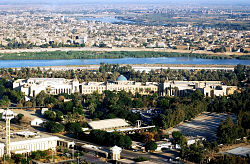
Timur invaded Baghdad in June 1401, dealing a devastating blow to the city. While he was still in Anatolia, Qara Yusuf assaulted and captured Baghdad in 1402, showing how contested the region remained.
Image source: Baghdad
Dec 1402
% complete
In December 1402, Timur besieged and conquered Smyrna, a stronghold of the Christian Knights Hospitalers; thus he referred to himself as ghazi or 'Warrior of Islam'.
Image source: Smyrna
1376
% complete
Jahangir, Timur's son, died of illness in 1376. His death removed an intended heir and affected the succession plans of the emerging Timurid dynasty.
Image source: Jahangir Mirza (Timurid prince)
1403
% complete
Timur's grandson Muhammad Sultan, his second intended heir, died from battle wounds in 1403, complicating the succession of the Timurid Empire.
Image source: Sultan Muhammad (Timurid)
Feb 17, 1405
% complete
In December 1404, Timur began military campaigns against Ming China and detained a Ming envoy. He became ill while encamped on the farther side of the Syr Daria and died at Farab on 17 or 18 February 1405, before ever reaching the Chinese border.
1409
% complete
It was not until 1409 that Timur's youngest son, Shah Rukh, was able to overcome his rivals and take the throne as Timur's successor, stabilizing the Timurid Empire. Herat would later be rebuilt under his orders around 1415.
Image source: Shah Rukh Khan
1411 - 1449
% complete
Timur was the grandfather of the Timurid sultan, astronomer and mathematician Ulugh Beg, who ruled Central Asia from 1411 to 1449, continuing the dynasty's cultural and scientific legacy.
Image source: Ulugh Beg
1526
% complete
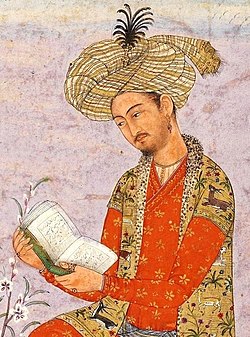
Babur (1483–1530), Timur's great-great-great-grandfather-descendant through the Timurid line, founded the Mughal Empire in the Indian subcontinent, extending Timur's legacy into South Asia.
Image source: Babur
1382
% complete
Despite their growing rivalry, Timur still supported Tokhtamysh against the Russians, and in 1382 Tokhtamysh invaded the Muscovite dominion and burned Moscow.
Image source: Moscow
1385
% complete
Tokhtamysh, now khan of the Golden Horde, turned against his patron Timur and in 1385 invaded Azerbaijan, beginning the long struggle between the two rulers.
Image source: Tokhtamysh–Timur war
1391
% complete
Tokhtamysh's army was boxed in against the east bank of the Volga River in the Orenburg region and destroyed at the Battle of the Kondurcha River in 1391, marking a major victory for Timur in his war with the Golden Horde.
Image source: Battle of the Kondurcha River
1395
% complete
In 1395, Timur defeated Tokhtamysh at the Battle of the Terek River, concluding the struggle between the two monarchs. The Golden Horde never recovered from its losses and disintegrated into smaller khanates within the next half-century, allowing Moscow to emerge as the dominant Russian state.
Image source: Battle of the Terek River
1399
% complete
Before the end of 1399, Timur started a war with Bayezid I, sultan of the Ottoman Empire, and the Mamluk sultan of Egypt Nasir-ad-Din Faraj, setting up the great confrontations of the early 1400s. Ahmad Jalayir fled again in 1399 to the Ottomans, aided by Qara Yusuf of the Kara Koyunlu.
Image source: Bayezid I
Jul 20, 1402
% complete
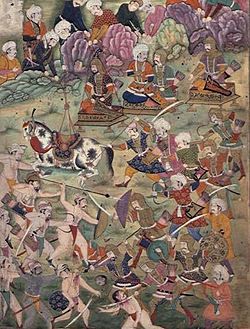
Timur invaded Anatolia and decisively defeated Bayezid I at the Battle of Ankara on 20 July 1402, one of the most significant battles of his career, shattering Ottoman power for years.
Image source: Battle of Ankara
1403
% complete
Writing in 1403, John III, Archbishop of Sultaniyya, claimed that Timur's mother was of lowly origin. The 18th century Books of Timur identify her as the daughter of 'Sadr al-Sharia', believed to refer to the Hanafi scholar Ubayd Allah al-Mahbubi of Bukhara.
1424 - 1428
% complete
Between 1424 and 1428, Sharaf ad-Din Ali Yazdi wrote a second Zafarnama drawing heavily on Shami's earlier work. In the Zafarnama, Mongols living in modern-day Mongolia are referred to as Qalmaq, not Mughul.
1636
% complete
Arabshah's history of Timur was translated into Latin by the Dutch Orientalist Jacobus Golius in 1636, bringing contemporary Muslim accounts of Timur to European scholars.
Image source: Ibn Arabshah
1637 - 1638
% complete
The scholar Abu Taleb Hosayni presented the Malfuzat-i Timuri and Tuzuk-i Timuri to the Mughal emperor Shah Jahan, a distant descendant of Timur, supposedly after discovering the Chagatai originals in Yemen. They are almost certainly 17th-century fabrications.
Image source: Shah Jahan
Or browse the full history timeline directory, with more than 2,000 topics.
This Tamerlane timeline was generated with the help of AI, using information found on the internet.
We work hard to keep these timelines accurate, but mistakes do get through. If you spot one, email us at [email protected] and we'll fix it for future visitors.
Generate yours with AI or build it from scratch, for free.
Export your timeline, add your own events, edit or remove AI-generated events, and much more
No credit card required.
Cancel anytime.
Cancel anytime.
You can create an unlimited number of timelines with up to 10 events on each one, customize how they look, export them to PDF, PNG, PowerPoint, CSV, and Excel, and share them with a link. Paid plans raise the event limit and add features like spreadsheet imports and collaborators.
Yes. You can cancel your subscription from your account page at any time, and you will not be charged again. Your subscription stays active for the rest of the period you already paid for.
Yes. We will email you a reminder before the annual renewal, and we will also email you a receipt.
Yes. You can email us within 15 days of any payment, and we will issue you a full refund.
Check out our pricing docs or send us an email anytime: [email protected].