
-
Resources
-
Pricing
The Tariff of Abominations was a highly protective U.S. tariff enacted in 1828 that intensified tensions between the industrial North and agricultural South, especially South Carolina. More Less
Build a timeline like this one in minutes, for free. Start Yours →
1806 - 1814
During the Napoleonic Wars, the Continental Blockade disrupted normal trade and contributed to British manufacturers offering goods in America at low prices. American manufacturers often could not match those prices, helping create pressure for protective tariffs.
Image source: Continental System
1806 - 1814
The wartime influx of inexpensive European manufactured goods exposed American producers to intense competition. This economic pressure became part of the background to a series of protective American tariffs.
Image source: History of tariffs in the United States
1816
Congress passed the first protective tariff in 1816. It formed an early federal response to foreign competition and began the sequence of tariff measures that eventually led to the Tariff of 1828.
Image source: Tariff of 1816
1816 - 1828
The tariffs of 1816 and 1824 were part of a broader series of American protective measures shaped by the commercial disruptions of the Napoleonic Wars and the difficulty American manufacturers faced competing with inexpensive European goods.
1824
In 1824, New England was described as being on the verge of bankruptcy because of the influx and use of European cloth. The situation strengthened arguments for higher protective duties.
1824
Congress increased tariff rates in 1824. This measure continued the protectionist policy begun in 1816 and preceded the still higher duties associated with the Tariff of 1828.
Image source: Tariff of 1824
1828 - 1833
Southern denunciation of the tariff escalated into a threat of civil war during the nullification crisis of 1832–33. The dispute became a direct confrontation between South Carolina and the federal government.
Image source: Nullification crisis
Jul 14, 1832
On July 14, 1832, President Jackson signed the Tariff of 1832 into law. The measure made some reductions in tariff rates, but it did not resolve Southern opposition.
Image source: Tariff of 1832
Jul 14, 1832
South Carolina considered the reductions in the Tariff of 1832 too small. In its view, the objectionable “abominations” of the 1828 tariff were still present.
Nov 1832
In November 1832, South Carolina called for a convention. The action moved the dispute from political protest toward formal state action against the federal tariff laws.
Nov 1832
The South Carolina convention declared that the tariffs of both 1828 and 1832 were unconstitutional and unenforceable within South Carolina. This declaration constituted the central act of nullification in the crisis.
Mar 2, 1833
The nullification crisis was resolved with the Tariff of 1833, a compromise that replaced the tariff regime associated with the controversy. The tariff was replaced in 1833, bringing the immediate crisis to an end.
1828
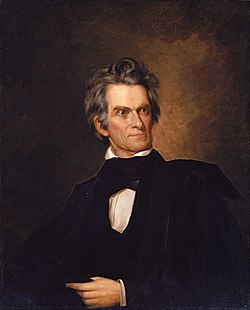
Vice President John C. Calhoun of South Carolina strongly opposed the Tariff of 1828. His opposition helped connect the tariff dispute to the broader constitutional argument over state authority.
Image source: John C. Calhoun
1828
Opponents of the tariff expected that Andrew Jackson's election would lead to a significant reduction in the duties. Their expectation reflected the belief that the new administration would respond to Southern resistance.
Image source: Tariff of Abominations
1828
The high protective duties were vehemently denounced in the South. Southern opposition increasingly treated the tariff as a constitutional and economic grievance, setting the stage for the later nullification crisis.
Nov 7, 1828
In the presidential election of 1828, Andrew Jackson defeated John Quincy Adams. Jackson received 642,553 popular votes and 178 electoral votes, while Adams received 500,897 popular votes and 83 electoral votes.
Image source: 1828 United States presidential election
Dec 1828
In December 1828, Calhoun anonymously authored the pamphlet South Carolina Exposition and Protest. It urged South Carolina to nullify the tariff within the state.
Image source: South Carolina Exposition and Protest
1829
In 1829, President Jackson stated that the Tariff of 1828 was constitutional. His position disappointed those who had expected his election to bring a major reduction in tariff rates.
May 19, 1828
President John Quincy Adams signed the 1828 tariff into law. Although he realized the measure could weaken him politically, he nonetheless approved the legislation.
May 19, 1828
The Tariff of 1828, a very high protective tariff, became law in the United States on May 19, 1828. Its unusually high duties led opponents to call it the Tariff of Abominations.
Build a timeline like this one in minutes, for free. Start Yours →
Or browse the full history timeline directory, with more than 2,500 topics.
This Tariff of Abominations timeline was generated with the help of AI, using information found on the internet.
We work hard to keep these timelines accurate, but mistakes do get through. If you spot one, email us at [email protected] and we'll fix it for future visitors.
Generate yours with AI or build it from scratch, for free.
Export your timeline, add your own events, edit or remove AI-generated events, and much more
No credit card required.
15-day money-back guarantee.
You can create an unlimited number of timelines with up to 10 events on each one, customize how they look, export them to PDF, PNG, PowerPoint, CSV, and Excel, and share them with a link. Timelines made with Timeline Maker AI keep every event the generator created, and you can add up to 5 events of your own. Paid plans remove the event limit, add spreadsheet imports and hide Preceden's branding, and the higher-priced plan also adds collaborators, a custom logo and a custom domain.
Yes. You can cancel your subscription from your account page at any time, and you will not be charged again. Your subscription stays active for the rest of the period you already paid for.
Yes. We email you a reminder 15 days before your annual renewal, and we email you a receipt after every payment.
Yes. You can email us within 15 days of any payment, and we will issue you a full refund.
Check out our pricing docs or send us an email anytime: [email protected].