-
Use Cases
-
Resources
-
Pricing
Vladimir Lenin (1870–1924) was a Russian revolutionary, politician, and political theorist who served as the first head of government of Soviet Russia and later the Soviet Union. He developed Marxism-Leninism, led the Bolshevik Revolution of 1917, and fundamentally transformed Russia into a one-party communist state. More Less
Apr 22, 1870
% complete
Vladimir Ilyich Ulyanov, later known as Lenin, was born in Simbirsk (now Ulyanovsk), Russia, to a well-educated family. His father was a school inspector and his mother was the daughter of a physician, giving Lenin access to education and a comfortable upbringing.
Image source: Vladimir Lenin
May 20, 1887
% complete
Lenin's older brother Alexander Ulyanov was executed for his involvement in a plot to assassinate Tsar Alexander III. This event profoundly affected Lenin and is often credited with radicalizing him against the tsarist regime.
Image source: Aleksandr Ulyanov
1891
% complete
After being expelled from Kazan University for participating in student protests, Lenin studied law as an external student and graduated from St. Petersburg University in 1891, briefly practicing law in Samara.
Dec 1895 - 1900
% complete
Lenin was arrested in St. Petersburg for revolutionary activities and exiled to Shushenskoye in Siberia for three years. During this period he married fellow Marxist Nadezhda Krupskaya and continued writing on Marxist theory.
1899
% complete
Lenin published his first major book, analyzing the development of capitalism in the Russian economy and arguing for the necessity of a proletarian revolution, establishing his reputation as a leading Marxist theoretician.
Image source: The Development of Capitalism in Russia
Dec 1900
% complete
Lenin co-founded the revolutionary newspaper Iskra ('The Spark') in Munich with other Russian Marxists, using it to unify the Russian Social Democratic movement and spread Marxist ideas.
Image source: Iskra
1901
% complete
Lenin began using the pseudonym 'Lenin' around 1901, possibly derived from the Lena River in Siberia, to distinguish himself from other revolutionaries and to conceal his identity from tsarist police.
1902
% complete
Lenin published his influential pamphlet 'What Is to Be Done?' arguing for a vanguard party of professional revolutionaries to lead the working class, a concept that became central to Bolshevik ideology.
Image source: What Is to Be Done? (Tolstoy book)
1903
% complete
At the Second Congress of the Russian Social Democratic Labour Party, Lenin's faction split from the Mensheviks over party organization, with Lenin's group becoming known as the Bolsheviks ('majority').
Image source: 2nd Congress of the Russian Social Democratic Labour Party
1916
% complete
Written while in exile in Switzerland, Lenin's work argued that imperialism was the highest stage of capitalism, driven by monopoly capital and leading inevitably to war and revolution.
Image source: Imperialism, the Highest Stage of Capitalism
Apr 16, 1917
% complete
Lenin returned to Petrograd from exile in Switzerland via a sealed train through Germany, arriving at Finland Station and immediately calling for 'All Power to the Soviets' in his April Theses.
Image source: Sealed train
Apr 17, 1917
% complete
Lenin published his April Theses, calling for the overthrow of the Provisional Government, transfer of power to the soviets, and an end to Russia's participation in World War I.
Image source: April Theses
Jul 16, 1917 - Jul 20, 1917
% complete
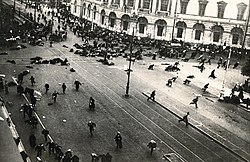
Spontaneous demonstrations by soldiers and workers in Petrograd were suppressed by the Provisional Government, forcing Lenin to flee to Finland and go into hiding to avoid arrest.
Image source: July Days
Aug 1917
% complete
While hiding in Finland, Lenin wrote 'State and Revolution,' articulating his theory of the state as an instrument of class oppression that must be replaced by the dictatorship of the proletariat.
Image source: The State and Revolution
Nov 7, 1917 - Nov 8, 1917
% complete
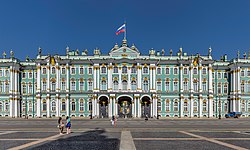
The Bolsheviks, led by Lenin, seized power in Petrograd by storming the Winter Palace and overthrowing the Provisional Government, establishing the first communist government in history.
Image source: October Revolution
Nov 8, 1917
% complete
The Bolsheviks issued the Decree on Land, abolishing private ownership of land and redistributing it to peasant communes, fulfilling a key promise to Russia's vast peasant population.
Image source: Decree on Land
Nov 8, 1917
% complete
Lenin's new government issued the Decree on Peace, calling for an immediate end to World War I and proposing a just, democratic peace without annexations, appealing to workers of all belligerent nations.
Image source: Decree on Peace
1918 - 1921
% complete
Lenin's government implemented War Communism, nationalizing industry, requisitioning grain from peasants, and centralizing economic control to support the Red Army during the Civil War, leading to widespread hardship and famine.
Image source: War communism
1918 - 1922
% complete
The Russian Civil War pitted the Bolshevik Red Army against the anti-communist White Army and other factions. Lenin's government survived through harsh measures including War Communism and the Red Terror, emerging victorious.
Image source: Russian Civil War
Mar 3, 1918
% complete
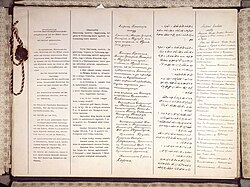
Lenin insisted on signing the Treaty of Brest-Litovsk with Germany, ending Russia's involvement in World War I at the cost of significant territorial losses, a controversial decision that split the Bolshevik leadership.
Image source: Treaty of Brest-Litovsk
Mar 12, 1918
% complete
The Soviet government moved the capital from Petrograd to Moscow, partly for strategic reasons as the Civil War loomed, and Lenin took up residence in the Kremlin.
Image source: Moscow
Aug 30, 1918
% complete
Socialist Revolutionary Fanny Kaplan shot and seriously wounded Lenin after a speech at a factory in Moscow. The failed assassination was followed by the Red Terror campaign against perceived enemies of the revolution.
Image source: Fanny Kaplan
Mar 2, 1919
% complete
Lenin founded the Communist International (Comintern) in Moscow to promote worldwide communist revolution, establishing the Soviet Union as the center of the international communist movement.
Image source: Communist International
1921 - 1922
% complete
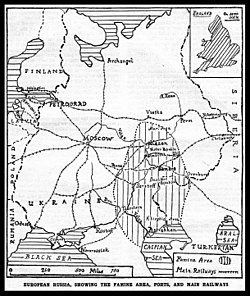
A devastating famine, exacerbated by War Communism policies and drought, killed millions in Soviet Russia. The government eventually allowed international aid organizations to provide relief.
Image source: Russian famine of 1921–1922
Mar 7, 1921 - Mar 17, 1921
% complete
Sailors at the Kronstadt naval base rebelled against Bolshevik rule, demanding political freedoms and an end to War Communism. The uprising was brutally suppressed, prompting Lenin to reconsider economic policy.
Image source: Kronstadt rebellion
Mar 21, 1921
% complete
Lenin introduced the New Economic Policy (NEP), allowing limited private enterprise and replacing grain requisitioning with a tax in kind, temporarily relaxing communist economic controls to rebuild the war-ravaged economy.
Dec 30, 1922
% complete
The Union of Soviet Socialist Republics was formally established, uniting Russia, Ukraine, Belarus, and the Transcaucasian Republics into a federal state under Bolshevik leadership, with Lenin as its founding father.
Image source: Soviet Union
May 26, 1922
% complete
Lenin suffered his first stroke, which partially paralyzed him and forced him to reduce his political activities. He experienced further strokes over the following months, gradually withdrawing from active leadership.
Dec 1922
% complete
In his final political writings, later known as Lenin's Testament, Lenin criticized leading party figures including Joseph Stalin, whom he recommended removing from the position of General Secretary.
Image source: Lenin's Testament
Jan 21, 1924
% complete
Lenin died at his estate in Gorki at age 53 after a series of strokes. His death triggered a massive outpouring of grief and a power struggle within the Communist Party, ultimately won by Joseph Stalin.
Image source: Death and state funeral of Vladimir Lenin
Jan 26, 1924
% complete
Days after Lenin's death, the city of Petrograd was renamed Leningrad in his honor, and his body was placed in a mausoleum in Red Square, becoming an object of pilgrimage for communists worldwide.
Image source: Saint Petersburg
Or browse the full history timeline directory, with more than 2,000 topics.
This Vladimir Lenin timeline was generated with the help of AI, using information found on the internet.
We work hard to keep these timelines accurate, but mistakes do get through. If you spot one, email us at [email protected] and we'll fix it for future visitors.
Generate yours with AI or build it from scratch, for free.
Export your timeline, add your own events, edit or remove AI-generated events, and much more
No credit card required.
Cancel anytime.
Cancel anytime.
You can create an unlimited number of timelines with up to 10 events on each one, customize how they look, export them to PDF, PNG, PowerPoint, CSV, and Excel, and share them with a link. Paid plans raise the event limit and add features like spreadsheet imports and collaborators.
Yes. You can cancel your subscription from your account page at any time, and you will not be charged again. Your subscription stays active for the rest of the period you already paid for.
Yes. We will email you a reminder before the annual renewal, and we will also email you a receipt.
Yes. You can email us within 15 days of any payment, and we will issue you a full refund.
Check out our pricing docs or send us an email anytime: [email protected].