-
Use Cases
-
Resources
-
Pricing
The Wailing Wall, also known as the Western Wall or Kotel, is a section of the ancient retaining wall of the Jewish Temple Mount in Jerusalem. It is considered the holiest site in Judaism where Jews are permitted to pray, and it has been a center of pilgrimage, worship, and conflict for centuries. More Less
957 BC
% complete
King Solomon completed the First Temple in Jerusalem on the Temple Mount, establishing the sacred site that would later give rise to the retaining walls whose remnants include the Western Wall. The temple stood as the central place of Jewish worship for centuries.
Image source: Solomon's Temple
586 BC
% complete
Nebuchadnezzar II's Babylonian army conquered Jerusalem and destroyed Solomon's Temple, ending the First Temple period. The catastrophe began the Babylonian exile and initiated Jewish longing for the restoration of the holy site.
Image source: Siege of Jerusalem (587 BC)
516 BC
% complete
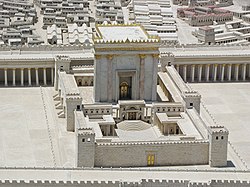
After the return from Babylonian exile, Jews rebuilt the Temple on the same site under Persian rule. This Second Temple became the center of Jewish religious life for nearly five hundred years.
Image source: Second Temple
20 BC
% complete
Herod the Great launched a grand reconstruction of the Second Temple complex, building enormous retaining walls around the expanded Temple Mount using massive ashlars, some weighing hundreds of tons. The Western Wall is widely believed to be part of Herod's construction.
10 BC
% complete
The main work on Herod's magnificent Temple was completed around this time, though finishing touches continued afterward. The enlarged platform and its retaining walls, including the western wall, became one of the marvels of the ancient world.
Image source: Temple Mount
Aug 4, 70 AD
% complete
Roman legions under Titus crushed the Great Jewish Revolt and burned the Second Temple on Tisha B'Av. The destruction left only portions of the outer retaining walls standing, including what became known as the Western Wall.
Image source: Siege of Jerusalem (70 CE)
130 AD
% complete
Emperor Hadrian refounded Jerusalem as the Roman colony of Aelia Capitolina and built a temple to Jupiter on the Temple Mount. Jews were forbidden entry, making the Western Wall a distant object of veneration rather than an accessible prayer site.
Image source: Aelia Capitolina
132 AD - 136 AD
% complete
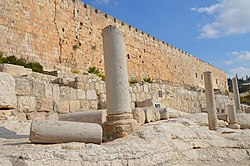
Simon Bar Kokhba led a major Jewish uprising against Rome, briefly re-establishing Jewish control over Jerusalem. After its suppression, Emperor Hadrian banned Jews from the city, deepening the symbolic importance of praying at the remaining walls from outside.
Image source: Bar Kokhba revolt
300 AD
% complete
Early midrashic sources began referring to the 'Western Wall of the Temple,' reflecting a tradition of mourning the destroyed sanctuary. Rabbinic literature associated the wall with divine presence that never departed from the western side.
Image source: Western Wall
335 AD
% complete
Under Christian Byzantine rule, Jerusalem became a pilgrimage center centered on Christian sites. Jews were periodically permitted limited access to Jerusalem, sometimes gathering near the Temple Mount's western wall to pray and lament.
Image source: Jerusalem in Christianity
614 AD - 617 AD
% complete
Persian Sassanid forces, aided by Jewish allies, captured Jerusalem and allowed Jewish worship temporarily. The short-lived autonomy ended when the Byzantines recaptured the city, but the episode fueled messianic hopes tied to the Temple site.
Image source: Sasanian conquest of Jerusalem
638 AD
% complete
The Rashidun Caliphate captured Jerusalem, beginning more than thirteen centuries of Muslim rule over the city, interrupted only by the Crusader period. The Temple Mount became home to Islamic shrines while Jews were gradually permitted to return.
Image source: Muslim conquest of the Levant
1099
% complete
Crusaders seized Jerusalem and massacred much of its population, expelling Jews from the city. The Temple Mount was converted to Christian use until Muslims reconquered the city under Saladin in 1187.
Image source: Siege of Jerusalem (1099)
Oct 2, 1187
% complete
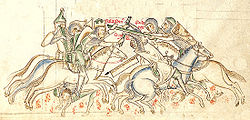
Saladin defeated the Crusaders at Hattin and reclaimed Jerusalem, allowing Jews to resettle. Under Ayyubid rule, Jewish communities returned and renewed their connection to prayer near the western retaining wall.
Image source: Battle of Hattin
1250 - 1517
% complete
During Mamluk rule, the Mughrabi Quarter grew along the western side of the Temple Mount, eventually surrounding the small plaza where Jews prayed before the Western Wall. Religious structures crowded close to the sacred remnant.
Image source: Mamluk Sultanate
1517
% complete
Sultan Selim I brought Jerusalem into the Ottoman Empire. Ottoman authorities generally tolerated Jewish prayer at the Western Wall, which became the most accessible sacred relic of the Temple for Jews worldwide.
Image source: Ottoman Empire
1538
% complete
Sultan Suleiman rebuilt Jerusalem's city walls and reportedly formalized arrangements for Jewish worship at the Western Wall. Under his reign, the wall emerged as the established site of Jewish communal lamentation and prayer.
Image source: Walls of Jerusalem
1700
% complete
European travelers popularized the name 'Wailing Wall' after witnessing Jewish mourners weeping over the ruined Temple there. Jews traditionally preferred names like the 'Western Wall' or 'Kotel,' rejecting the mournful label as imposed by outsiders.
1840
% complete
Sir Moses Montefiore repeatedly petitioned Ottoman authorities to purchase the Western Wall plaza and the adjacent Mughrabi Quarter for Jewish worshippers. Though negotiations failed, his efforts highlighted the growing international attention to Jewish access.
Image source: Moses Montefiore
1867
% complete
British Royal Engineers, including Charles Warren, surveyed and excavated around the Temple Mount walls, documenting their Herodian foundations. Their work revealed the extraordinary scale of the ancient masonry hidden below ground level.
Image source: Western Wall Tunnel
1899
% complete
Jewish philanthropists acquired properties overlooking the Western Wall, including the Abu Gosh house, to improve conditions for worshippers who had long prayed in a cramped alleyway beneath Mamluk-era buildings.
Image source: Western Wall Plaza
Nov 11, 1918
% complete
The defeat of the Ottoman Empire opened a new chapter for Palestine under British administration. Zionist leaders anticipated improved access and rights at the Western Wall, though tensions over the site would soon intensify.
Image source: Armistice of 11 November 1918
Aug 23, 1929 - Aug 29, 1929
% complete
Disputes between Jews and Muslims over screens and furniture at the Western Wall sparked deadly riots across Palestine, including the Hebron massacre. The violence underscored how the wall had become a flashpoint of the Arab–Jewish conflict.
Image source: 1929 Palestine riots
1931
% complete
A League of Nations commission affirmed Muslim ownership of the wall but guaranteed Jewish free access for prayer. It prohibited certain Jewish practices, such as blowing the shofar at the site, a ban that persisted under later authorities.
May 28, 1948
% complete
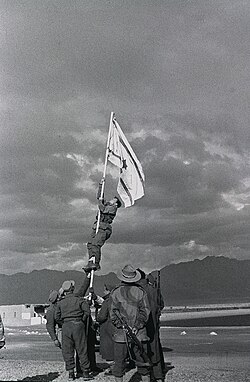
During Israel's War of Independence, Jordanian forces seized East Jerusalem and the Old City, cutting off Jewish access to the Western Wall for nineteen years. Jews could no longer pray at the site they regarded as Judaism's holiest accessible place.
Image source: 1948 Arab–Israeli War
Jun 7, 1967
% complete
Israeli paratroopers took the Old City during the Six-Day War, and soldiers famously gathered at the Western Wall in jubilation. Rabbi Shlomo Goren blew the shofar there, ending nineteen years of separation and restoring Jewish prayer at the Kotel.
Image source: Six-Day War
Jun 10, 1967
% complete
Days after capturing the Old City, Israel demolished the Moroccan Quarter adjacent to the Wall, displacing hundreds of residents, to create the large open Western Wall Plaza used for prayer and national ceremonies today.
Image source: Mughrabi Quarter
1968
% complete
Archaeologists began excavating along the full northern length of the Western Wall, uncovering Herodian streets, the massive Western Stone, and underground passages now visited by tourists through the Western Wall Tunnel.
Sep 24, 1996
% complete
Israel's decision to open a new exit to the Western Wall Tunnel triggered violent Palestinian protests across the West Bank and Gaza, leaving dozens dead and highlighting the enduring political sensitivity surrounding the site.
Aug 2013
% complete
Israel designated a section south of the main plaza, near Robinson's Arch, for non-Orthodox and mixed-gender prayer. The move responded to long-running disputes over egalitarian worship at the Western Wall, which continue today.
Image source: Robinson's Arch
Or browse the full history timeline directory, with more than 2,000 topics.
This Wailing Wall timeline was generated with the help of AI, using information found on the internet.
We work hard to keep these timelines accurate, but mistakes do get through. If you spot one, email us at [email protected] and we'll fix it for future visitors.
Generate yours with AI or build it from scratch, for free.
Export your timeline, add your own events, edit or remove AI-generated events, and much more
No credit card required.
Cancel anytime.
Cancel anytime.
You can create an unlimited number of timelines with up to 10 events on each one, customize how they look, export them to PDF, PNG, PowerPoint, CSV, and Excel, and share them with a link. Paid plans raise the event limit and add features like spreadsheet imports and collaborators.
Yes. You can cancel your subscription from your account page at any time, and you will not be charged again. Your subscription stays active for the rest of the period you already paid for.
Yes. We will email you a reminder before the annual renewal, and we will also email you a receipt.
Yes. You can email us within 15 days of any payment, and we will issue you a full refund.
Check out our pricing docs or send us an email anytime: [email protected].