-
Use Cases
-
Resources
-
Pricing
Walt Whitman (1819–1892) was an American poet, essayist, and journalist, widely regarded as one of the most influential figures in American literature. Often called the 'father of free verse,' he broke from traditional poetic forms to celebrate democracy, individualism, nature, and the human body. His masterwork, Leaves of Grass, was first published in 1855 and revised and expanded throughout his life. Whitman also served as a nurse during the Civil War, an experience that deeply shaped his poetry, including his elegies for Abraham Lincoln. More Less
May 31, 1819
% complete
Walt Whitman was born in West Hills, New York, on Long Island, the second of nine children of Walter Whitman Sr., a carpenter, and Louisa Van Velsor Whitman. He would grow up to become one of America's most influential poets.
Image source: Walt Whitman
May 1, 1823
% complete
When Whitman was four years old, his family moved from rural Long Island to Brooklyn, where his father hoped to find better opportunities as a house builder amid the growing city.
Jan 1, 1830
% complete
At age eleven, Whitman left formal schooling to work as an office boy for attorneys in Brooklyn. He continued his self-education through extensive reading and visits to museums and libraries.
Jan 1, 1831
% complete
Whitman became a printer's apprentice at the Long Island Star newspaper, where he learned the printing trade, developed a love of language, and was first exposed to the world of journalism.
Jan 1, 1838 - Dec 31, 1841
% complete
Whitman worked as a schoolteacher in various small towns on Long Island. The experience proved difficult and often frustrating, but it deepened his connection with ordinary Americans.
May 1, 1838
% complete
Whitman founded and edited his own weekly newspaper, the Long-Islander, in Huntington, New York, serving as publisher, editor, pressman, and distributor.
Mar 5, 1846 - Jan 28, 1848
% complete
Whitman became editor of the influential Brooklyn Daily Eagle, where he wrote on politics, culture, and civic affairs until he was dismissed over his opposition to slavery.
Image source: Brooklyn Eagle
Feb 1, 1848 - May 1, 1848
% complete
Whitman traveled to New Orleans to work as an editor for the Crescent. The journey through the American South exposed him to the brutality of slavery, leaving a lasting impression on him.
Image source: Crescent City Connection
Nov 23, 1842
% complete
Whitman published Franklin Evans; or, The Inebriate, a temperance novel written quickly to capitalize on the temperance movement. He later dismissed it as a youthful commercial venture.
Image source: Franklin Evans
Jan 1, 1876
% complete
During the U.S. Centennial, Whitman's reputation rose both at home and abroad, aided by the publication of his Civil War prose journal Memoranda During the War and renewed interest in Leaves of Grass.
Image source: Walt Whitman
Jan 1, 1882
% complete
Whitman published Specimen Days & Collect, a prose collection drawing on his wartime notebooks, nature observations, and memoirs, offering an intimate portrait of his life and experiences.
Image source: Specimen Days
Jul 4, 1855
% complete
Whitman self-published the first edition of Leaves of Grass, containing twelve untitled poems, including 'Song of Myself.' He set some of the type himself and famously wrote an anonymous review praising himself.
Jul 21, 1855
% complete
Ralph Waldo Emerson wrote to Whitman: 'I greet you at the beginning of a great career.' Whitman later printed the letter without permission, using it to promote subsequent editions of his book.
Aug 1, 1856
% complete
The second edition expanded the book with twenty new poems, including 'Crossing Brooklyn Ferry,' and prominently featured Emerson's letter of praise on its spine and cover.
May 17, 1860
% complete
Published by Thayer and Eldridge in Boston, the third edition included the 'Calamus' poems exploring love between men and the 'Enfans d'Adam' poems, marking a major expansion of the work.
Nov 1, 1867
% complete
The fourth edition incorporated the Civil War poems of Drum-Taps and Sequel into the main body of Leaves of Grass, reflecting how the war transformed Whitman's poetry.
Mar 1, 1882
% complete
Boston officials declared Leaves of Grass obscene literature, forcing publisher Osgood & Co. to drop the book. Whitman found a new Philadelphia publisher, and publicity from the controversy boosted sales.
Image source: Leaves of Grass
Jan 1, 1891 - Dec 31, 1892
% complete
Whitman prepared the final version of Leaves of Grass, often called the deathbed edition, which contained nearly 400 poems and represented four decades of revision and expansion.
Mar 4, 1861
% complete
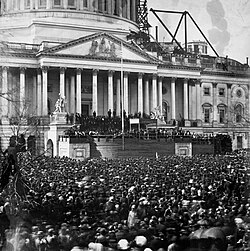
While working in Washington, D.C., Whitman observed Lincoln's first inauguration, later recalling the president-elect's solemn demeanor as the nation stood on the brink of civil war.
Image source: First inauguration of Abraham Lincoln
Dec 16, 1862
% complete
Seeing his brother George listed as wounded, Whitman rushed to the front in Virginia. Finding George only lightly wounded, he was nevertheless moved by the suffering of wounded soldiers and decided to stay.
Jan 1, 1863 - Jun 30, 1865
% complete
To support himself while nursing soldiers, Whitman worked as a clerk in the Army Paymaster's Office in Washington, D.C., and later at the Bureau of Indian Affairs in the Interior Department.
Jan 1, 1863 - Dec 31, 1865
% complete
Whitman volunteered as a nurse in Washington military hospitals, comforting thousands of sick and wounded Union soldiers, writing letters home for them, and bringing small gifts and cheer.
Apr 15, 1865
% complete
Following Lincoln's assassination, Whitman wrote 'O Captain! My Captain!', his most famous poem, an elegy comparing Lincoln to a fallen ship captain. It appeared in Sequel to Drum-Taps in late 1865.
Image source: O Captain! My Captain!
Oct 1, 1865
% complete
Whitman published Drum-Taps, a collection of Civil War poems including 'Beat! Beat! Drums!' and 'Vigil Strange I Kept on the Field One Night,' capturing the war's human cost with unflinching realism.
Image source: Drum-Taps
Jun 30, 1865
% complete
Interior Secretary James Harlan dismissed Whitman after finding Leaves of Grass morally offensive. His friend William O'Connor defended him in the pamphlet 'The Good Gray Poet' and helped him obtain a post at the Attorney General's office.
Jan 1, 1868
% complete
William Michael Rossetti published a selection of Whitman's poems in England, launching a devoted British following that included Anne Gilchrist, who corresponded warmly with Whitman and championed his work.
Image source: William Michael Rossetti
Feb 1, 1873
% complete
Whitman suffered a serious stroke that left him partially paralyzed. That same year his mother died, devastating him, and he moved to Camden, New Jersey, near his brother George.
Sep 1, 1873
% complete
After his stroke and his mother's death, Whitman settled in Camden, New Jersey, living with his brother before purchasing his own modest rowhouse on Mickle Street, where he spent his final years.
Jan 1, 1876 - Dec 31, 1884
% complete
Whitman formed a deep friendship with Harry Stafford, a young working-class man in Camden, sustained by affectionate letters and gifts throughout the 1870s and early 1880s.
Mar 1, 1885
% complete
With help from friends, Whitman purchased the modest three-room house at 330 Mickle Street, Camden — the only home he ever owned — where he received visitors and literary admirers.
Image source: Walt Whitman House
Mar 26, 1892
% complete
Walt Whitman died of pleurisy at his Mickle Street home in Camden at age 72. An open-casket funeral attended by more than a thousand mourners was held at his home, and he was buried in Harleigh Cemetery.
Or browse the full history timeline directory, with more than 2,000 topics.
This Walt Whitman timeline was generated with the help of AI, using information found on the internet.
We work hard to keep these timelines accurate, but mistakes do get through. If you spot one, email us at [email protected] and we'll fix it for future visitors.
Generate yours with AI or build it from scratch, for free.
Export your timeline, add your own events, edit or remove AI-generated events, and much more
No credit card required.
Cancel anytime.
Cancel anytime.
You can create an unlimited number of timelines with up to 10 events on each one, customize how they look, export them to PDF, PNG, PowerPoint, CSV, and Excel, and share them with a link. Paid plans raise the event limit and add features like spreadsheet imports and collaborators.
Yes. You can cancel your subscription from your account page at any time, and you will not be charged again. Your subscription stays active for the rest of the period you already paid for.
Yes. We will email you a reminder before the annual renewal, and we will also email you a receipt.
Yes. You can email us within 15 days of any payment, and we will issue you a full refund.
Check out our pricing docs or send us an email anytime: [email protected].