
-
Use Cases
-
Resources
-
Pricing
7000 BC
Based on dental evidence, Irish's 2016 conclusion placed possible common ancestors of West African and Proto-Bantu peoples in the western Sahara during the Kiffian period at Gobero.
Image source: Gobero
7000 BC
The proposed ancestral population may have migrated southward from the Sahara into areas including Benin, Cameroon, Ghana, Nigeria, and Togo as the Green Sahara underwent desertification around 7000 BC.
Image source: African humid period
5000 BC
The oldest pottery identified in an area inhabited by Bantu speakers was found at Shum Laka in northern Cameroon and dates to approximately 5000 BC.
3000 BC - 2026 AD
Archaeological evidence from the separate works of Jean Hurault and Rigobert Tueché indicates cultural continuity in the region from 3000 BC until today.
26 BC - 2026 AD
The Bamenda highlands are described as having been occupied for 2000 years until today, placing their long-term occupation from approximately 26 BC through the present.
26 BC - 2026 AD
The majority of groups in the Bamenda highlands are described as having an ancient history of descent from the north, in the direction of the Mambilla region.
26 BC - 2026 AD
The Bamenda highlands are somewhat south of and contiguous with the Mambilla region, which is presented as the direction of ancient northern descent for many Bamenda groups.
1979
Jean Hurault's 1979 work is among the archaeological studies cited as evidence for cultural continuity from 3000 BC until today.
1986
Jean Hurault's 1986 work is cited alongside other archaeological research supporting the interpretation of long-term cultural continuity.
1988
Jean Hurault's 1988 work forms part of the archaeological evidence cited for continuity in the region through the present.
2000
Rigobert Tueché's 2000 work is cited with Hurault's studies as evidence of cultural continuity from 3000 BC until today.
Image source: Bantu peoples
5000 BC - 3000 BC
Archaeological sites south of Shum Laka, in southern Cameroon and Gabon, indicate that the Western Stream of the Bantu expansion began between 5000 and 3000 BC.
Image source: Bantu expansion
5000 BC - 3000 BC
Evidence from sites in Gabon is included in the archaeological indications that the Western Stream began during the period from 5000 to 3000 BC.
2500 BC - 1200 BC
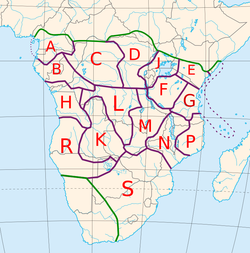
Amid migration from Nigeria and Cameroon, one branch diverged toward the eastern Bantu-speaking regions, including the area that is now the Democratic Republic of the Congo.
2500 BC - 1200 BC
Agricultural Proto-Bantu peoples began migrating from the Nigeria–Cameroon region during the broad period from 2500 to 1200 BC.
2500 BC - 1200 BC
Nigeria is identified as one of the source areas from which agricultural Proto-Bantu peoples began their migrations between 2500 and 1200 BC.
2500 BC - 1200 BC
Cameroon is identified as a source region for agricultural Proto-Bantu migration during the period between 2500 and 1200 BC.
2500 BC - 1200 BC
A western branch of the migrating Proto-Bantu peoples developed toward regions including the Congo and Gabon.
2000 BC - 500 BC
A period of climate change affected the West-Central African rainforest between 2000 and 500 BC, creating conditions thought to have supported Bantu expansion.
2000 BC - 500 BC
Climate-related degradation of the West-Central African rainforest between 2000 and 500 BC is thought to have aided the expansion.
1500 BC
Initial progress of the expansion was very slow, and central Cameroon was only reached around 1500 BC.
1000 BC
Herding practices reached the far south several centuries before Bantu-speaking migrants did, indicating that pastoral practices preceded the relevant Bantu-speaking migration there.
100 BC
By the first century BC, Bantu-speaking communities in the Great Lakes region had developed iron-forging techniques.
100 BC
The iron-forging techniques developed by Great Lakes Bantu-speaking communities by the first century BC enabled them to produce carbon steel.
Image source: Iron metallurgy in Africa
1000 AD
Some Eastern Cushitic speakers also settled along the Kenyan coast around 1000 AD.
1000 AD
Northern Kenya became a settlement area for some Eastern Cushitic speakers around 1000 AD.
1000 AD
Many centuries after the earlier phases of expansion, some Eastern Cushitic speakers settled in northern and coastal Kenya around 1000 AD.
1966
In 1966, Roland Oliver published an article presenting correlations concerning the Bantu migration as a reasonable hypothesis.
2016
Irish's 2016 dental analysis concluded that the common ancestors of West African and Proto-Bantu peoples may have originated in the western Sahara.
2023
A 2023 genetic study sampled 1,487 Bantu speakers from 143 populations across 14 African countries.
2023
The 2023 genetic study concluded that the expansion occurred approximately 4,000 years ago in Western Africa.
2024
Seidensticker's 2024 work indicates that the prevalent paradigm forcibly connects Central African ceramics with Central African languages and treats the locations of language speakers and ceramic remains as synonymous.
2024
Seidensticker argues that attempts to correlate linguistic reconstructions with archaeological data have propagated the faulty presumption that the earliest ceramics in an area prove the earliest presence of Bantu speakers, producing circular reasoning.
Or browse the full history timeline directory, with more than 2,500 topics.
This Bantu Migration timeline was generated with the help of AI, using information found on the internet.
We work hard to keep these timelines accurate, but mistakes do get through. If you spot one, email us at [email protected] and we'll fix it for future visitors.
Generate yours with AI or build it from scratch, for free.
Export your timeline, add your own events, edit or remove AI-generated events, and much more
No credit card required.
Cancel anytime.
Cancel anytime.
You can create an unlimited number of timelines with up to 10 events on each one, customize how they look, export them to PDF, PNG, PowerPoint, CSV, and Excel, and share them with a link. Paid plans raise the event limit and add features like spreadsheet imports and collaborators.
Yes. You can cancel your subscription from your account page at any time, and you will not be charged again. Your subscription stays active for the rest of the period you already paid for.
Yes. We will email you a reminder before the annual renewal, and we will also email you a receipt.
Yes. You can email us within 15 days of any payment, and we will issue you a full refund.
Check out our pricing docs or send us an email anytime: [email protected].