-
Use Cases
-
Resources
-
Pricing
Early Human Migration refers to the prehistoric movements of Homo sapiens and earlier hominins from their origins in Africa to populate the rest of the world. Beginning roughly 200,000–300,000 years ago in Africa, humans migrated into the Middle East, Asia, Europe, Australia, and eventually the Americas, adapting to diverse environments along the way. More Less
200,000 BCE
% complete
The Omo remains, excavated between 1967 and 1974 in Omo National Park, Ethiopia, and dated to 200,000 years ago, were long held to be the oldest known fossils of Homo sapiens.
Image source: Omo remains
28,500 BCE
% complete
Evidence of early Homo sapiens was found at the site of Byzovaya in the Urals (Komi Republic), based on 2011 excavations at this northern location.
Image source: Komi cuisine
Jul 2019
% complete
In July 2019, anthropologists reported the discovery of 210,000-year-old remains of a Homo sapiens, among the oldest known outside Africa.
Image source: Apidima Cave
50,000 BCE
% complete
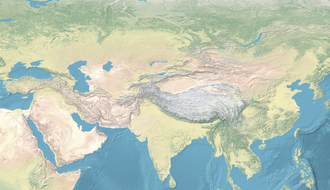
Yang (in 2022) concluded that a distinctive 'Basal-East Asian population', referred to as the 'East- and Southeast Asian lineage' (ESEA), ancestral to modern East Asians, Southeast Asians, Polynesians, and Siberians, originated in Mainland Southeast Asia at around 50,000 BC and expanded through multiple migration waves southwards and northwards.
Image source: Early human migrations
30,000 BCE
% complete
A 2013 study associated several phenotypical traits associated with Mongoloids with a single mutation of the EDAR gene, dated to around 30,000 years ago.
2013
% complete
A 2013 study found Neanderthal introgression of 18 genes within the chromosome 3p21.31 region (HYAL region) of East Asians.
Image source: Interbreeding between archaic and modern humans
2016
% complete
Some evidence, including a 2016 study by Busby et al., suggests admixture from ancient and recent migrations from Eurasia into parts of Sub-Saharan Africa.
Image source: Sub-Saharan Africa
2016
% complete
A 2016 study presented an analysis of the population genetics of the Ainu people of northern Japan as key to the reconstruction of the early peopling of East Asia.
Image source: Ainu people
2017
% complete
A 2017 study of the ancient DNA of Tianyuan Man found that the individual is related to modern Asian and Native American populations.
Image source: Tianyuan man
2018
% complete
Research published in 2018 shows that ancient Eurasians migrated into Africa and that Eurasian admixture in modern Sub-Saharan Africans ranges from 0% to 50%, varying by region and generally higher in the Horn of Africa and parts of the Sahel zone, and found to a lesser degree in parts of Western and Southern Africa.
40,000 BCE
% complete
Evidence published in 2014 from genome analysis of ancient human remains suggests that modern native populations of Europe partly descend from 'Western Hunter-Gatherers', derivative of the Cro-Magnon population of Europe.
Image source: Western hunter-gatherer
7000 BCE
% complete
Genome evidence published in 2014 shows that Early European Farmers were introduced to Europe from the Near East during the Neolithic Revolution, forming one of three distinct lineages contributing to modern European populations.
Image source: Early European Farmers
4000 BCE
% complete
Evidence published in 2014 indicates that Ancient North Eurasians expanded to Europe in the context of the Indo-European expansion, forming the third major lineage contributing to modern native populations of Europe.
Image source: Ancient North Eurasian
4000 BCE - 3500 BCE
% complete
The oldest remains in the Caribbean are known from the Greater Antilles (Cuba and Hispaniola) dating between 4000 and 3500 BCE, and comparisons between tool technologies suggest these peoples moved across the Yucatán Channel from Central America.
Image source: History of the Caribbean
2000 BCE
% complete
All evidence suggests that later migrants to the Caribbean from 2000 BCE and onwards originated from South America, via the Orinoco region.
1000 CE
% complete
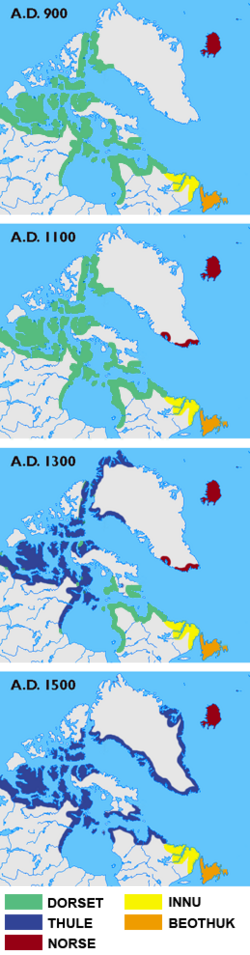
The Thule culture emerged from western Alaska around CE 1000, giving rise to the ancestors of the modern Inuit.
Image source: Thule people
1000 CE - 1500 CE
% complete
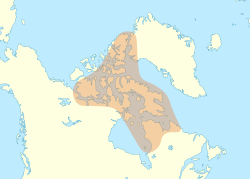
The Inuit are the descendants of the Thule culture, which emerged from western Alaska around CE 1000 and gradually displaced the Dorset culture across the Arctic.
Image source: Dorset culture
3000 BCE - 1500 BCE
% complete
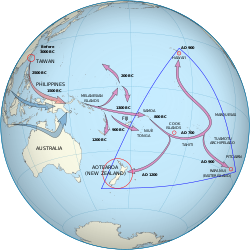
Using advanced sailing technologies like catamarans, outrigger boats, and crab claw sails, the Austronesians built the first sea-going ships and rapidly colonized Island Southeast Asia at around 3000 to 1500 BCE.
Image source: Austronesian peoples
2200 BCE - 1000 BCE
% complete
From the Philippines and Eastern Indonesia, the Austronesians colonized Micronesia by 2200 to 1000 BCE.
Image source: Micronesia
1600 BCE - 1000 BCE
% complete
A branch of the Austronesians reached Island Melanesia between 1600 and 1000 BCE, establishing the Lapita culture, named after the archaeological site in Lapita, New Caledonia, where their characteristic pottery was first discovered.
Image source: Lapita culture
1500 BCE
% complete
Back-migrations from the Lapita culture merged back into Island Southeast Asia in 1500 BCE.
1200 BCE
% complete
The Austronesians ventured into Remote Oceania, reaching Vanuatu, New Caledonia, and Fiji by 1200 BCE.
Image source: Near Oceania and Remote Oceania
900 BCE - 800 BCE
% complete
The Austronesians continued into Remote Oceania, reaching Samoa and Tonga by around 900 to 800 BCE.
Image source: Polynesians
200 BCE
% complete
Back-migrations from the Lapita culture also merged back into Micronesia at around 200 BCE.
900 CE
% complete
From their Polynesian homelands, Austronesian voyagers further colonized Hawaii by 900 CE.
Image source: Native Hawaiians
1000 CE
% complete
Polynesian voyagers reached and colonized Rapa Nui (Easter Island) by 1000 CE, one of the most remote inhabited islands on Earth.
Image source: Rapa Nui people
1200 CE
% complete
Polynesians completed their remarkable maritime expansion by colonizing New Zealand by 1200 CE, becoming the ancestors of the Māori people.
Image source: Māori people
Or browse the full history timeline directory, with more than 2,000 topics.
This Early Human Migration timeline was generated with the help of AI, using information found on the internet.
We work hard to keep these timelines accurate, but mistakes do get through. If you spot one, email us at [email protected] and we'll fix it for future visitors.
Generate yours with AI or build it from scratch, for free.
Export your timeline, add your own events, edit or remove AI-generated events, and much more
No credit card required.
Cancel anytime.
Cancel anytime.
You can create an unlimited number of timelines with up to 10 events on each one, customize how they look, export them to PDF, PNG, PowerPoint, CSV, and Excel, and share them with a link. Paid plans raise the event limit and add features like spreadsheet imports and collaborators.
Yes. You can cancel your subscription from your account page at any time, and you will not be charged again. Your subscription stays active for the rest of the period you already paid for.
Yes. We will email you a reminder before the annual renewal, and we will also email you a receipt.
Yes. You can email us within 15 days of any payment, and we will issue you a full refund.
Check out our pricing docs or send us an email anytime: [email protected].