-
Use Cases
-
Resources
-
Pricing
The Human Genome Project (HGP) was an international scientific research effort, launched in 1990 and completed in 2003, with the goal of sequencing all three billion base pairs of human DNA. Led by the U.S. National Institutes of Health and Department of Energy, alongside international partners including the UK, Japan, France, Germany, and China, the project identified roughly 20,000-25,000 human genes and made the data freely available to scientists worldwide. It transformed biology, enabling advances in medicine, genetics, biotechnology, and personalized healthcare. More Less
1974
% complete
The gene mapping technique of restriction fragment length polymorphism (RFLP) arose from Mark Skolnick's search at the University of Utah for the location of the breast cancer gene, which began in 1974.
Image source: Human Genome Project

1977
% complete
In 1977, Walter Gilbert, Frederick Sanger, and Paul Berg invented methods of sequencing DNA, providing the fundamental technical foundation that would later make the Human Genome Project possible.
Image source: DNA sequencing
May 1985
% complete
In May 1985, Robert L. Sinsheimer convened a meeting of scientists to discuss the feasibility of sequencing the human genome, an early step in building momentum for a large-scale genome project.
1986
% complete
A long chain of events led to approved reprogramming of funds enabling OHER to launch the project in 1986. In spring 1986, Trivelpiece used a chart to brief Martin and Under Secretary Joseph Salgado about his intention to reprogram $4 million with John S. Herrington's approval.
Mar 1986
% complete
In March 1986, the Santa Fe Workshop was organized by Charles DeLisi and David Smith of the Department of Energy's Office of Health and Environmental Research (OHER), helping shape plans for the project.
1990
% complete
In 1990, the two major funding agencies, the Department of Energy and the National Institutes of Health, developed a memorandum of understanding to coordinate plans and set the clock for the initiation of the Project to 1990.
1988
% complete
The first line item for the Human Genome Project appeared in President Reagan's 1988 budget submission and was ultimately approved by Congress, following a line item budget of $13 million in the 1987 submission.
1990
% complete
To address ethical concerns, the Ethical, Legal, and Social Implications (ELSI) program was founded in 1990. Its budget started at approximately $1.57 million but increased to approximately $18 million by 2014.
1996
% complete
In 1996, the United States passed the Health Insurance Portability and Accountability Act (HIPAA), which protects against the unauthorized and non-consensual release of individually identifiable health information to entities not actively engaged in healthcare provision.
Image source: Health Insurance Portability and Accountability Act
Jul 2024
% complete
In July 2024, an investigation by Undark Magazine, co-published with STAT News, revealed for the first time several ethical lapses by the scientists spearheading the Human Genome Project.
Oct 1, 1990 - Apr 14, 2003
% complete
Planning for the project began in 1984 by the US government, and it officially launched in 1990. The $3 billion, publicly funded 13-year project was founded by the US Department of Energy and the National Institutes of Health, aiming to determine the DNA sequence of the entire euchromatic human genome.
1993
% complete
In 1993, Aristides Patrinos succeeded Galas and Francis Collins succeeded Watson, assuming the role of overall Project Head as Director of the NIH National Center for Human Genome Research, which would later become the National Human Genome Research Institute.
Image source: Francis Collins
1996
% complete
The 1996 Bermuda Statement established terms for releasing genomic data. Celera later promised to publish findings in accordance with these terms by releasing new data annually, though unlike the publicly funded HGP, which released data daily, they would not permit free redistribution or scientific use of the data.
1998
% complete
A parallel project was conducted outside the government by the Celera Corporation, or Celera Genomics, which was formally launched in 1998 under American researcher Craig Venter.
Image source: Celera Corporation
1998
% complete
In 1998, a similar, privately funded quest to sequence the human genome was launched by American researcher Craig Venter and his firm Celera Genomics, creating a competitive race with the public Human Genome Project.
Image source: Craig Venter
Mar 2000
% complete
In March 2000, President Bill Clinton, along with Prime Minister Tony Blair in a dual statement, urged that all researchers who wished to research the sequence should have 'unencumbered access' to the genome sequence.
Jun 26, 2000
% complete
Because of widespread international cooperation, advances in genomics, and parallel advances in computing technology, a rough draft of the genome was finished in 2000, announced jointly by US President Bill Clinton and British Prime Minister Tony Blair on 26 June 2000.
Jul 7, 2000
% complete
On 7 July 2000, the UCSC Genome Bioinformatics Group released the first working draft of the human genome on the web, making the sequence freely accessible to researchers worldwide.
Feb 2001
% complete
Although the working draft was announced in June 2000, it was not until February 2001 that Celera and the HGP scientists published details of their drafts. At that time, press releases announced the project had been completed by both groups.
Apr 14, 2003
% complete
Ongoing sequencing led to the announcement of the essentially complete genome on 14 April 2003, two years earlier than planned. The declaration included about 92% of the genome.
May 27, 2004
% complete
Although the 2003 completion reportedly covered 99% of the euchromatic human genome with 99.99% accuracy, a major quality assessment published on 27 May 2004 indicated over 92% of sampling exceeded 99.99% accuracy, within the intended goal.
2005
% complete
Improved drafts were announced in 2003 and 2005, filling in to approximately 92% of the sequence currently, while genome 'finishing' work continued for more than a decade after the initial completion.
May 2006
% complete
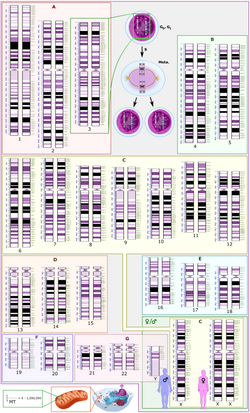
In May 2006, another milestone was passed when the sequence of the very last chromosome was published in Nature, marking significant progress toward full completion of the project.
Image source: Chromosome 1
Mar 2009
% complete
In March 2009, the Genome Reference Consortium (GRC) released a more accurate version of the human genome, but it still left more than 300 gaps, while 160 such gaps remained in 2015.
Image source: Reference genome
2020
% complete
Months after May 2020, the application of new long-range sequencing techniques and a hydatidiform mole-derived cell line in which both copies of each chromosome are identical led to the first telomere-to-telomere, truly complete sequence of a human chromosome, the X chromosome.
Image source: Whole genome sequencing
May 2020
% complete
Though in May 2020 the GRC reported 79 'unresolved' gaps, accounting for as much as 5% of the human genome, new techniques soon began closing them using long-range sequencing and special cell lines.
May 2021
% complete
Level 'complete genome' was achieved in May 2021, with only 0.3% of the bases covered by potential issues, representing a major advance over earlier drafts of the human genome.
Jan 2022
% complete
The full gapless sequence containing 22 autosomes and the X chromosome was published in January 2022 by the Telomere-to-Telomere (T2T) consortium, making it the first fully sequenced human genome and highlighting the 8% of the genome the original HGP had not sequenced.
Apr 2022
% complete
In April 2022, the Telomere-to-Telomere (T2T) consortium published a complete sequence of the non-Y chromosomes, further emphasizing the portion of the human genome left unsequenced by the original HGP.
Aug 2023
% complete
The full sequence of the Y chromosome was only published in August 2023 due to challenges with sequencing and assembling caused by its highly repetitive nature. Rhie et al. completed this final piece of the puzzle.
Image source: Y chromosome
2008
% complete
Beginning in 2008, a new technology known as RNA-seq was introduced that allowed scientists to directly sequence the messenger RNA in cells, expanding the impact of genomics beyond DNA sequencing.
Image source: RNA-Seq
2023
% complete
By 2023, the speed record for sequencing a genome was around five hours; more often, however, it takes weeks — a dramatic improvement over the years-long effort of the original Human Genome Project.
Image source: Whole genome sequencing
Or browse the full history timeline directory, with more than 2,000 topics.
This History of the Human Genome Project timeline was generated with the help of AI, using information found on the internet.
We work hard to keep these timelines accurate, but mistakes do get through. If you spot one, email us at [email protected] and we'll fix it for future visitors.
Generate yours with AI or build it from scratch, for free.
Export your timeline, add your own events, edit or remove AI-generated events, and much more
No credit card required.
Cancel anytime.
Cancel anytime.
You can create an unlimited number of timelines with up to 10 events on each one, customize how they look, export them to PDF, PNG, PowerPoint, CSV, and Excel, and share them with a link. Paid plans raise the event limit and add features like spreadsheet imports and collaborators.
Yes. You can cancel your subscription from your account page at any time, and you will not be charged again. Your subscription stays active for the rest of the period you already paid for.
Yes. We will email you a reminder before the annual renewal, and we will also email you a receipt.
Yes. You can email us within 15 days of any payment, and we will issue you a full refund.
Check out our pricing docs or send us an email anytime: [email protected].