-
Use Cases
-
Resources
-
Pricing
1848
% complete
Neanderthal fossils were discovered in Gibraltar even earlier than the famous 1856 find, but it was originally claimed that these were the remains of a modern human who had suffered some kind of illness, delaying recognition of a distinct archaic human species.
Image source: Neanderthal
1856
% complete
Neanderthal remains were discovered in a limestone quarry in 1856, three years before the publication of On the Origin of Species. These fossils became central to later debates about human evolution and interbreeding between humans and archaic relatives.
1891
% complete
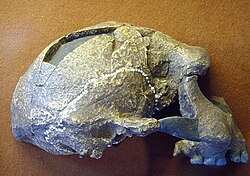
The first fossils of Homo erectus were discovered by Dutch physician Eugene Dubois in 1891 on the Indonesian island of Java. He originally named the material Anthropopithecus erectus (1892–1893) and then Pithecanthropus erectus (1893–1894), considering its morphology intermediate between humans and apes.
Image source: Java Man
1907
% complete
In 1907, miners in Germany discovered the Mauer mandible, a very primitive fossilized jaw. In 2009, a study reevaluated the Mauer mandible against other fossilized remains to determine where Homo heidelbergensis sits on the human evolutionary scale.
Image source: Mauer 1
1921
% complete
In 1921, a cranium was found in cave deposits during a mining excursion in what is now known as Zambia, adding an important specimen to the record of archaic humans in Africa.
Image source: Kabwe 1
1974
% complete
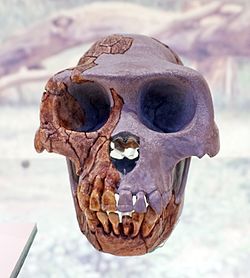
In the late 1970s and the 1980s, Ethiopia emerged as the new hot spot of paleoanthropology after Lucy, the most complete fossil member of the species Australopithecus afarensis, was found in 1974 by Donald Johanson near Hadar in the Afar Triangle region of northern Ethiopia.
Image source: Lucy (Australopithecus)
1994
% complete
In 1994, researchers in Italy discovered skull fragments, contributing another important piece of evidence to the European record of archaic humans.
Image source: Ceprano Man
Feb 2006
% complete
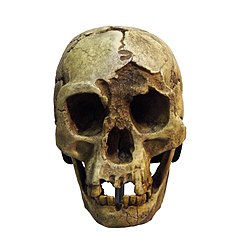
In February 2006 a fossil, the Gawis cranium, was found which might possibly be a species intermediate between Homo erectus and anatomically modern humans, offering insight into the transition within the genus Homo.
Image source: Gawis cranium
2008
% complete
In 2008, archaeologists working at Denisova Cave in the Altai Mountains of Siberia uncovered a small bone fragment from the fifth finger of a juvenile member of another human species, the Denisovans, known mostly through genetic evidence.
Image source: Denisovan
2016
% complete
In 2016, fossil teeth and a partial jaw from hominins assumed to be ancestral to Homo erectus were reported, shedding light on the origins of this long-lived and widespread human species.
Image source: Homo erectus
Sep 2019
% complete
In September 2019, scientists reported the computerized determination, based on 260 CT scans, of a virtual skull shape of the last common human ancestor to modern humans, providing a model of what our immediate ancestor may have looked like.
Image source: Human evolution
1859
% complete
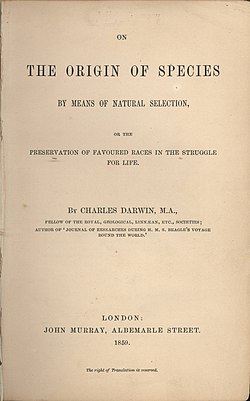
The possibility of linking humans with earlier apes by descent became clear only after 1859 with the publication of Charles Darwin's On the Origin of Species, in which he argued for the idea of the evolution of new species from earlier ones.
Image source: On the Origin of Species
1863
% complete
Thomas Huxley argued for human evolution from apes by illustrating many of the similarities and differences between humans and other apes in his 1863 book Evidence as to Man's Place in Nature.
Image source: Man's Place in Nature
1870 - 1899
% complete
A major problem in the 19th century was the lack of fossil intermediaries. Despite early Neanderthal finds and Dubois' Java Man, it was only in the 1920s when such fossils were discovered in Africa that intermediate species began to accumulate.
1871
% complete
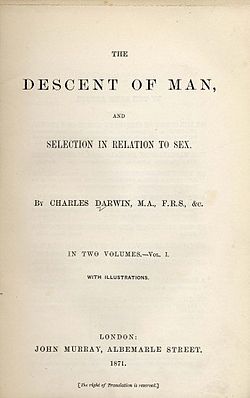
Darwin applied the theory of evolution and sexual selection to humans in his 1871 book The Descent of Man, and Selection in Relation to Sex, extending his evolutionary framework to humanity itself.
Image source: The Descent of Man, and Selection in Relation to Sex
1940
% complete
Franz Weidenreich compared in detail the characters of Dubois' Java Man, then named Pithecanthropus erectus, with Peking Man, then named Sinanthropus pekinensis. He concluded in 1940 that because of their anatomical similarity with modern humans, all these specimens should be gathered in a single species of the genus Homo.
1988
% complete
This model was proposed in 1988 by Milford H. Wolpoff, suggesting that modern humans evolved across multiple regions of the Old World with gene flow between populations, in contrast to recent African origin models.
Image source: Multiregional origin of modern humans
1994
% complete
In 1994, Randall Susman used the anatomy of opposable thumbs as the basis for his argument that both the Homo and Paranthropus species were toolmakers, expanding views on which hominins manufactured stone tools.
Image source: Paranthropus
2007
% complete
A 2007 study provides support for the hypothesis that bipedalism evolved because it used less energy than quadrupedal knuckle-walking, offering an adaptive explanation for one of humanity's defining traits.
Image source: Bipedalism
2022
% complete
Encephalization has been tied to increased starches and meat in the diet; however, a 2022 meta study called into question the role of meat in driving the evolution of larger brains in the human lineage.
May 2023
% complete
In May 2023, scientists reported a more complicated pathway of human evolution than previously understood, reflecting discoveries since 2010 showing that human evolution should not be seen as a simple linear or branched progression, but a mix of related species.
1925
% complete
In 1925, Raymond Dart described Australopithecus africanus, one of the first hominin species recognized from Africa, helping to establish Africa as a key region for understanding human origins.
Image source: Australopithecus africanus
1994
% complete
In 1994, Meave Leakey discovered Australopithecus anamensis, an early bipedal hominin species that extended knowledge of the earliest stages of human evolution in East Africa.
Image source: Australopithecus anamensis
1995
% complete
White's 1995 discovery of Ardipithecus ramidus pushed back the fossil record to 4.2 million years ago, revealing an earlier stage of hominin evolution closer to the human-chimpanzee split.
Image source: Ardipithecus ramidus
2000
% complete
In 2000, Martin Pickford and Brigitte Senut discovered, in the Tugen Hills of Kenya, a 6-million-year-old bipedal hominin which they named Orrorin tugenensis, among the oldest known potential human ancestors.
Image source: Orrorin
2001
% complete
In 2001, a team led by Michel Brunet discovered the skull of Sahelanthropus tchadensis, dated to 7.2 million years ago, which Brunet argued was a bipedal hominin, pushing back the possible origin of the human lineage.
Image source: Sahelanthropus
2003
% complete
Found in 2003 and dated to approximately 18,000 years old, this small-bodied hominin from Flores, Indonesia, had a brain size far below the modern Homo sapiens average of 1400 cm3, demonstrating surprising diversity in late-surviving human relatives.
Image source: Homo floresiensis
2010
% complete
In 2010, Saadanius was described as a close relative of the last common ancestor of the crown catarrhines, tentatively dated to 29–28 million years ago, helping to fill an 11-million-year gap in the fossil record.
Image source: Saadanius
May 2010
% complete
In May 2010, a new species, Homo gautengensis, was proposed based on specimens discovered in South Africa, adding to the growing diversity of recognized species within the genus Homo.
Image source: Homo gautengensis
2013
% complete
In 2013, fossil skeletons of Homo naledi, an extinct species of hominin provisionally assigned to the genus Homo, were found in the Rising Star Cave system in South Africa's Cradle of Humankind region near Johannesburg. As of September 2015, fossils of at least fifteen individuals, amounting to 1,550 specimens, had been excavated.
Image source: Homo naledi
1967
% complete
In their seminal 1967 paper in Science, Sarich and Wilson estimated the divergence time of humans and apes as four to five million years ago, at a time when standard interpretations of the fossil record gave this divergence as at least 10 to as much as 30 million years.
2006
% complete
Patterson (2006) dated the final divergence between humans and chimpanzees at 5 to 6 million years ago, refining estimates of when the two lineages separated.
2010
% complete
Sequencing of the Neanderthal genome in 2010 indicated that Neanderthals did indeed interbreed with anatomically modern humans during the Middle Paleolithic and early Upper Paleolithic, confirming long-debated hybridization between human species.
Image source: Neanderthal genetics
2012
% complete
A 2012 study in Iceland of 78 children and their parents suggests a mutation rate of only 36 mutations per generation; this datum extends the separation between humans and chimpanzees to an earlier period greater than 7 million years ago.
2016
% complete
Sergi Castellano of the Max Planck Institute reported in 2016 that while Denisovan and Neanderthal genomes are more related to each other than to ours, Siberian Neanderthal genomes show more similarity to modern human genes than do European Neanderthal populations.
Image source: Interbreeding between archaic and modern humans
2016
% complete
In a 2016 comparative genomics study, a Harvard Medical School/UCLA research team made a world map of the distribution of Denisovan and Neanderthal genes and made predictions about where they may be impacting modern human biology.
2023
% complete
A 2023 genetic study suggests that a similar human population bottleneck of between 1,000 and 100,000 survivors occurred around 930,000 and 813,000 years ago, indicating a dramatic reduction in ancestral human population size.
Image source: Population bottleneck
Or browse the full history timeline directory, with more than 2,000 topics.
This Human Evolution timeline was generated with the help of AI, using information found on the internet.
We work hard to keep these timelines accurate, but mistakes do get through. If you spot one, email us at [email protected] and we'll fix it for future visitors.
Generate yours with AI or build it from scratch, for free.
Export your timeline, add your own events, edit or remove AI-generated events, and much more
No credit card required.
Cancel anytime.
Cancel anytime.
You can create an unlimited number of timelines with up to 10 events on each one, customize how they look, export them to PDF, PNG, PowerPoint, CSV, and Excel, and share them with a link. Paid plans raise the event limit and add features like spreadsheet imports and collaborators.
Yes. You can cancel your subscription from your account page at any time, and you will not be charged again. Your subscription stays active for the rest of the period you already paid for.
Yes. We will email you a reminder before the annual renewal, and we will also email you a receipt.
Yes. You can email us within 15 days of any payment, and we will issue you a full refund.
Check out our pricing docs or send us an email anytime: [email protected].