-
Use Cases
-
Resources
-
Pricing
The evolution of horses is one of the most well-documented examples of evolutionary change in the fossil record. Over roughly 55 million years, horses evolved from small, multi-toed forest-dwelling animals like Eohippus (Hyracotherium) into large, fast, single-toed grazers such as modern Equus. This transformation was driven by environmental changes, particularly the spread of grasslands, which favored longer legs, larger bodies, and high-crowned teeth adapted for grazing. More Less
10000 BC
% complete
Horses became extinct in North America about 10,000 years ago, at the end of the Pleistocene, likely due to a combination of climate change and human hunting pressure.
Image source: Evolution of the horse
10000 BC
% complete
The disappearance of native horses from the Americas roughly 10,000 years ago left the continent without equids for millennia until their eventual reintroduction by European colonists in the 15th century.
1493
% complete
Beginning in 1493, Spanish colonists transported domestic horses from Europe back to the Americas, reversing the species' ancient extinction on the continent.
Image source: Spanish colonization of the Americas
1493
% complete
When Spanish colonists brought domestic horses from Europe beginning in 1493, escaped animals quickly established large feral herds that spread widely across the Americas.
Image source: Wild horse
1493
% complete
The first Iberian horses returned to the New World when they were landed on Hispaniola, establishing the initial breeding stock for later expansion throughout the Caribbean and mainland.
Image source: Horses in the United States
1493
% complete
Horses only returned to the Americas with Christopher Columbus in 1493, marking the end of an absence of roughly ten thousand years following their prehistoric extinction there.
Image source: Christopher Columbus
1493 - 1538
% complete
From Hispaniola, Iberian horses were carried to Panama, Mexico, Brazil, Peru, Argentina, and eventually Florida, rapidly reestablishing horses across both American continents.
1493 - 1538
% complete
As Spanish colonization expanded southward, Iberian horses were brought to Peru and Argentina, laying the foundation for the great South American herds.
1519
% complete
The first horses to return to the main continental landmass were 17 horses brought by the expedition of Hernán Cortés in 1519 during his conquest of Mexico.
Image source: Hernán Cortés
1519
% complete
In 1519 Hernán Cortés's expedition delivered seventeen horses to the Mexican mainland, making them the first horses back on the main continent since the Pleistocene extinctions.
1538
% complete
In 1538, Iberian horses were brought to Florida as part of the continuing spread of Spanish colonization, completing the reintroduction of horses across much of the New World.
1807
% complete
William Clark's 1807 expedition to Big Bone Lick found 'leg and foot bones of the Horses', which were included with other fossils sent to Thomas Jefferson and evaluated by the anatomist Caspar Wistar.
Image source: Big Bone Lick State Park
1807
% complete
The horse leg and foot bones recovered at Big Bone Lick by William Clark were sent along with other fossils to Thomas Jefferson and examined by anatomist Caspar Wistar, but neither commented on the significance of the find.
Oct 10, 1833
% complete
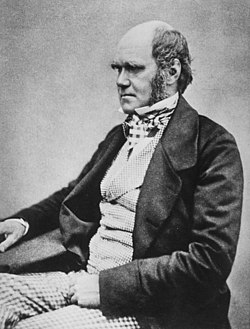
On 10 October 1833, at Santa Fe, Argentina, Charles Darwin was 'filled with astonishment' when he found a horse's tooth in the same stratum as fossil giant armadillos, and wondered if it might have been washed down from a later layer.
Image source: Charles Darwin
Oct 10, 1833
% complete
After finding the horse tooth at Santa Fe alongside giant armadillo fossils, Darwin considered whether it might have washed down from a later stratum but concluded this was 'not very probable'.
1879
% complete
In 1879, paleontologist Othniel Charles Marsh discovered fossils in North America that formed the original sequence of species believed to have evolved into the modern horse.
Image source: Othniel Charles Marsh
1981
% complete
A species originally thought to be monodactyl was shown by a 1981 fossil find in Nebraska to include some tridactyl individuals, complicating assumptions about toe reduction in horse evolution.
Image source: Merychippus
1836
% complete
After the Beagle expedition returned in 1836, anatomist Richard Owen confirmed Darwin's tooth came from an extinct species, which he named Equus curvidens, noting its remarkable second introduction into South America.
Image source: Richard Owen
1836
% complete
Richard Owen named the extinct horse Equus curvidens based on Darwin's find, remarking that this evidence of a former genus, once extinct in South America and twice introduced, was among the most interesting fruits of Darwin's voyage.
1848
% complete
In 1848, Joseph Leidy published 'On the fossil horses of America', systematically examining Pleistocene horse fossils from various collections, including that of the Academy of Natural Sciences.
Image source: Joseph Leidy
1848
% complete
Leidy concluded that at least two ancient horse species had existed in North America: Equus curvidens and another species, which he named Equus americanus.
1879
% complete
Based on fossils discovered in North America in 1879 by Othniel Charles Marsh, scientists constructed the original linear sequence of species thought to have evolved into the horse, a view long used to illustrate gradual evolution.
1951
% complete
George Gaylord Simpson first recognized in 1951 that the modern horse was not the 'goal' of the entire equid lineage, but simply the only genus among many horse lineages to survive.
Image source: George Gaylord Simpson
1951
% complete
Simpson's 1951 reinterpretation reframed horse evolution as a bushy radiation of lineages rather than a ladder, with the modern horse merely the last surviving branch.
2018
% complete
A 2018 study found remnants of the remaining digits in the horse's hoof, suggesting a retention of all five digits in an 'hourglass' arrangement with metacarpals/tarsals proximally and phalanges distally.
2018
% complete
The 2018 discovery of digit remnants within the hoof demonstrated that the horse retains traces of all five ancestral digits, refining scientific understanding of how limb reduction proceeded during equid evolution.
2009
% complete
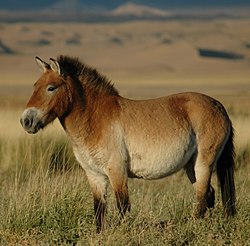
A 2009 molecular analysis using ancient DNA recovered from archaeological sites placed Przewalski's horse in the middle of domesticated horses, challenging earlier views of it as a separate wild species.
2011
% complete
A 2011 mitochondrial DNA analysis suggested that Przewalski's horse and modern domestic horses diverged some 160,000 years ago, revising conclusions drawn from the 2009 study.
Image source: Przewalski's horse
Jun 2013
% complete
In June 2013, researchers announced they had sequenced the genome of a 560–780 thousand year old horse using material extracted from a leg bone buried in permafrost in Canada's Yukon territory.
Image source: Ancient DNA
Jun 2013
% complete
The June 2013 announcement of a genome sequenced from permafrost-preserved Yukon material pushed back the age limit of recoverable ancient DNA dramatically, offering unprecedented insight into early horse evolution.
Image source: Yukon
2018
% complete
A new analysis in 2018 involved genomic sequencing of ancient DNA from mid-fourth-millennium B.C.E. horses, shedding light on the timing and nature of horse domestication.
Image source: Domestication of the horse
Or browse the full history timeline directory, with more than 2,000 topics.
This Evolution of Horses timeline was generated with the help of AI, using information found on the internet.
We work hard to keep these timelines accurate, but mistakes do get through. If you spot one, email us at [email protected] and we'll fix it for future visitors.
Generate yours with AI or build it from scratch, for free.
Export your timeline, add your own events, edit or remove AI-generated events, and much more
No credit card required.
Cancel anytime.
Cancel anytime.
You can create an unlimited number of timelines with up to 10 events on each one, customize how they look, export them to PDF, PNG, PowerPoint, CSV, and Excel, and share them with a link. Paid plans raise the event limit and add features like spreadsheet imports and collaborators.
Yes. You can cancel your subscription from your account page at any time, and you will not be charged again. Your subscription stays active for the rest of the period you already paid for.
Yes. We will email you a reminder before the annual renewal, and we will also email you a receipt.
Yes. You can email us within 15 days of any payment, and we will issue you a full refund.
Check out our pricing docs or send us an email anytime: [email protected].