-
Use Cases
-
Resources
-
Pricing
The history of evolution theory traces the development of ideas about how species change over time, beginning with early naturalists like Lamarck, culminating in Charles Darwin's theory of natural selection published in 1859, and evolving through the modern synthesis that integrated genetics with natural selection to form today's understanding of evolutionary biology. More Less
1839
% complete
In the case of evolution through natural selection, Darwin conceived the hypothesis around 1839, after his voyage on HMS Beagle and years of reflection on the diversity of life, laying the groundwork for what would become one of the most influential ideas in science.
1842 - 1859
% complete
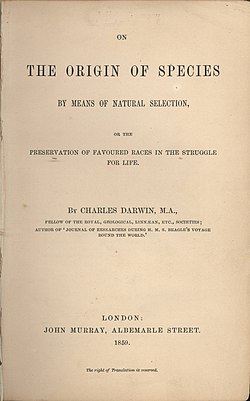
Between his first draft in 1842 and publication in 1859, Darwin delayed announcing his theory, continuing to amass evidence and refine arguments — a period often discussed in accounts of why On the Origin of Species appeared two decades after the idea was conceived.
1842 - 1859
% complete
After making his first draft in 1842, Darwin spent many years developing, refining and gathering evidence for his theory of evolution by natural selection, conducting experiments and corresponding widely before finally publishing.
Image source: On the Origin of Species
1842
% complete
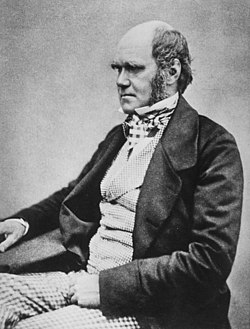
Three years after conceiving the hypothesis, Darwin made a first draft of the concept of evolution through natural selection in 1842. This early sketch showed he had already worked out the core mechanism that would later appear in his great work.
Image source: Charles Darwin
Nov 24, 1859
% complete
After years of development, Darwin finally published his evidence and theory in On the Origin of Species in 1859. The book presented a compelling case for descent with modification through natural selection and transformed the study of biology.
1857
% complete
Spencer's definition of evolution as a progression toward greater heterogeneity was not limited to living things. He extended it to cosmic and social domains, treating evolution as a universal principle governing star systems, geology and human society alike.
Image source: Herbert Spencer
1857
% complete
In 1857, the philosopher Herbert Spencer defined evolution as "change from the homogeneous to the heterogeneous." He claimed, before Darwin published his theory, that this was "settled beyond dispute" for organic evolution and applied it broadly to the evolution of star systems, geology and human society.
1865
% complete
Even Spencer by 1865 was admitting that his definition of evolution as "change from the homogeneous to the heterogeneous" was imperfect. Nevertheless, it remained popular throughout the nineteenth century before declining under the criticisms of William James and others.
1865 - 1900
% complete
Despite Spencer's own admission that his definition was imperfect, the idea of evolution as "change from the homogeneous to the heterogeneous" remained popular throughout the nineteenth century, shaping public understanding of the term before its decline.
1866
% complete
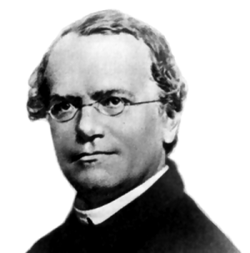
Gregor Mendel conducted research on the inheritance of simple trait variations in peas, discovering the principles of heredity. His work went largely unnoticed during his lifetime but would later become foundational to evolutionary biology.
Image source: Gregor Mendel
1866 - 1900
% complete
Mendel's research on the inheritance of simple trait variations in peas lay unrecognized for decades until its rediscovery in 1900, after Darwin's death, when it became clear that his principles of heredity were essential to explaining evolution.
1880
% complete
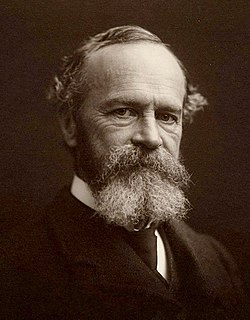
Throughout the late nineteenth century, Spencer's broad definition of evolution remained popular, but it eventually declined under the criticisms of William James and other thinkers who found the formulation vague and unsatisfying as a scientific definition.
Image source: William James
1890
% complete
Spencer's once-popular definition of evolution declined under the criticisms of William James and others, who argued that the formula was too vague to serve as a useful scientific description of evolutionary change.
1900
% complete
The principles of heredity were re-discovered in 1900, after Darwin's death, in Gregor Mendel's research on the inheritance of simple trait variations in peas. This rediscovery provided the genetic basis needed to understand how variation is transmitted between generations.
Image source: Mendelian inheritance
1920 - 1950
% complete
In the early twentieth century, population genetics had centre stage in evolutionary studies. By combining Mendelian inheritance with Darwinian selection, researchers explained how genetic variation within populations changes over time, forming the core of the modern synthesis.
Image source: Population genetics
1953
% complete
More recently than the era of population genetics, DNA has become the main focus of observation and experimentation in evolutionary biology, allowing scientists to trace ancestry and measure evolutionary change directly at the molecular level.
Image source: DNA
1930
% complete
Alongside the fossil record, the evidence of plant and animal structures — homologous anatomies across species — formed part of the case Huxley assembled in The Incontrovertible Fact of Evolution for the reality of common descent.
Image source: Comparative anatomy
1930
% complete
Julian Huxley's 1930 book dealing with the fossil record and the evidence of plant and animal structures presented the fossil record as central support for the incontrovertible fact of evolution, showing gradual changes across deep time.
Image source: Fossil
1930
% complete
After rigorous scrutiny, Huxley concluded that "the broad positions of Darwinism re-emerge from a scrutiny of the most exacting sort essentially unchanged," affirming the durability of Darwin's core ideas even as details were refined.
Image source: Darwinism
1930
% complete
The third book of the wide-ranging series The Science of Life, written by Julian Huxley and dealing with the fossil record and comparative evidence, was entitled The Incontrovertible Fact of Evolution, bringing evolutionary science to a broad audience.
Image source: List of life sciences
1930
% complete
Huxley noted that beyond the established facts of evolution we come to speculative matter, to theories. But he concluded that "the broad positions of Darwinism re-emerge from a scrutiny of the most exacting sort essentially unchanged."
Image source: Julian Huxley
1930
% complete
Writing in 1930, biologist Julian Huxley entitled the third book of the wide-ranging series The Science of Life, which dealt with the fossil record and the evidence of plant and animal structures, The Incontrovertible Fact of Evolution, emphasizing the strength of the empirical evidence.
1932
% complete
In 1932, a portion of Julian Huxley's book was republished under the title Evolution, Fact and Theory, helping popularize the distinction between the historical reality of evolution and the theories explaining its mechanisms.
1981
% complete
Many scientists and philosophers of science have described evolution as fact and theory, following Gould's influential framing: the historical reality of common descent is a fact, while natural selection and other mechanisms constitute the theoretical explanation.
Image source: Evolution as fact and theory
1981
% complete
Many scientists and philosophers of science have described evolution as fact and theory, a phrase which was used as the title of an article by paleontologist Stephen Jay Gould in 1981, clarifying that the occurrence of evolution is a fact while its mechanisms are described by theories.
Image source: Stephen Jay Gould
1990
% complete
Neil Campbell wrote in his 1990 biology textbook, "Today, nearly all biologists acknowledge that evolution is a fact," reflecting the overwhelming scientific consensus on the historical reality of evolution.
1990
% complete
As Neil Campbell wrote in his 1990 textbook, today nearly all biologists acknowledge that evolution is a fact — a consensus echoed by Futuyma, Gould and science educators, cementing evolution's status among the best-supported ideas in science.
Image source: Scientific consensus
1998
% complete
Futuyma writes in Evolutionary Biology (1998), "The statement that organisms have descended with modifications from common ancestors – the historical reality of evolution – is not a theory," underscoring that the fact of evolution stands apart from theories about its causes.
Image source: Douglas J. Futuyma
2000
% complete
Writing for the National Science Teachers Association, Robertson observed that scientists frequently respond to claims that evolution is "just a theory" by asserting that evolution is a fact, illustrating the persistent confusion between everyday and scientific uses of the word theory.
2000
% complete
Robertson, writing for the National Science Teachers Association, notes, "I have heard too many scientists claim that evolution is a fact, often in retort to the claim that it is just a theory," highlighting ongoing public debate over scientific terminology.
Image source: National Science Teaching Association
Or browse the full history timeline directory, with more than 2,000 topics.
This History of Evolution Theory timeline was generated with the help of AI, using information found on the internet.
We work hard to keep these timelines accurate, but mistakes do get through. If you spot one, email us at [email protected] and we'll fix it for future visitors.
Generate yours with AI or build it from scratch, for free.
Export your timeline, add your own events, edit or remove AI-generated events, and much more
No credit card required.
Cancel anytime.
Cancel anytime.
You can create an unlimited number of timelines with up to 10 events on each one, customize how they look, export them to PDF, PNG, PowerPoint, CSV, and Excel, and share them with a link. Paid plans raise the event limit and add features like spreadsheet imports and collaborators.
Yes. You can cancel your subscription from your account page at any time, and you will not be charged again. Your subscription stays active for the rest of the period you already paid for.
Yes. We will email you a reminder before the annual renewal, and we will also email you a receipt.
Yes. You can email us within 15 days of any payment, and we will issue you a full refund.
Check out our pricing docs or send us an email anytime: [email protected].