-
Use Cases
-
Resources
-
Pricing
1280
% complete
The crocodile was described in the late-thirteenth-century Rochester Bestiary, which drew on classical sources including Pliny's Historia naturalis.
1865 - 2008
% complete
Crocodilians became recurring characters in children's stories, including Lewis Carroll's poem How Doth the Little Crocodile in Alice's Adventures in Wonderland, Roald Dahl's The Enormous Crocodile in 1978, and Emily Gravett's The Odd Egg in 2008.
Image source: Crocodile
1902
% complete
In Rudyard Kipling's 1902 Just So Stories, the Elephant's Child acquires his trunk after a crocodile pulls his nose very hard.
Image source: Just So Stories
1911
% complete
In J. M. Barrie's 1911 novel Peter and Wendy, Captain Hook loses his hand to a crocodile.
1977 - 2007
% complete
Movies and shows often represented crocodilians as dangerous water obstacles or monstrous man-eaters, including Eaten Alive in 1977, Alligator in 1980, Lake Placid in 1999, Crocodile in 2000, and Primeval and Black Water in 2007.
1986
% complete
In the 1986 film Crocodile Dundee, the title character Mick Dundee's nickname is said to come from an incident involving a crocodile attack.
1943
% complete
The gharial, historically widespread in India's major river systems, began a chronic decline in 1943.
1967
% complete
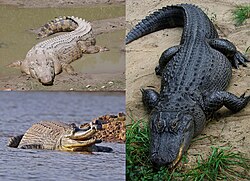
After its 1967 endangered-species listing, federal and state wildlife agencies in the southern United States worked toward recovery of the American alligator.
Image source: American alligator
1967
% complete
In 1967, the American alligator was listed as an endangered species, prompting conservation action by the United States Fish and Wildlife Service and state wildlife agencies in the southern United States.
1971
% complete
Following severe population reductions from hunting, saltwater crocodiles in Australia were given legal protections.
1971
% complete
In Australia, heavy hunting reduced saltwater crocodiles in the Northern Territory to five percent of their historical numbers by 1971.
1972
% complete
In 1972, the Chinese government declared the Chinese alligator a Class I endangered species, granting it the maximum amount of legal protection.
1973
% complete
Starting in 1973, CITES attempted to prevent trade in body parts from endangered animals, including crocodile skins.
1979
% complete
Beginning in 1979, captive-breeding programs were established in China and North America, creating a healthy captive population of Chinese alligators.
1983
% complete
At the 1983 Conference of the Parties in Botswana, advocates for aggrieved local people argued that selling lawfully hunted crocodilian skins was reasonable.
Image source: CITES
1987
% complete
Legal protection and coordinated conservation allowed the American alligator to recuperate, and it was removed from the endangered species list in 1987.
2000
% complete
By 2000, skins from twelve crocodilian species were traded by thirty countries. The skins were harvested legally in the wild or obtained from farms, while unlawful trade had almost vanished.
2001
% complete
After legal protection was introduced, saltwater crocodile numbers in Australia had greatly increased by 2001.
2008
% complete
In 2008, alligators bred at the Bronx Zoo were successfully reintroduced to Chongming Island in China.
2009
% complete
By 2009, hunting and destructive fishing practices had reduced the Philippine crocodile to around 100 individuals, making it possibly the most threatened crocodilian.
1968
% complete
Heinz Wermuth chose Crocodylia as the proper name for the group, basing it on the type genus Crocodylus, established by Laurenti in 1768.
1987
% complete
Before 1988, Crocodilia was used broadly for modern crocodilians as well as more distant relatives that are now classified within Crocodylomorpha and Pseudosuchia.
2003
% complete
A study published in 2003 measured an American alligator's bite force at up to 2,125 lbf, or 9.45 kN.
2010 - 2013
% complete
Studies published in 2010 and 2013 concluded that crocodilians breathe more like birds than mammals, with airflow moving through the lungs in a unidirectional loop rather than tidally in and out.
2012
% complete
A 2012 study measured the bite force of a saltwater crocodile at 3,700 lbf, or 16 kN.
2015
% complete
A 2015 discussion argued that species-specific morphologies in vocal folds or their analogues may reasonably be expected as far back as basal reptiles.
Image source: Crocodilia
2021
% complete
A 2021 cladogram presented the relationships among the major extant crocodilian groups, providing a modern view of crocodilian evolutionary relationships.
2023
% complete
A 2023 study using tinamou birds and American alligator test subjects found that the alligators did not appear to engage in visual perspective-taking like the birds.
2010 - 2020
% complete
More than 1,000 attacks by Nile crocodiles were estimated to have occurred between 2010 and 2020, with almost 70 percent proving fatal.
2010 - 2020
% complete
Saltwater crocodiles were implicated in more than 1,300 attacks on humans between 2010 and 2020, and almost half of those attacks were fatal.
2010 - 2020
% complete
American alligators were responsible for 127 recorded attacks between 2010 and 2020, only six of which were fatal.
Or browse the full history timeline directory, with more than 2,000 topics.
This Evolution of Crocodilians timeline was generated with the help of AI, using information found on the internet.
We work hard to keep these timelines accurate, but mistakes do get through. If you spot one, email us at [email protected] and we'll fix it for future visitors.
Generate yours with AI or build it from scratch, for free.
Export your timeline, add your own events, edit or remove AI-generated events, and much more
No credit card required.
Cancel anytime.
Cancel anytime.
You can create an unlimited number of timelines with up to 10 events on each one, customize how they look, export them to PDF, PNG, PowerPoint, CSV, and Excel, and share them with a link. Paid plans raise the event limit and add features like spreadsheet imports and collaborators.
Yes. You can cancel your subscription from your account page at any time, and you will not be charged again. Your subscription stays active for the rest of the period you already paid for.
Yes. We will email you a reminder before the annual renewal, and we will also email you a receipt.
Yes. You can email us within 15 days of any payment, and we will issue you a full refund.
Check out our pricing docs or send us an email anytime: [email protected].