-
Use Cases
-
Resources
-
Pricing
The Battle of Adrianople, fought on August 9, 378 AD near modern-day Edirne, Turkey, saw the Eastern Roman army under Emperor Valens suffer a catastrophic defeat by Gothic forces led by Fritigern. It is often considered one of the worst military disasters in Roman history and a pivotal moment in the empire's decline. More Less
370 - 375
% complete
The rise of the Huns in the Eurasian steppe devastated Gothic territories north of the Danube. The Hunnic onslaught shattered the Ostrogothic kingdom and sent waves of terrified Visigoths fleeing westward, seeking refuge within the borders of the Roman Empire.
Image source: Huns
376
% complete
Ermanaric, the powerful king of the Greuthungi (Ostrogoths), died following the collapse of his realm under sustained Hunnic assault. His death removed a major obstacle to the migration of Gothic peoples toward the Danube frontier of the Roman Empire.
Image source: Ermanaric
376
% complete
Tens of thousands of Visigoths crossed the Danube into Roman territory, an unprecedented influx that overwhelmed Roman administrative capacity. The scale of the crossing was so great that Ammianus Marcellinus compared it to the rivers of myth attempting to swallow whole nations.
Image source: Gothic War (376–382)
377
% complete
After Lupicinus attempted an assassination of the Gothic leaders Fritigern and Alavivus during a banquet at Marcianople, the Goths rose in revolt. Alavivus was killed while Fritigern escaped, rallied his people, and defeated Lupicinus's forces in battle, beginning open war with Rome.
Image source: Marcianopolis
377
% complete
Fritigern's forces pillaged throughout Thrace with impunity. Gothic troops serving as federates in the Roman army deserted and joined the rebellion, swelling the rebel numbers and complicating Rome's efforts to contain the uprising.
377
% complete
Roman generals Trajanus and Profuturus, reinforced by Western troops under Richomeres, engaged the Goths near the Willows (Ad Salices). The bloody but indecisive battle failed to break the Gothic strength, allowing the rebels to continue their campaign of destruction.
378
% complete
A force of Saracen horsemen from Arabia serving in the Roman army skirmished successfully against Gothic raiders near Constantinople, briefly boosting Roman morale. One Saracen warrior reportedly drank blood from a slain enemy, unnerving the superstitious Goths.
Image source: Iberians
Nov 17, 375
% complete
The death of Western Emperor Valentinian I elevated his son Gratian to sole rule of the West, initially alongside his young half-brother Valentinian II. Gratian would later march east to aid his uncle Valens against the Goths, but his delayed arrival contributed to the disaster.
Image source: Gratian
376
% complete
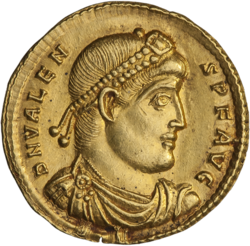
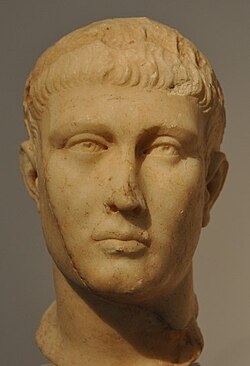
Fleeing the Huns, the Tervingi (Visigoths) under Fritigern and Alavivus appealed to the Eastern Roman Emperor Valens for permission to cross the Danube and settle on Roman soil. Valens, needing recruits for his army, agreed to admit them, setting in motion a catastrophic chain of events.
Image source: Valens
376 - 377
% complete
Roman commanders Lupicinus and Maximus subjected the starving Gothic refugees to extortion, forcing them to trade children for dog meat at exorbitant prices. The mistreatment bred deep resentment among the Goths, who had been promised land and provisions that never materialized.
378
% complete
The general Sebastianus, newly appointed by Valens, conducted small-scale ambush operations against Gothic detachments using picked infantry cohorts, achieving several minor successes. His growing popularity may have stirred Valens's jealousy and hastened the emperor's desire for a decisive victory of his own.
Jan 19, 379
% complete
Following the catastrophe at Adrianople, the Spaniard Theodosius was proclaimed emperor at Sirmium and tasked with restoring order in the East. Through patient campaigns and diplomacy, he gradually wore down the Gothic forces rather than seeking another pitched battle.
Image source: Theodosius I
378
% complete
Fearing coordinated uprisings, the comes Julius summoned Gothic federate soldiers across Asia Minor to musters in various towns and then massacred them all in a single day. This ruthless preemptive strike prevented a potential second front in the East.
Image source: Julius Caesar
Aug 10, 378
% complete
Flushed with victory, the Goths assaulted the walled city of Adrianople the next day but were repulsed by its defenders and the arrival of Roman cavalry under Frigeridus and Profuturus. The failure demonstrated that their victory in open battle could not be translated into capturing fortified cities.
Image source: Edirne
380
% complete
Gothic bands pushed perilously close to Constantinople itself, prompting panic in the capital. A sortie by Arab auxiliaries once again drove them off, and the city's massive walls remained impregnable to the raiders, who lacked siege capability.
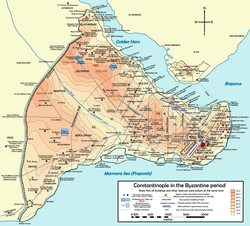
Image source: Constantinople
Oct 3, 382
% complete
Theodosius concluded a treaty with the Goths, granting them lands south of the Danube as foederati—autonomous allies under their own leaders, exempt from imperial taxation. This unprecedented settlement marked a turning point in Rome's relationship with barbarian peoples inside its borders.
395
% complete
Following Theodosius's death, the Gothic leader Alaric led his people in revolt, exploiting the autonomy granted in 382. The subsequent decade of warfare culminated in the Sack of Rome in 410, demonstrating how the settlement born from Adrianople ultimately destabilized the Western Empire.
Image source: Alaric I
396
% complete
In the decades after Adrianople, fear of barbarian attack prompted renewed fortification efforts across Greece. Cities like Athens repaired ancient walls and built new defenses, reflecting the lasting insecurity the Gothic wars instilled in the eastern Mediterranean world.
Aug 6, 378
% complete
Emperor Valens marched his army out of Constantinople toward Adrianople after scouts reported that only about 10,000 Gothic warriors stood ahead. Eager to win glory before Gratian arrived with reinforcements, Valens pressed forward despite warnings to await his nephew's forces.
Aug 9, 378
% complete
On the day before the battle and again on the morning of it, Fritigern sent envoys proposing negotiations, possibly to stall for time while his cavalry returned from foraging. Valens refused to negotiate with such a lowly opponent, and Roman skirmishers opened hostilities prematurely.
Image source: Battle of Adrianople
Aug 9, 378
% complete
In sweltering heat, the Roman army formed up for hours without water before attacking the Gothic wagon laager. The disorganized assault collapsed when Gothic cavalry under Alatheus and Saphrax smashed into the exposed Roman flank, turning the field into a killing ground.
Aug 9, 378
% complete
Emperor Valens perished in the fighting, possibly burned alive in a farmhouse where he took shelter, though his body was never recovered. Two-thirds of the Eastern Roman army, perhaps 15,000 to 20,000 men, including many veteran officers, were annihilated in one afternoon.
Or browse the full history timeline directory, with more than 2,000 topics.
This Battle of Adrianople timeline was generated with the help of AI, using information found on the internet.
We work hard to keep these timelines accurate, but mistakes do get through. If you spot one, email us at [email protected] and we'll fix it for future visitors.
Generate yours with AI or build it from scratch, for free.
Export your timeline, add your own events, edit or remove AI-generated events, and much more
No credit card required.
Cancel anytime.
Cancel anytime.
You can create an unlimited number of timelines with up to 10 events on each one, customize how they look, export them to PDF, PNG, PowerPoint, CSV, and Excel, and share them with a link. Paid plans raise the event limit and add features like spreadsheet imports and collaborators.
Yes. You can cancel your subscription from your account page at any time, and you will not be charged again. Your subscription stays active for the rest of the period you already paid for.
Yes. We will email you a reminder before the annual renewal, and we will also email you a receipt.
Yes. You can email us within 15 days of any payment, and we will issue you a full refund.
Check out our pricing docs or send us an email anytime: [email protected].