
-
Use Cases
-
Resources
-
Pricing
The Battle of Austerlitz, fought on December 2, 1805, near the village of Austerlitz in Moravia (present-day Czech Republic), was Napoleon Bonaparte's greatest military triumph. Often called the 'Battle of the Three Emperors,' it saw the French Grande Armée decisively defeat a larger Russo-Austrian army under Tsar Alexander I and Holy Roman Emperor Francis II, effectively ending the War of the Third Coalition and dissolving the Holy Roman Empire shortly afterward. More Less
1792
% complete
Europe had been in turmoil since the start of the French Revolutionary Wars in 1792, a conflict that set the stage for decades of warfare between revolutionary and later Napoleonic France and the great powers of Europe.
Image source: French Revolutionary Wars
1797
% complete
In 1797, after five years of war, the French Republic broke up the First Coalition, an alliance of Austria, Prussia, Great Britain, Spain, and various Italian states.
Image source: War of the First Coalition
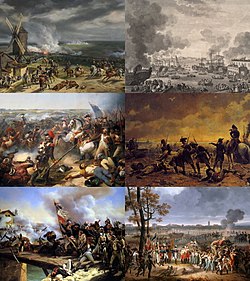
1798
% complete
A Second Coalition, led by Britain, Austria and Russia, and including the Ottoman Empire, Portugal and the Kingdom of Naples, was formed in 1798, but by 1801 this too had been defeated, leaving the British the only opponent of the new French Consulate.
Image source: War of the Second Coalition
1799
% complete
During the Italian and Swiss expedition of 1799 the Russians drove the French out of Italy, but they failed in Switzerland.
Image source: Italian and Swiss expedition of 1799
1801
% complete
Archduke Charles, brother of the Austrian Emperor, had started to reform the Austrian army in 1801 by taking away power from the Hofkriegsrat, the military-political council responsible for the armed forces.
Image source: Karl Philipp, Prince of Schwarzenberg
Mar 1802
% complete
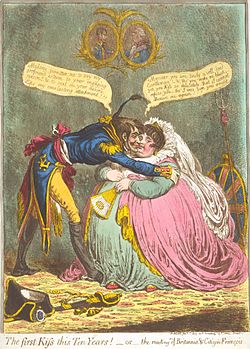
In March 1802, France and Britain agreed to end hostilities under the Treaty of Amiens, bringing a temporary peace between the two powers.
Image source: Treaty of Amiens
May 1803
% complete
In May 1803, Britain declared war on France, resuming hostilities after the brief peace brought by the Treaty of Amiens.
Image source: Battle of Austerlitz
Dec 1804
% complete
In December 1804, an Anglo-Swedish agreement led to the creation of the Third Coalition against France.
Image source: War of the Third Coalition
1805
% complete
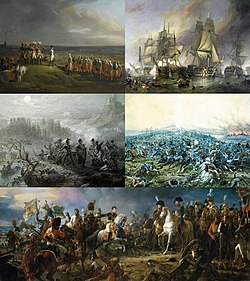
The fighting qualities of the Austrian cavalry were high in 1805, but they were often outnumbered by French horsemen due to Napoleon's new cavalry tactics 'en masse'. The artillery of 1805 was the best among the entire continental Coalition, but no better than the French.
1805
% complete
The Russian army in 1805 had many characteristics of Ancien Régime organization. From Peter the Great until the war with Napoleonic France in 1805, Russia almost always achieved success in military affairs.
Image source: Imperial Russian Army
1805
% complete
By 1805, the Grande Armée had grown to a force of 350,000 men, who were well equipped, well trained, and led by competent officers.
Image source: Grande Armée
Apr 1805
% complete
British Prime Minister William Pitt the Younger spent 1804 and 1805 in a flurry of diplomatic activity geared towards forming a new coalition against France, and by April 1805, Britain and Russia had signed an alliance.
Jan 1, 1800 - Dec 31, 1899
% complete
In French history, Austerlitz is acknowledged as an impressive military victory, and in the 19th century, when fascination with the First French Empire was at its height, the battle was revered by French authors such as Victor Hugo, who wrote of the 'sound of heavy cannons rolling towards Austerlitz' echoing in the 'depths of [his] thoughts'.
1805
% complete
A notable monument is the Pyramid of Austerlitz, built by French soldiers stationed there to commemorate the 1805 campaign near Utrecht in the Netherlands.
Image source: Pyramid of Austerlitz
1910 - 1912
% complete
It was designed and built in the Art Nouveau style by Josef Fanta in 1910–1912.
1923
% complete
World War I postponed the monument's dedication until 1923.
1992
% complete
Since 1992, the area where the Battle of Austerlitz took place has been protected by law as a landscape monument zone.
2005
% complete
In the 2005 bicentennial, controversy erupted when neither French President Jacques Chirac nor Prime Minister Dominique de Villepin attended any functions commemorating the battle.
1805
% complete
The settlement imposed an indemnity of 40 million francs, equivalent to €106 million in 2025, on the Habsburgs and allowed the fleeing Russian troops free passage through hostile territories and back to their home soil.
1805
% complete
Austria agreed to recognize French territory captured by the treaties of Campo Formio (1797) and Lunéville (1801), cede land to Bavaria, Württemberg and Baden, which were Napoleon's German allies, pay 40 million francs in war indemnities and cede Venice to the Kingdom of Italy.
Image source: Peace of Pressburg (1805)
Dec 2, 1805
% complete
Remarkably, the pleiad of Russian military commanders nurtured by the great general Alexander Suvorov (1730–1800) – including Mikhail Kutuzov, Pyotr Bagration, Mikhail Miloradovich, Nikolay Kamensky, Sergei Kamensky, Peter Wittgenstein and Friedrich von Buxhoeveden – was decisively defeated at Austerlitz.
Image source: Alexander Suvorov
Dec 2, 1805
% complete
The Battle of Austerlitz (2 December 1805), also known as the Battle of the Three Emperors, was one of the most important military engagements of the Napoleonic Wars.
Dec 6, 1805
% complete
An armistice was signed between Austria and France after the battle on 6 December 1805 at Slavkov Castle.
Image source: Slavkov u Brna
1806
% complete
The Confederation rendered the Holy Roman Empire virtually useless, so Francis dissolved the Holy Roman Empire in 1806, but remained as emperor of Austria. 1806 was seen as the Empire's final year.
Image source: Holy Roman Empire
1806
% complete
Prussian worries about the growing French influence in Central Europe led to the War of the Fourth Coalition in 1806. Prussia saw these moves as an affront to its status as the main power of Central Europe, and it went to war with France.
Image source: War of the Fourth Coalition
Aug 1805
% complete
In August 1805, Napoleon, Emperor of the French since December of the previous year, turned his sights from the English Channel to the Rhine to deal with the new Austrian and Russian threats.
Image source: Ulm campaign
Sep 9, 1805
% complete
On 9 September 1805, Kutuzov arrived at the battlefield, quickly contacting Francis I of Austria and his courtiers to discuss strategy and logistics.
Image source: Mikhail Kutuzov
Nov 1805
% complete
After eliminating an Austrian army during the Ulm campaign, French forces seized Vienna in November 1805.
Nov 28, 1805
% complete
Stará Pošta ('old post') in Kovalovice is an original building from 1785. On 28 November 1805, the French cavalry general Murat set up his headquarters here.
Image source: Joachim Murat
Dec 1, 1805
% complete
By 1 December 1805, the French troops had been shifted in accordance with the Allied movement southward, as Napoleon expected.
Or browse the full history timeline directory, with more than 2,000 topics.
This Battle of Austerlitz timeline was generated with the help of AI, using information found on the internet.
We work hard to keep these timelines accurate, but mistakes do get through. If you spot one, email us at [email protected] and we'll fix it for future visitors.
Generate yours with AI or build it from scratch, for free.
Export your timeline, add your own events, edit or remove AI-generated events, and much more
No credit card required.
Cancel anytime.
Cancel anytime.
You can create an unlimited number of timelines with up to 10 events on each one, customize how they look, export them to PDF, PNG, PowerPoint, CSV, and Excel, and share them with a link. Paid plans raise the event limit and add features like spreadsheet imports and collaborators.
Yes. You can cancel your subscription from your account page at any time, and you will not be charged again. Your subscription stays active for the rest of the period you already paid for.
Yes. We will email you a reminder before the annual renewal, and we will also email you a receipt.
Yes. You can email us within 15 days of any payment, and we will issue you a full refund.
Check out our pricing docs or send us an email anytime: [email protected].