
-
Use Cases
-
Resources
-
Pricing
The Battle of Borodino was fought on September 7, 1812, between the French Grande Armée under Napoleon Bonaparte and the Russian army led by General Mikhail Kutuzov, west of Moscow. It was the deadliest day of the Napoleonic Wars, with roughly 70,000 casualties, and although the French technically won, they failed to destroy the Russian army. The battle opened the way to Moscow but marked the beginning of Napoleon's disastrous retreat from Russia. More Less
1799
% complete
The vast French military resources in manpower, horsepower, and firepower, along with the fusion of the Ancien Régime's legacy with the formations of the French revolution and Napoleon's reforms, transformed the French army into a military machine that had dominated Europe by 1799.
Image source: Grande Armée
Dec 2, 1805
% complete
Despite being the finest army of its day in 1812, the French military was in decline since the Battle of Austerlitz due to spending military resources in the Peninsular War, and losing many French veterans in battles like Eylau, Aspern, and Wagram.
Image source: Battle of Austerlitz
Feb 7, 1807 - Feb 8, 1807
% complete
The bloody Battle of Eylau cost the French many experienced veterans, part of the steady erosion of the Grande Armée's core of seasoned soldiers through battles like Eylau, Aspern, and Wagram.
Image source: Battle of Eylau
May 2, 1808
% complete
The Peninsular War consumed enormous French military resources and manpower, contributing to the decline of the French army after its peak following Austerlitz and weakening the Grande Armée before the invasion of Russia.
Image source: Peninsular War
May 21, 1809 - May 22, 1809
% complete
At Aspern-Essling in 1809 Napoleon suffered his first major defeat, losing many veteran soldiers who could not easily be replaced, further weakening the quality of the Grande Armée ahead of 1812.
Image source: Battle of Aspern-Essling
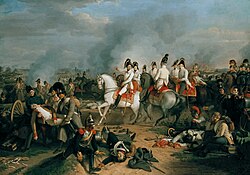
Jul 5, 1809 - Jul 6, 1809
% complete
Though victorious at Wagram, Napoleon again lost large numbers of experienced troops, deepening the decline in veteran manpower that would affect the Grande Armée's performance during the Russian campaign.
Image source: Battle of Wagram
1802
% complete
A series of reforms to the Russian army had begun in 1802, creating regiments of three battalions, each battalion having four companies. These changes laid the foundation for the modernization that would reshape Russian forces in the years leading up to the confrontation with Napoleon.
Image source: Battle of Borodino
1806
% complete
In 1806 a divisional system was introduced into the Russian army, improving its organization, command structure, and operational flexibility as it prepared for future conflicts with the great powers of Europe.
1812
% complete
Corps were established in the Russian army in 1812, completing a decade of military reforms. By the time of Borodino the Russian army had changed greatly from the force which met the French in 1805–1807.
1812
% complete
By the time of Borodino the Russian army had changed greatly from the force which met the French in 1805–1807, thanks to reforms creating new regimental, divisional, and corps structures throughout the intervening years.
Image source: Imperial Russian Army
Jun 24, 1812
% complete
Napoleon with the French Grande Armée began his invasion of Russia on 24 June 1812 by crossing the Niemen river. This massive undertaking set in motion the campaign that would culminate in the Battle of Borodino.
Image source: French invasion of Russia
Sep 6, 1812
% complete
On the eve of battle, around 250,000 troops of the French Grande Armée and the Russian army converged on the outskirts of Moscow near the village of Borodino, setting the stage for one of the bloodiest days of the Napoleonic Wars.
Sep 7, 1812
% complete
With at least 68,000 killed and wounded among roughly 250,000 engaged troops, Borodino became the deadliest single-day battle of the Napoleonic Wars and one of the bloodiest single-day battles in military history until the First Battle of the Marne in 1914.
Sep 7, 1812
% complete
The Battle of Borodino or the Battle of the Moskva took place on the outskirts of Moscow near the village of Borodino on 7 September 1812, during Napoleon's invasion of Russia. The fighting involved around 250,000 troops and left at least 68,000 killed and wounded.
Sep 7, 1812
% complete
Similar difficulties exist with the Battle of Waterloo or battles of the War of 1812 in North America, while the Battle of Borodino offers its own particular challenges to accuracy, making definitive accounts of troop movements and command decisions difficult to establish.
Sep 7, 1812
% complete
General Kutuzov commanded the Russian army at Borodino. Historian Chandler, writing in 1966, echoed Soviet-era Russian histories in asserting that Kutuzov remained in control of the battle throughout, ordering counter-moves to Napoleon's tactics personally rather than Bagration and Barclay doing so.
Image source: Mikhail Kutuzov
1992
% complete
In 1992, in the Russian magazine Rodina, there was a debate between historians Boris Abalikhin and Alexey Vasilyev, the first claiming the battle ended in a draw, the second that the French won a tactical victory.
May 1813
% complete
Since May 1813, at least 29 ships were named Borodino after the battle, beginning a long naval tradition of honoring the engagement and its participants in vessel names.
May 1813
% complete
Following the battle, 24 ships were named in honor of Mikhail Kutuzov, the Russian commander-in-chief at Borodino, reflecting his enduring prestige in Russian naval tradition.
May 1813
% complete
Eighteen ships were named in honor of Matvei Platov, the Cossack leader who played a prominent role in the campaign of 1812 and the Battle of Borodino.
Image source: Matvei Platov
May 1813
% complete
Fifteen ships were named in honor of Pyotr Bagration, the Russian general mortally wounded at Borodino while commanding the left wing of the Russian army.
Image source: Pyotr Bagration
May 1813
% complete
Thirty-three ships were named in honor of the Cossacks, whose harassing tactics against the Grande Armée made them legendary figures of the 1812 campaign.
Image source: Cossacks
May 1813
% complete
Four ships were named in honor of Denis Davydov, the celebrated partisan poet-officer of the Russian army during Napoleon's invasion.
Image source: Denis Davydov
May 1813
% complete
Two ships each were named in honor of Louis-Alexandre Berthier, Jean-Baptiste Bessières and Michel Ney; and one ship each honored the officers of the Marine Guards crew, extending commemoration even to French participants.
Image source: Michel Ney
1821
% complete
In 1821, the year the Emperor of the French passed away, the American poet Sumner Lincoln Fairfield published his first poetic work—the poem 'The Battle of Borodino'—in Savannah, USA, bringing the epic clash to an American literary audience.
Image source: Sumner Lincoln Fairfield
1880
% complete
Pyotr Ilyich Tchaikovsky composed his 1812 Overture to commemorate Russia's successful defence against the French invasion, including the defence at Borodino. The work remains one of the most famous pieces of classical music ever written.
Image source: 1812 Overture
1912
% complete
A huge panorama representing the battle was painted by Franz Roubaud for the 100th anniversary of Borodino in 1912, becoming one of the largest panoramic paintings in the world.
Image source: Franz Roubaud
1912
% complete
In 1912, on the initiative of French people, the Russian government sanctioned construction of a monument dedicated to the French soldiers who fell in the Battle of Borodino, marking the centenary of the battle.
1977
% complete
A minor planet, 3544 Borodino, was discovered by Soviet astronomer Nikolai Stepanovich Chernykh in 1977 and was later named after the village of Borodino.
Image source: 3544 Borodino
1987
% complete
A commemorative one-ruble coin was released in the Soviet Union in 1987 to commemorate the 175th anniversary of the Battle of Borodino, and four million were minted.
Or browse the full history timeline directory, with more than 2,000 topics.
This Battle of Borodino timeline was generated with the help of AI, using information found on the internet.
We work hard to keep these timelines accurate, but mistakes do get through. If you spot one, email us at [email protected] and we'll fix it for future visitors.
Generate yours with AI or build it from scratch, for free.
Export your timeline, add your own events, edit or remove AI-generated events, and much more
No credit card required.
Cancel anytime.
Cancel anytime.
You can create an unlimited number of timelines with up to 10 events on each one, customize how they look, export them to PDF, PNG, PowerPoint, CSV, and Excel, and share them with a link. Paid plans raise the event limit and add features like spreadsheet imports and collaborators.
Yes. You can cancel your subscription from your account page at any time, and you will not be charged again. Your subscription stays active for the rest of the period you already paid for.
Yes. We will email you a reminder before the annual renewal, and we will also email you a receipt.
Yes. You can email us within 15 days of any payment, and we will issue you a full refund.
Check out our pricing docs or send us an email anytime: [email protected].