-
Use Cases
-
Resources
-
Pricing
1400
% complete
During the 15th century, civil war raged across England as the Houses of York and Lancaster fought each other for the English throne. The conflict, later known as the Wars of the Roses, extended across England and Wales in the latter half of the century and set the stage for the climactic Battle of Bosworth Field.
Image source: Wars of the Roses
1450
% complete
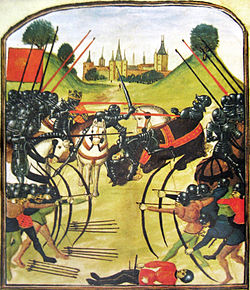
By the 15th century, English chivalric ideas of selfless service to the king had been corrupted. Loyalty became tied to personal gain and shifting allegiances, which shaped the behaviour of nobles during the Wars of the Roses and influenced key figures at the Battle of Bosworth.
Image source: Battle of Bosworth Field
Sep 23, 1459
% complete
Sir William Stanley was a staunch Yorkist supporter, fighting in the Battle of Blore Heath in 1459 and helping Hastings to put down uprisings against Edward IV in 1471. By 1485, he had served three kings: Henry VI, Edward IV, and Richard III.
Image source: Battle of Blore Heath

1461
% complete
Northumberland had been captured and imprisoned by the Yorkists in 1461, losing his titles and estates. However, Edward released him eight years later and restored his earldom, after which he served under Richard during the 1482 invasion of Scotland.
Mar 1470
% complete
The two Stanley brothers had conflicts that erupted into violence around March 1470. Despite these tensions, both would play pivotal roles at the Battle of Bosworth in 1485, with Sir William's intervention proving decisive.
1471
% complete
In 1471 the Yorkists defeated their rivals in the battles of Barnet and Tewkesbury. These victories secured Edward IV's hold on the throne and temporarily crushed Lancastrian resistance, though Henry Tudor remained in exile abroad.
1471
% complete
A military veteran of the Battle of Towton in 1461, Richard served as Hastings' deputy at Calais in 1471. This experience contributed to his reputation as a capable soldier and leader before he ascended the throne.
Jun 1472
% complete
Having taken Lady Margaret as his second wife in June 1472, Stanley became Henry Tudor's stepfather, a relationship which did nothing to win him Richard's favour. Despite these differences, Stanley did not join Buckingham's revolt in 1483.
Image source: Thomas Stanley, 1st Earl of Derby
1473
% complete
Edward IV had ruled the case in favour of Stanley in 1473, but Richard planned to overturn his brother's ruling and give the wealthy estate to the Harringtons. This grievance alienated Lord Stanley and influenced his conduct at Bosworth.
1473
% complete
The earl fled abroad and continued his fight against the Yorkists, raiding shipping and eventually capturing the island fort of St Michael's Mount in 1473. He surrendered after receiving no aid or reinforcement, but escaped from prison in 1484 and joined Henry's court in France with his erstwhile gaoler Sir James Blount.
Image source: Jasper Tudor
1482
% complete
Margaret of Anjou died in 1482. Although she did not live to see Bosworth, Shakespeare later had her speak to Richard's mother before the battle to foreshadow Richard's fate and fulfill the prophecy she had given in Henry VI.
Image source: Margaret of Anjou
1482
% complete
In 1482, Edward charged Richard to lead an army into Scotland with the aim of replacing King James III with the Duke of Albany. As well as obtaining a guarantee that the Scottish government would concede territories and diplomatic benefits to the English crown, Richard's campaign retook the town of Berwick-upon-Tweed, which the Scots had conquered in 1460.
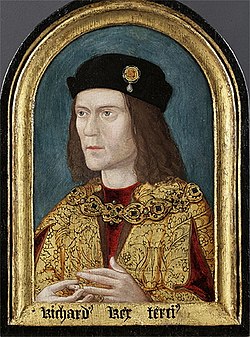
Image source: Richard III of England
Apr 9, 1483
% complete
Edward IV died 12 years after Tewkesbury in April 1483. His death destabilized the realm, as his twelve-year-old son Edward V was deemed too young to rule unaided, opening the door for Richard of Gloucester to seize power.
Image source: Edward IV of England
Jun 26, 1483
% complete
Richard's reign began in 1483 when he ascended the throne after his twelve-year-old nephew, Edward V, was declared illegitimate, likely at Richard's instigation. His seizure of power created deep resentment among disaffected Yorkists who would later side with Henry Tudor.
Oct 1483
% complete
In October 1483, a conspiracy emerged to displace Richard from the throne. The revolt failed, but it marked a turning point in opposition to Richard's reign and strengthened Henry Tudor's claim as a rallying point for dissenters.
Oct 1483
% complete
Henry's first attempt to invade England in 1483 foundered in a storm before reaching shore. Undeterred, he regrouped in exile in France and prepared a second expedition that would ultimately succeed two years later.
Image source: Henry VII of England
Mar 16, 1485
% complete
On 16 March 1485 Richard's queen, Anne Neville, died, and rumours spread across the country that she was murdered to pave the way for Richard to marry his niece, Elizabeth. These rumours further damaged Richard's reputation and eroded support for his reign.
Image source: Anne Neville
Aug 7, 1485
% complete
Henry's crossing of the English Channel in 1485 was without incident, and his second attempt arrived unopposed on 7 August 1485 on the south-west coast of Wales. He gathered support as he marched through Wales towards England, building an army to challenge Richard III.
Aug 21, 1485
% complete
He spent the night at the Blue Boar inn (demolished 1836) in Leicester as he prepared to confront Henry Tudor's approaching army. The next day he marched out to meet the Lancastrian forces near Market Bosworth in Leicestershire.
Image source: Blue Boar Street
Aug 22, 1485
% complete
Fought on 22 August 1485, the battle was won by an alliance of Lancastrians and disaffected Yorkists. It was the last significant battle of the Wars of the Roses, ending Plantagenet rule and beginning the Tudor dynasty under Henry VII.
Aug 22, 1485
% complete
He led a charge of mounted men around the melee and tore into Henry's group; several accounts state that Richard's force numbered 800–1000 knights, but Ross says it was more likely that Richard was accompanied only by his household men and closest friends. Near this spot, at the age of 32, King Richard III fell fighting gallantly in defence of his realm and his crown against the usurper Henry Tudor.
Aug 23, 1485
% complete
The earliest record, a municipal memorandum of 23 August 1485 from York, locates the battle 'on the field of Redemore'. This is corroborated by a 1485–86 letter that mentions 'Redesmore' as its site; according to historian Peter Foss, records did not associate the battle with 'Bosworth' until 1510.
Jun 16, 1487
% complete
The rebel army fended off several attacks by Northumberland's forces, before engaging Henry's army at the Battle of Stoke Field on 16 June 1487. This final engagement secured Henry VII's hold on the throne after Bosworth.
Image source: Battle of Stoke Field
1489
% complete
A rebellion in 1489 started with Northumberland's murder, reflecting continued unrest in the north of England even after Bosworth. Military historians have noted the significance of this event in the consolidation of Henry VII's rule.
1502
% complete
According to Reader Colin Burrow, André was so overwhelmed by the historic significance of the battle that he represented it with a blank page in his Henry VII (1502), an unusual literary tribute underscoring how momentous contemporaries considered the victory.
1510
% complete
According to historian Peter Foss, records did not associate the battle with 'Bosworth' until 1510, some twenty-five years after the event. Earlier sources consistently referred to the site as 'Redemore'.
1521
% complete
The history of Scottish author John Major (published in 1521) claims that Charles had granted Henry 5,000 men, of whom 1,000 were Scots, headed by Sir Alexander Bruce. Such accounts shaped early understandings of the forces assembled at Bosworth.
1538
% complete
The church was demolished following the friary's dissolution in 1538, and the location of Richard's tomb was long uncertain. Centuries later, archaeologists would rediscover his remains beneath a Leicester car park.
Image source: Exhumation and reburial of Richard III of England
1550
% complete
Foss brings further evidence for his 'Redemore' theory by quoting Edward Hall's 1550 Chronicle, which supports the identification of the battlefield with the Redemore wetland rather than the traditional site near Bosworth village.
Image source: Edward Hall
1577
% complete
Holinshed stated in his chronicle that he found firm ground where he expected the marsh to be. Hutton later misinterpreted a passage from Holinshed's 1577 Chronicle when locating the battle west of Ambion Hill, an error that influenced battlefield theories for centuries.
Image source: Raphael Holinshed
1593
% complete
From the 15th to the 18th centuries the battle was glamourised as a victory of good over evil, and features as the climax of William Shakespeare's play Richard III. Shakespeare drew inspiration from Henry IV's use of them at the Battle of Shrewsbury (1403) to amplify the perception of Richard's courage on the battlefield, and despite dramatic licences taken, his version was the model of the event for English textbooks during the 18th and 19th centuries.
Image source: Richard III (play)
1622
% complete
Historian William Burton, author of Description of Leicestershire (1622), wrote that the battle was 'fought in a large, flat, plaine, and spacious ground, three miles distant from [Bosworth], between the Towne of Shenton, Sutton [Cheney], Dadlington and Stoke [Golding]', providing important evidence about the battlefield's true location.
1788
% complete
In 1788, a local pointed out one of the springs to Hutton as the one mentioned in the legend. Peter Foss proposes that Daniel Williams was influenced by William Hutton's 1788 The Battle of Bosworth-Field, which Foss blames for introducing the notion that the battle was fought west of Ambion Hill on the north side of the River Sence.
1804
% complete
In the 18th and 19th centuries, the Ashby Canal carved through the land west and south-west of Ambion Hill. The changes to the landscape were so extensive that when Hutton revisited the region in 1807 after an earlier 1788 visit, he could not readily find his way around.
Image source: Ashby Canal
1813
% complete
Samuel Parr in 1813 marked the well from which the king is said to have drunk during the battle with an inscription commemorating where Richard III fell fighting gallantly in defence of his realm and his crown.
1955
% complete
In Laurence Olivier's 1955 film adaptation of Richard III, the Battle of Bosworth is represented not by a single duel but a general melee that became the film's most recognised scene and a regular screening at Bosworth Battlefield Heritage Centre.
Image source: Richard III (1955 film)
1973
% complete
The council engaged historian Daniel Williams to research the battle, and in 1974 his findings were used to build the Bosworth Battlefield Heritage Centre and the presentation it houses. Erected in 1973, the memorial site was selected on the basis of Williams's theory.
1974
% complete
The Bosworth Battlefield Heritage Centre was built in 1974, on a site that has since been challenged by several scholars and historians. It became the focal point for visitors seeking to learn about the battle.
1985
% complete
After the battle's quincentenary celebration in 1985, a dispute among historians led many to doubt the accuracy of Williams's theory. Elton pointed out that the 20th-century English public largely ignored the battle until its quincentennial celebration.
1995
% complete
The adaptation of the setting for Richard III to a 1930s fascist England in Ian McKellen's 1995 film, however, did not sit well with historians, who objected to the liberties taken with the historical setting of the Battle of Bosworth.
Image source: Richard III (1995 film)
2003
% complete
Geological surveys conducted from 2003 to 2009 by the Battlefields Trust show that the southern and eastern flanks of Ambion Hill were solid ground in the 15th century, contrary to Williams's claim that it was a large area of marshland, casting doubt on the traditional battlefield location.
Oct 2009
% complete
In October 2009, a team of researchers who had performed geological surveys and archaeological digs in the area since 2003 suggested a location two miles (3 km) south-west of Ambion Hill, based on extensive survey work carried out by the Battlefields Trust headed by Glenn Foard, leading eventually to the discovery of the real location of the core battlefield.
Sep 12, 2012
% complete
On 12 September 2012, archaeologists announced the discovery of a buried skeleton with spinal abnormalities and head injuries under a car park in Leicester, and their suspicions that it was Richard III.
Feb 4, 2013
% complete
On 4 February 2013, it was announced that DNA testing had convinced Leicester University scientists and researchers 'beyond reasonable doubt' that the remains were those of King Richard.
Mar 26, 2015
% complete
On 26 March 2015, these remains were ceremonially buried in Leicester Cathedral, finally giving the king slain at Bosworth a dignified resting place more than five centuries after his death.
Or browse the full history timeline directory, with more than 2,000 topics.
This Battle of Bosworth Field timeline was generated with the help of AI, using information found on the internet.
We work hard to keep these timelines accurate, but mistakes do get through. If you spot one, email us at [email protected] and we'll fix it for future visitors.
Generate yours with AI or build it from scratch, for free.
Export your timeline, add your own events, edit or remove AI-generated events, and much more
No credit card required.
Cancel anytime.
Cancel anytime.
You can create an unlimited number of timelines with up to 10 events on each one, customize how they look, export them to PDF, PNG, PowerPoint, CSV, and Excel, and share them with a link. Paid plans raise the event limit and add features like spreadsheet imports and collaborators.
Yes. You can cancel your subscription from your account page at any time, and you will not be charged again. Your subscription stays active for the rest of the period you already paid for.
Yes. We will email you a reminder before the annual renewal, and we will also email you a receipt.
Yes. You can email us within 15 days of any payment, and we will issue you a full refund.
Check out our pricing docs or send us an email anytime: [email protected].