-
Use Cases
-
Resources
-
Pricing
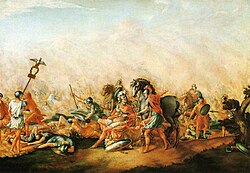
The Battle of Cannae was a major engagement of the Second Punic War fought on August 2, 216 BC, near the town of Cannae in Apulia, southeastern Italy. The Carthaginian army under Hannibal Barca, though outnumbered, encircled and annihilated a much larger Roman force commanded by consuls Lucius Aemilius Paullus and Gaius Terentius Varro. Using the famous double envelopment tactic, Hannibal's troops killed or captured the vast majority of the Roman army, making it one of the bloodiest single days of battle in history and a masterpiece of military tactics still studied today. More Less
221 BC
At just 26 years old, Hannibal Barca was appointed commander-in-chief of the Carthaginian army in Hispania following the assassination of his brother-in-law Hasdrubal. He quickly consolidated control over the region and began preparing for an ambitious campaign against Rome, driven by his family's long-standing hostility toward the Roman Republic.
Image source: Hannibal

219 BC - 218 BC
Hannibal laid siege to Saguntum, a Roman-allied city on the eastern coast of Hispania. After eight months, the city fell and was sacked. Rome demanded Carthage hand over Hannibal; when Carthage refused, Rome declared war, marking the outbreak of the Second Punic War.
Image source: Siege of Saguntum

218 BC
The Second Punic War erupted between Rome and Carthage, becoming one of the largest and most devastating wars of antiquity. It would last seventeen years and feature some of history's most famous battles, including Trebia, Lake Trasimene, and ultimately Cannae.
Image source: Second Punic War

Oct 218 BC
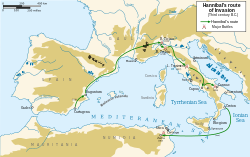
In a daring strategic stroke, Hannibal led his army—including war elephants—over the Alps into northern Italy. The grueling crossing cost him nearly half his men but caught the Romans completely off guard and allowed him to bring the war directly onto Italian soil.
Image source: Hannibal's crossing of the Alps
Dec 218 BC
Hannibal won his first major victory in Italy at the Trebia River, luring the Roman consular army of Tiberius Sempronius Longus into attacking across a cold, swollen river. Ambush forces hidden in the riverbed struck the Romans from behind, inflicting heavy losses and shattering Roman confidence.
Image source: Battle of the Trebia

217 BC
Following the disaster at Trasimene, Rome appointed Quintus Fabius Maximus as dictator. He adopted a cautious 'delaying' strategy, shadowing Hannibal while avoiding pitched battle. Though strategically sound, the unpopular policy earned him the nickname 'Cunctator' (the Delayer) and frustrated a Roman public hungry for decisive action.
Image source: Fabian strategy

Jun 21, 217 BC
Hannibal ambushed the Roman army of consul Gaius Flaminius along the northern shore of Lake Trasimene. Trapped between hills and the lake with no room to maneuver, the Romans suffered catastrophic losses, with Flaminius himself killed. It remains one of the largest ambushes in military history.
Image source: Battle of Lake Trasimene
216 BC
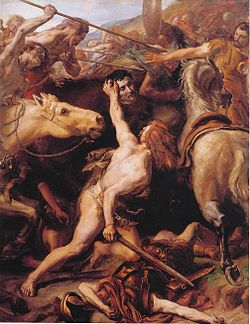
Impatient with Fabian delay, the Roman people elected Gaius Terentius Varro and Lucius Aemilius Paullus as consuls for 216 BC, explicitly seeking a decisive confrontation with Hannibal. Rome assembled an unprecedented force—roughly eight legions, the largest army it had ever fielded—to crush the invader.
216 BC
Despite losing perhaps a quarter of its entire manpower pool in one afternoon, Rome refused to surrender. The Senate raised new legions from slaves, criminals, and even boys under military age, and instituted emergency measures such as human sacrifice rites. This extraordinary resilience became legendary proof of Roman determination.
216 BC
Emboldened by Hannibal's triumph, several southern Italian peoples defected to Carthage, including Capua—the second-largest city in Italy—as well as much of Apulia, Lucania, Bruttium, and later Tarentum. Yet crucially, most of Rome's Latin core allies remained loyal, denying Hannibal a decisive strategic victory.
This Battle of Cannae timeline was generated with the help of AI, using information found on the internet.
We work hard to keep these timelines accurate, but mistakes do get through. If you spot one, email us at [email protected] and we'll fix it for future visitors.
Generate yours with AI or build it from scratch, for free.