
-
Use Cases
-
Resources
-
Pricing
The Battle of Caporetto (also known as the Twelfth Battle of the Isonzo) was a major World War I battle fought from October 24 to November 19, 1917, near Kobarid (Caporetto) in present-day Slovenia. German and Austro-Hungarian forces, employing new infiltration tactics, launched a surprise offensive that shattered the Italian Second Army, forcing a chaotic retreat of over 100 kilometers to the Piave River. The Italian army suffered around 300,000 casualties, including some 265,000 captured. The disaster prompted Allied reinforcements, led to the unification of Italian command under General Armando Diaz, and inspired Ernest Hemingway's novel 'A Farewell to Arms.' More Less
1917
% complete
Over the decades, 'Caporetto' entered Italian language and memory as a byword for a terrible, humiliating defeat, invoked whenever national efforts collapsed in disarray.
Image source: Battle of Caporetto
Nov 1917
% complete
By any standard, Twelfth Isonzo (Caporetto) and its aftermath represented an unprecedented catastrophe for Italian arms, with enormous losses of men, materiel, and territory in a single campaign.
Dec 1917 - 1919
% complete
The disaster came as a shock to the Italian nation and triggered a search for scapegoats, with accusations of treason and incompetence directed at commanders, politicians, and even socialists on the home front.
Dec 1917
% complete
Opera Nazionale Combattenti, an Italian charitable organization, was set up in December 1917 in the immediate aftermath of the battle, to provide assistance to veterans of the First World War.
Jun 1918
% complete
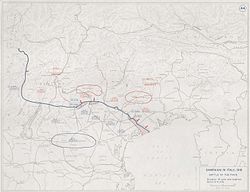
When the Austrians launched an offensive across the entire front in June 1918, their bridgeheads were contained and were ultimately forced back across the river, marking a decisive failure for Austria-Hungary.
Image source: Second Battle of the Piave River
1919
% complete
The search for culprits culminated in a 1919 Italian military commission that investigated the causes of the debacle, examining failures of command and intelligence that had led to the defeat.
Mar 1917 - Sep 1917
% complete
Throughout the spring and summer of 1917, the Italians had launched numerous offensives on the Austro-Hungarian Lines in the Isonzo Sector, seeking to break through towards Ljubljana and Trieste.
Image source: Battles of the Isonzo
Aug 1917
% complete
In August 1917 Paul von Hindenburg and Arthur Arz von Straußenburg decided to send troops from the Eastern Front to the Isonzo Sector in response to the Italian advances.
Aug 18, 1917 - Sep 12, 1917
% complete
The Eleventh Battle of the Isonzo was the most successful Italian offensive in pushing back the Austro-Hungarians, gaining ground on the Bainsizza plateau and alarming the Central Powers about Italy's growing strength.
Image source: Eleventh Battle of the Isonzo
Sep 1917 - Oct 1917
% complete
German divisions were transferred from the Eastern Front to the Italian front during September and October 1917, secretly massing forces for a combined Austro-German offensive against the Italians near Caporetto.
Oct 24, 1917
% complete
The battle between the Kingdom of Italy and the Central Powers began on 24 October 1917 near the town of Kobarid (then part of the Austrian Littoral) and near the river Isonzo, with a devastating Austro-German assault that shattered the Italian Second Army's front.
Oct 24, 1917 - Nov 1917
% complete
Also known as the Twelfth Battle of the Isonzo, the fighting centered on Kobarid (Caporetto), where German and Austro-Hungarian troops using new infiltration tactics broke through the Italian lines with gas bombardments and rapid advances down mountain valleys.
Oct 24, 1917 - Nov 1917
% complete
The Italian Second Army suffered a catastrophic collapse in the opening days of the battle, with hundreds of thousands of soldiers killed, wounded, captured, or scattered in retreat as enemy forces poured through the broken front.
Oct 25, 1917 - Nov 1917
% complete
Following the breakthrough, Central Powers forces advanced rapidly across northeastern Italy, capturing vast quantities of supplies and artillery and driving the retreating Italian armies westwards.
Oct 27, 1917 - Nov 1917
% complete
In the wake of the breakthrough, the Italian army conducted a long and chaotic retreat across the plains of Friuli, abandoning territory gained over two years of fighting along the Isonzo.
Oct 30, 1917
% complete
Finally, on 30 October 1917, Cadorna ordered the majority of the Italian force to retreat to the other side of the Tagliamento, attempting to establish a new defensive line behind the river.
Image source: Luigi Cadorna
Nov 19, 1917
% complete
The battle concluded on 19 November 1917 after nearly a month of fighting, having represented one of the worst defeats in Italian military history despite the eventual stabilization of the front along the Piave.
1921
% complete
Curzio Malaparte wrote an excoriation of the battle in his first book, La rivolta dei santi maledetti, published in 1921, condemning the leadership failures that produced the catastrophe at Caporetto.
Image source: Battle of Caporetto
1922 - 1980
% complete
La rivolta dei santi maledetti was censored by the state and suppressed for decades, remaining unavailable to readers until it was finally published in full in 1980.
Aug 1922
% complete
It became used to denote a terrible defeat – the failed General Strike of 1922 by the socialists was referred to by Mussolini as the 'Caporetto of Italian Socialism', cementing the battle's place in Italian political rhetoric.
Or browse the full history timeline directory, with more than 2,000 topics.
This Battle of Caporetto timeline was generated with the help of AI, using information found on the internet.
We work hard to keep these timelines accurate, but mistakes do get through. If you spot one, email us at [email protected] and we'll fix it for future visitors.
Generate yours with AI or build it from scratch, for free.
Export your timeline, add your own events, edit or remove AI-generated events, and much more
No credit card required.
Cancel anytime.
Cancel anytime.
You can create an unlimited number of timelines with up to 10 events on each one, customize how they look, export them to PDF, PNG, PowerPoint, CSV, and Excel, and share them with a link. Paid plans raise the event limit and add features like spreadsheet imports and collaborators.
Yes. You can cancel your subscription from your account page at any time, and you will not be charged again. Your subscription stays active for the rest of the period you already paid for.
Yes. We will email you a reminder before the annual renewal, and we will also email you a receipt.
Yes. You can email us within 15 days of any payment, and we will issue you a full refund.
Check out our pricing docs or send us an email anytime: [email protected].