
-
Use Cases
-
Resources
-
Pricing
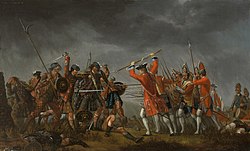
The Battle of Culloden, fought on April 16, 1746, near Inverness in the Scottish Highlands, was the decisive confrontation between the Jacobite forces of Charles Edward Stuart ('Bonnie Prince Charlie') and the British government army led by the Duke of Cumberland. Lasting less than an hour, it ended in a crushing defeat for the Jacobites and marked the end of the Jacobite attempt to restore the Stuart dynasty to the British throne. The battle was followed by brutal repression of Highland culture, including the dismantling of the clan system, making Culloden a pivotal turning point in Scottish history. More Less
1701 - 1800
% complete
During the 18th century, the battlefield area was used as common grazing ground, mainly for tenants of the Culloden estate.
1760
% complete
The thatched roofed farmhouse of Leanach that stands today dates from about 1760; however, it stands on the same location as the turf-walled cottage that probably served as a field hospital for government troops following the battle.
1846
% complete
The Inverness Courier's account of events surrounding the centenary in the spring of 1846 suggests the commemorations had a recreational dimension, but as the century progressed they became more solemn and elegiac.
1849
% complete
Thoughts turned to erecting a physical memorial, and in 1849 a foundation stone for a Culloden monument was laid on the battlefield.
1852
% complete
By 1852, the project to build a Culloden monument had been abandoned due to a lack of funds.
1858
% complete
A memorial stone carved by Edward Power in 1858 was eventually incorporated into the cairn erected on the battlefield in 1881.
1881
% complete
Possibly the most recognisable feature of the battlefield today is the 20-foot (6 m)-tall memorial cairn, erected by Duncan Forbes in 1881.
1925
% complete
An annual commemoration ceremony under the auspices of the Gaelic Society of Inverness began in 1925.
1946
% complete
A major event attended by up to 500 people marked the 200th anniversary of the battle in 1946.
2001
% complete
Since 2001, the site of the battle has undergone topographic, geophysical and metal detector surveys in addition to archaeological excavations.
Dec 2007
% complete
It was first opened in December 2007, with the intention of preserving the battlefield in a condition similar to how it was on 16 April 1746.
Image source: Battle of Culloden
2011
% complete
The battlefield has been inventoried and protected by Historic Scotland under the Historic Environment (Amendment) Act 2011.
Image source: Battle of Auldearn
2024
% complete
In 2024, in a 60 m² area near what is believed to have been the government front line, archaeologists recovered large numbers of musket balls and grapeshot, indicating extremely intense close-range combat.
Oct 2025
% complete
In October 2025, archaeologists unearthed a complete 17.5 lb (8 kg) unexploded mortar shell, still packed with gunpowder.
Jul 23, 1745
% complete
The Jacobite rising of 1745 began on 23 July when Charles Edward Stuart landed in the Western Isles, seeking to restore his father James Francis Edward Stuart to the British throne.
Image source: Charles Edward Stuart
Apr 1746
% complete
By April 1746 the Jacobites were short of supplies and facing a superior and better-equipped opponent commanded by the Duke of Cumberland.
Apr 16, 1746
% complete
The Battle of Culloden took place on 16 April 1746 near Inverness in the Scottish Highlands. A Jacobite army under Charles Edward Stuart was decisively defeated by a British government force under the Duke of Cumberland, ending the Jacobite rising of 1745 and Jacobitism as a significant force in British politics.
1746
% complete
Only one in twenty prisoners was actually put on trial, most transported to the British colonies for life under the Traitors Transported Act 1746. In all, around 1,200 were transported, 905 released under the Indemnity Act 1747, and 362 exchanged with France as prisoners of war.
1746
% complete
Many senior Jacobites made their way to Loch nan Uamh, where Charles Edward Stuart had first landed at the outset of the campaign in 1745.
Image source: Loch nan Uamh Viaduct
1862 - 1953
% complete
Frank Watson Wood (1862–1953) was better known as a naval artist who mainly painted in watercolours, but he painted The Highland Charge at the Battle of Culloden in oil.
1890
% complete
The Skye Boat Song was composed in the late 19th century and recalled the journey of Bonnie Prince Charlie from Benbecula to the Isle of Skye.
1925
% complete
Broster's The Flight of the Heron (1925), the first volume of her Jacobite Trilogy, was later made into TV serials by Scottish Television in 1968 (eight episodes) and by the BBC in 1976.
1947
% complete
Naomi Mitchison's novel The Bull Calves (1947) deals with Culloden and its aftermath.
Image source: Dairy cattle
1964
% complete
Culloden (1964), a BBC TV docudrama written and directed by Peter Watkins, depicts the battle in the style of 20th-century television reporting.
Image source: Culloden (film)
1966 - 1967
% complete
The Highlanders (1966–1967) is a serial in the BBC science fiction series Doctor Who, in which the Doctor and his companions Polly and Ben arrive in 1746, hours after the Battle of Culloden.
1992
% complete
Dragonfly in Amber by Diana Gabaldon (1992, London) is a detailed fictional tale based on historical sources, featuring time travel with a 20th-century protagonist caught up in the foredoomed struggle at Culloden.
Image source: Dragonfly in Amber
1994
% complete
Chasing the Deer (1994) is a cinematic dramatisation of the events leading up to the battle, starring Brian Blessed and Fish.
Image source: Chasing the Deer
2001
% complete
The Portuguese author Hélia Correia opens her novel Lillias Fraser (2001) in the aftermath of the Battle of Culloden.
2006
% complete
The Alexander McQueen fashion collection The Widows of Culloden (Autumn/Winter 2006) is inspired by the widows left after the battle.
Image source: The Widows of Culloden
2008
% complete
Drummossie Moor – Jack Cameron, The Irish Brigade and the battle of Culloden by Ian Colquhoun (Arima/Swirl 2008) tells the story from the point of view of the Franco-Irish regulars who covered the Jacobite retreat.
Image source: Ian Colquhoun
Or browse the full history timeline directory, with more than 2,000 topics.
This Battle of Culloden timeline was generated with the help of AI, using information found on the internet.
We work hard to keep these timelines accurate, but mistakes do get through. If you spot one, email us at [email protected] and we'll fix it for future visitors.
Generate yours with AI or build it from scratch, for free.
Export your timeline, add your own events, edit or remove AI-generated events, and much more
No credit card required.
Cancel anytime.
Cancel anytime.
You can create an unlimited number of timelines with up to 10 events on each one, customize how they look, export them to PDF, PNG, PowerPoint, CSV, and Excel, and share them with a link. Paid plans raise the event limit and add features like spreadsheet imports and collaborators.
Yes. You can cancel your subscription from your account page at any time, and you will not be charged again. Your subscription stays active for the rest of the period you already paid for.
Yes. We will email you a reminder before the annual renewal, and we will also email you a receipt.
Yes. You can email us within 15 days of any payment, and we will issue you a full refund.
Check out our pricing docs or send us an email anytime: [email protected].