-
Use Cases
-
Resources
-
Pricing
The Battle of Guadalcanal was a major six-month campaign in the Pacific Theater of World War II, fought between Allied forces (primarily the United States) and the Empire of Japan. It began with American landings on Guadalcanal, Tulagi, and Florida Islands in August 1942 and ended with Japanese evacuation in February 1943. The battle was the first major Allied offensive against Japan and marked a strategic turning point in the Pacific War. More Less
Dec 7, 1941
% complete
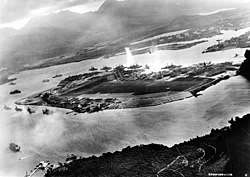
On 7 December 1941, Japanese forces attacked the United States Pacific Fleet at Pearl Harbor, Hawaii, drawing the United States into World War II and setting the stage for the struggle for control of the Pacific.
Image source: Attack on Pearl Harbor
May 1, 1942 - Aug 6, 1942
% complete
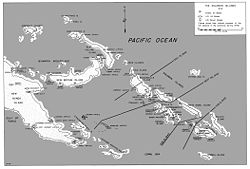
In preparation for the offensive in the Pacific, U.S. forces assembled troops, ships, and supplies during mid-1942 for what would become Operation Watchtower, the first major Allied ground offensive of the war.
Image source: Guadalcanal campaign
May 3, 1942
% complete
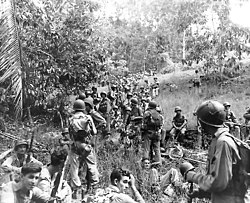
The Imperial Japanese Navy occupied Tulagi in May 1942 and constructed a seaplane base nearby, establishing a foothold in the southern Solomon Islands that threatened Allied sea lines to Australia.
May 4, 1942 - Jun 7, 1942
% complete
The Guadalcanal campaign followed successful Allied defensive actions at the Battle of the Coral Sea and the Battle of Midway in May and June 1942, which blunted Japan's advance across the South Pacific.
Image source: Battle of the Coral Sea
Jun 1, 1942
% complete
In Japan's overall strategy for 1942, aircraft based in the Solomons would provide ground-based air cover for Japanese naval forces advancing farther into the South Pacific, prompting Allied counteraction.
Jul 2, 1942
% complete
In summer 1942, the Allies decided to mount major offensives in New Guinea and the Solomon Islands with the objectives of defending sea lines to Australia and eventually attacking the major Japanese base at Rabaul on New Britain.
Image source: Guadalcanal campaign
Jul 2, 1942
% complete
Leahy established two goals for 1942–1943: first, that Guadalcanal would be taken alongside an Allied offensive in New Guinea under MacArthur; second, that the Admiralty Islands and Bismarck Archipelago, including Rabaul, would be captured as well.
Jul 2, 1942
% complete
The directive held that the eventual goal was the American reconquest of the Philippines, from which American forces had been evicted in early 1942, framing the Solomons offensive as a step toward that objective.
Aug 1, 1942
% complete
To preserve unity of command, the boundary between MacArthur's South West Pacific Area and Nimitz's Pacific Ocean Area was shifted westward, effective from 1 August 1942, placing Guadalcanal under Nimitz's direction.
Aug 7, 1942 - Feb 9, 1943
% complete
The battle was fought between 7 August 1942 and 9 February 1943, involving major land and naval battles on and surrounding the island of Guadalcanal in one of the longest campaigns of the Pacific War.
Aug 7, 1942 - Aug 9, 1942
% complete
On 7 August 1942, Allied forces, predominantly U.S. Marines, landed on Guadalcanal, Tulagi, and nearby islands, launching the first major Allied offensive against Japanese positions in the Pacific.
Aug 7, 1942 - Aug 8, 1942
% complete
The Japanese defenders, who had occupied the islands since May 1942, offered little initial resistance, but the capture of Guadalcanal soon turned into a lengthy campaign as both sides added reinforcements.
Aug 20, 1942 - Nov 30, 1942
% complete
The capture of Guadalcanal soon turned into a lengthy campaign as both sides poured reinforcements onto the island, fighting over Henderson Field through months of grueling jungle combat and naval clashes.
Sep 12, 1942 - Sep 14, 1942
% complete
In September 1942, Japanese forces launched their first major attempt to retake Henderson Field, assaulting Marine positions on Edson's Ridge; the determined defense repelled the attacks at heavy cost.
Image source: Battle of Edson's Ridge
Oct 23, 1942 - Oct 26, 1942
% complete
In late October 1942, Japanese army forces mounted a coordinated assault on Henderson Field but suffered a decisive defeat, ending Japan's best chance to recapture the vital airfield from the Americans.
Image source: Battle for Henderson Field
Nov 1, 1942 - Nov 13, 1942
% complete
After the defeat in the Battle for Henderson Field, the Imperial Japanese Army planned to try again to retake the airfield in November 1942, but further reinforcements were needed before the operation could proceed.
Dec 1, 1942 - Dec 31, 1942
% complete
In December, the Japanese decided to abandon Guadalcanal to focus on the defense of the other Solomon Islands, marking a strategic withdrawal after months of costly attempts to retake the island.
Image source: Operation Ke
Dec 7, 1942 - Dec 31, 1942
% complete
By 7 December 1942, Hyakutake's forces were losing about 50 men each day from malnutrition, disease, and Allied ground or air attacks as the besieged Japanese army starved in the jungles of Guadalcanal.
Dec 31, 1942
% complete
By the end of 1942 it was clear Japan had lost the Guadalcanal campaign, a serious blow to Japan's strategic plans for the defense of its empire and an unanticipated defeat at the hands of the Americans.
Jan 1, 1943 - Jan 31, 1943
% complete
The Japanese secretly began to prepare for the evacuation, called Operation Ke, scheduled to begin during the latter part of January 1943, planning to withdraw surviving troops under cover of deception operations.
Jan 14, 1943
% complete
On 14 January 1943, a Tokyo Express run delivered a battalion of troops to act as a rear guard for the Ke evacuation, covering the withdrawal of the remaining Japanese forces from the island.
Feb 1, 1943 - Feb 9, 1943
% complete
The Japanese completed Operation Ke in early February, and evacuated their last forces by 9 February 1943, leaving the Allies in control of Guadalcanal and marking the end of the six-month campaign.
Aug 7, 1942 - Feb 9, 1943
% complete
Tom Yarbrough wrote for the Associated Press, Bob Miller for the United Press, John Hersey for Time and Life, Sergeant James Hurlbut for the Marine Corps, and Mack Morriss for Yank magazine, documenting the campaign firsthand.
Nov 12, 1942 - Nov 15, 1942
% complete
The decisive naval battle of 12–15 November 1942 saw fierce night actions around Guadalcanal in which the U.S. Navy turned back Japanese bombardment and reinforcement efforts, effectively securing the island for the Allies.
Image source: Naval Battle of Guadalcanal
Nov 12, 1942 - Nov 15, 1942
% complete
Ira Wolfert of the North American Newspaper Alliance wrote a series of articles about the November 1942 Naval Battle of Guadalcanal that won him a Pulitzer Prize, bringing vivid accounts of the fighting to American readers.
Jan 1, 1943
% complete
Richard Tregaskis, who wrote for International News Service, gained fame with the publication of his bestselling Guadalcanal Diary in 1943, one of the most influential works of war journalism from the Pacific theater.
Image source: Richard Tregaskis
Jan 1, 1943 - Jan 22, 1943
% complete
The constant pressure to reinforce Guadalcanal had weakened Japanese efforts in other theaters, contributing to a successful Australian and American counteroffensive in New Guinea which culminated in the capture of Buna and Gona in early 1943.
Jun 30, 1943
% complete
In June, the Allies launched Operation Cartwheel which, after modification in August 1943, formalized the strategy of isolating Rabaul and cutting its sea lines of communication, building on the momentum from Guadalcanal.
Image source: Operation Cartwheel
Jun 30, 1943 - Aug 15, 1945
% complete
The campaign was followed by other major Allied offensives in the Pacific, most notably the Solomon Islands, New Guinea, Gilbert and Marshall Islands, Mariana and Palau Islands, Philippines, and Volcano and Ryukyu Islands campaigns prior to the surrender of Japan in August 1945.
Image source: Solomon Islands campaign
Or browse the full history timeline directory, with more than 2,000 topics.
This Battle of Guadalcanal timeline was generated with the help of AI, using information found on the internet.
We work hard to keep these timelines accurate, but mistakes do get through. If you spot one, email us at [email protected] and we'll fix it for future visitors.
Generate yours with AI or build it from scratch, for free.
Export your timeline, add your own events, edit or remove AI-generated events, and much more
No credit card required.
Cancel anytime.
Cancel anytime.
You can create an unlimited number of timelines with up to 10 events on each one, customize how they look, export them to PDF, PNG, PowerPoint, CSV, and Excel, and share them with a link. Paid plans raise the event limit and add features like spreadsheet imports and collaborators.
Yes. You can cancel your subscription from your account page at any time, and you will not be charged again. Your subscription stays active for the rest of the period you already paid for.
Yes. We will email you a reminder before the annual renewal, and we will also email you a receipt.
Yes. You can email us within 15 days of any payment, and we will issue you a full refund.
Check out our pricing docs or send us an email anytime: [email protected].