
-
Use Cases
-
Resources
-
Pricing
The Battle of Inchon was an amphibious invasion launched by United Nations forces during the Korean War. Orchestrated by General Douglas MacArthur, the daring landing at Inchon, South Korea, on September 15, 1950, caught North Korean forces off guard, severed their supply lines, and enabled the recapture of Seoul, dramatically turning the tide of the war in favor of the UN and South Korea. More Less
Jun 25, 1950
% complete
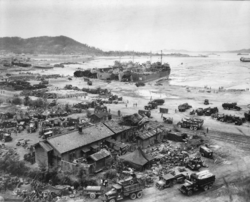
From the outbreak of the Korean War following the invasion of South Korea by North Korea on 25 June 1950, the KPA had enjoyed superiority in both manpower and ground combat equipment over the ROK and UN forces dispatched to South Korea to prevent it from collapsing.
Image source: Battle of Inchon
Jun 27, 1950
% complete
On June 27, 1950, in the Dogfight over Incheon, the US Air Force shot down a North Korean plane over Incheon, one of the early air engagements of the war over the port city that would later become the site of the famous amphibious landing.
Jul 18, 1950
% complete
That distinction belonged to the United Nations landing that took place on 18 July 1950 at Pohang, South Korea, which preceded the Inchon operation as the first UN amphibious landing of the war.
Jul 23, 1950
% complete
On 23 July, MacArthur formulated a new plan, code-named Operation Chromite, calling for an amphibious assault by the US Army's 2nd Infantry Division and the United States Marine Corps (USMC)'s 5th Marine Regiment in mid-September 1950.
Aug 1950
% complete
MacArthur won over Sherman by speaking of his affection for the US Navy and relating the story of how the Navy carried him out of Corregidor to safety in 1942 during World War II.
Sep 1950
% complete
The UN forces did not become aware of the presence of mines in North Korean waters until early September 1950, raising fears that this would interfere with the Incheon invasion.
Sep 12, 1950
% complete
He got underway for Incheon in his flagship, the heavy cruiser USS Rochester, on 12 September 1950, to personally oversee the amphibious operation he had championed against considerable skepticism.
Aug 17, 1950
% complete
On 17 August 1950, a ROK Navy intelligence unit infiltrated the islands of Yonghung-do and Tokchok-do as part of Operation X-ray, and obtained information on the conditions there until 14 September.
Sep 1, 1950
% complete
Separately on 1 September 1950, a UN reconnaissance team (with members from US military intelligence units including the KLO and CIA) also infiltrated Yonghung-do to obtain information on the conditions there ahead of the landing.
Sep 1950
% complete
Exacerbating this fear, the leader of a North Korean-Japanese spy ring arrested in Japan in early September 1950 had a copy of the plan for Operation Chromite, and the UN forces did not know whether he had managed to transmit the plan to North Korea before his arrest.
Sep 4, 1950
% complete
US Navy patrol aircraft, surface warships, and submarines operated in the Sea of Japan (East Sea) and the Yellow Sea to detect any reaction by North Korean, Soviet, or People's Republic of China military forces, and on 4 September 1950 F4U Corsair fighters of Fighter Squadron 53 operating from USS Valley Forge shot down a Soviet Air Force A-20 Havoc bomber after it opened fire on them as it flew toward the UN naval task force.
Sep 5, 1950
% complete
On 5 September 1950, aircraft of the USAF's Far East Air Forces began attacks on roads and bridges to isolate Kunsan, typical of the kind of raids expected prior to an invasion there, part of the deception plan to disguise the true target.
Sep 10, 1950
% complete
On 10 September 1950, five days before the Incheon landing, 43 American warplanes flew over Wolmi-do, dropping 93 napalm canisters to "burn out" its eastern slope in an attempt to clear the way for American troops.
Sep 12, 1950 - Sep 13, 1950
% complete
On the docks at Pusan, USMC officers briefed their men on an upcoming landing at Kunsan within earshot of many Koreans, and on the night of 12–13 September 1950 the Royal Navy frigate HMS Whitesand Bay landed US Army special operations troops and Royal Marine Commandos on the docks at Kunsan, making sure that North Korean forces noticed their visit.
Sep 1950
% complete
He contrasts the US military's 1950 Incheon-Seoul operation with the German offensive in the Baltic in 1941: in the Baltic region the Germans achieved strategic surprise on the first day and then, exhibiting a breakthrough mentality, pushed forward rapidly, seizing key positions and advancing almost 200 miles (320 km) in four days.
Sep 1950
% complete
American forces achieved a strategic masterpiece in the Incheon landing in September 1950 and then largely negated it by a slow, tentative, 11-day advance on Seoul, only 20 miles (32 km) away.
1981
% complete
Inchon (1981), directed by Terence Young with Laurence Olivier as General Douglas MacArthur, dramatized the planning and execution of the famous landing, becoming one of the most notable cinematic depictions of the battle.
Image source: Inchon (film)
1982
% complete
Wolmi Island (1982), a North Korean film, depicted the defense of Wolmi-do from the perspective of the defenders, offering the opposing regime's cinematic account of the battle.
Image source: Wolmido
Sep 15, 1950
% complete
At 00:50 on 15 September 1950, Lieutenant Clark and his South Korean squad activated the lighthouse on the island of Palmido, guiding the invasion fleet through the treacherous approaches to Incheon harbor in darkness.
Sep 15, 1950
% complete
At 06:30 on 15 September 1950, the lead elements of X Corps hit "Green Beach" on the northern side of Wolmido, beginning the main assault of the Battle of Inchon.
Sep 15, 1950
% complete
According to Heinl, "With the capture of So Wolmi Do at 1115, the 3d Battalion, 5th Marines had accomplished its mission," securing the island fortress guarding the approach to Incheon.
Sep 15, 1950
% complete
Eight LSTs followed at 1800, landing follow-up forces ashore after the tide rose again, sustaining the momentum of the amphibious assault at Incheon.
Sep 15, 1950
% complete
The 2.5 miles of mud flats defining the approach necessitated the use of 172 Amtracs, supported by two LSMRs launching 2000 5-inch rockets each, to carry the Marines across the exposed tidal flats into the city.
Sep 15, 1950
% complete
At 1730, the first three waves reached the beach at Incheon, as the second phase of the assault pushed inland from the seawall toward the heart of the port city.
Sep 15, 1950
% complete
By 2150, the 105mm 1st and 2d Battalions, 11th Marines, were in position and ready to lend artillery support to the infantry pushing through Incheon during the night of the landings.
Sep 18, 1950
% complete
Doyle's Invasion Force — Attack Task Force 90; and the Military Sea Transportation Service, which was to bring in the United States Army's 7th Infantry Division on 18 September 1950, reinforcing the expanding beachhead.
Sep 19, 1950
% complete
The battle began on 15 September 1950 and ended on 19 September, with UN forces securing the port of Incheon after a dramatic reversal of fortune in the Korean War.
Or browse the full history timeline directory, with more than 2,000 topics.
This Battle of Inchon timeline was generated with the help of AI, using information found on the internet.
We work hard to keep these timelines accurate, but mistakes do get through. If you spot one, email us at [email protected] and we'll fix it for future visitors.
Generate yours with AI or build it from scratch, for free.
Export your timeline, add your own events, edit or remove AI-generated events, and much more
No credit card required.
Cancel anytime.
Cancel anytime.
You can create an unlimited number of timelines with up to 10 events on each one, customize how they look, export them to PDF, PNG, PowerPoint, CSV, and Excel, and share them with a link. Paid plans raise the event limit and add features like spreadsheet imports and collaborators.
Yes. You can cancel your subscription from your account page at any time, and you will not be charged again. Your subscription stays active for the rest of the period you already paid for.
Yes. We will email you a reminder before the annual renewal, and we will also email you a receipt.
Yes. You can email us within 15 days of any payment, and we will issue you a full refund.
Check out our pricing docs or send us an email anytime: [email protected].