-
Use Cases
-
Resources
-
Pricing
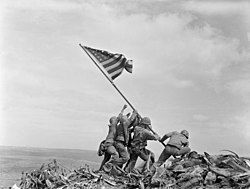
The Battle of Iwo Jima was a major World War II battle fought from February 19 to March 26, 1945, in which United States Marine Corps forces invaded the Japanese island of Iwo Jima. The battle was among the bloodiest in the Pacific Theater, with heavy casualties on both sides, and is famously remembered for the iconic photograph of American soldiers raising the flag on Mount Suribachi. More Less
Dec 7, 1941
% complete
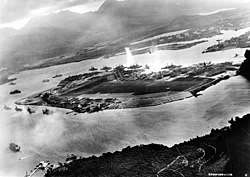
When the Attack on Pearl Harbor happened in 1941, the United States had been caught unprepared. The surprise Japanese strike thrust America into World War II and set the stage for the long island-hopping campaign across the Pacific that would eventually lead to Iwo Jima.
Image source: Attack on Pearl Harbor
Jan 1944 - Feb 1944
% complete
After the American capture of the Marshall Islands and air attacks against the Japanese fortress island of Truk Atoll in the Carolines in January 1944, Japanese military leaders reevaluated their strategic position and began reinforcing their inner defensive line.
Image source: Battle of Iwo Jima
1944 - Mar 1945
% complete
Aircraft losses in 1944 had been so severe that even if war production was not affected by American air attacks, combined Japanese air strength was not expected to increase to 3,000 warplanes until March or April 1945. There was also a serious shortage of trained pilots, many having died over the Solomon Islands in 1942 and at the Battle of the Philippine Sea in mid-1944.
Feb 1944
% complete
The United States seized bases in the Marshall Islands in the battles of Kwajalein and Eniwetok in February 1944. In response, Japanese reinforcements were sent to Iwo Jima: 500 men from the naval base at Yokosuka and 500 from Chichi Jima reached the island during March and April 1944.
Jul 1944
% complete
The loss of the Marianas during the summer of 1944 greatly increased the importance of the Volcano Islands for the Japanese, who feared that losing them would further facilitate American air raids against the home islands, disrupt war manufacturing, and severely damage civilian morale.
Oct 1944
% complete
By late 1944, the Combined Fleet had lost almost all of its striking power during naval engagements in the latter half of the year, meaning it could not interdict American landings on Iwo Jima or provide meaningful support to the garrison.
Apr 1945
% complete
The lessons learned on Iwo Jima served as guidelines for the Battle of Okinawa beginning in April 1945, and influenced American planning for a potential invasion of the Japanese home islands.
Image source: Battle of Okinawa
1942
% complete
In 1942, Sergeant Phillip Johnson was assigned to direct the code training of Platoon 382, made up of Navajo men. The Navajo code talkers developed an unbreakable code based on their native language that proved invaluable in Marine communications throughout the Pacific, including at Iwo Jima.
Image source: Code talker
Jun 15, 1944
% complete
Starting on June 15, 1944, the U.S. Navy and Army Air Forces began intensive bombardment of Iwo Jima. The pre-invasion shelling and bombing continued for months in an effort to soften Japanese defenses before the planned amphibious assault.
Feb 17, 1945
% complete
On February 17, 1945, the destroyer escort USS Blessman deployed Underwater Demolition Team 15 (UDT-15) onto Iwo Jima's Blue Beach for reconnaissance, gathering vital intelligence about the shoreline and beach obstacles ahead of the main landing.
Feb 18, 1945
% complete
During the night of February 18, 1945, Vice Admiral Marc Mitscher's large carrier force, Task Force 58, arrived off Iwo Jima. Its aircraft provided crucial air cover and bombardment support for the upcoming amphibious landings.
Apr 1945 - Jul 1945
% complete
Starting in April 1945 and exclusively in July 1945, P-51 Mustang fighters based on Iwo Jima were repurposed from bomber escort duty to strike and interdiction missions, using the captured island as a forward base against targets in the Japanese home islands.
May 1945 - Jul 1945
% complete
Of the nearly 2,000 B-29s which landed on Iwo Jima from May to July 1945, more than 80% did so for routine refueling. During June 1945, which saw the largest number of landings, none of the more than 800 B-29s that landed on the island did so because of combat damage.
Mar 1944
% complete
In March 1944, the Japanese 31st Army, commanded by General Hideyoshi Obata, was activated to garrison Japan's inner line of defense. The Japanese had been preparing for the defense of Iwo Jima since this time, which gave them a significant advantage by the time of the American invasion.
Mar 1944 - Feb 1945
% complete
Under General Kuribayashi's direction, the Japanese dug an extensive tunnel network across Iwo Jima. By the time the Americans invaded on February 19, 1945, 18 km (11 mi) of a planned 27 km (17 mi) of tunnels had been completed, connecting bunkers, artillery positions, and supply depots.
Jun 1944
% complete
In June 1944, Lieutenant General Tadamichi Kuribayashi was assigned to command the defense of Iwo Jima. He would abandon the standard strategy of defending at the beaches, instead opting for a defense in depth built around tunnels, bunkers, and fortified positions.
Image source: Tadamichi Kuribayashi
Nov 1944 - Jan 1945
% complete
From November 1944 to January 1945, the Japanese used Iwo Jima to stage intermittent air attacks on the Mariana Islands, where American B-29 bases threatened the Japanese home islands. These raids underscored the strategic importance of capturing the island.
Feb 19, 1945
% complete
On February 19, 1945, United States Marines landed on Iwo Jima, beginning one of the fiercest battles of World War II. Unlike earlier Pacific battles such as Saipan in June 1944, where the Japanese had defended at the water's edge, Kuribayashi's forces fought from fortified inland positions, unleashing devastating fire on the beaches.
Feb 23, 1945
% complete
Associated Press photographer Joe Rosenthal captured his iconic photograph of six Marines raising the U.S. flag atop Mount Suribachi on February 23, 1945 — the second of two flag-raisings on the site that day. The image became one of the most famous photographs in American history.
Image source: Raising the Flag on Iwo Jima
Feb 23, 1945
% complete
On the morning of February 23, 1945, Marines raised the first American flag atop Mount Suribachi after days of brutal fighting to capture the volcanic peak. A larger second flag was raised later that day so it could be seen more widely across the island.
Mar 4, 1945
% complete
As early as March 4, 1945, while fighting was still taking place on Iwo Jima, the B-29 Dinah Might of the USAAF 9th Bomb Group reported it was low on fuel near the island and requested an emergency landing. This demonstrated the island's immediate value as an emergency airfield for B-29 operations.
Mar 26, 1945
% complete
The Battle of Iwo Jima ended on March 26, 1945, after 36 days of ferocious combat. According to the Navy Department Library, the assault resulted in more than 26,000 American casualties, including 6,800 dead — a staggering toll compared even to the much larger 82-day Battle of Okinawa.
Apr 1945
% complete
As early as April 1945, retired Chief of Naval Operations William V. Pratt questioned whether the enormous cost of capturing Iwo Jima justified its value, reflecting a debate within American leadership over the price paid for the small volcanic island.
Image source: William V. Pratt
1946 - 2019
% complete
Three subsequent Marine Corps investigations into the identities of the six men in Rosenthal's photograph determined: in 1946 and 1947, that Harlon Block was incorrectly identified as Henry Hansen (both were killed six days after the photo); in May and June 2016, that John Bradley was not in the photograph and Private First Class Harold Schultz was; and in 2019, that Rene Gagnon was not in the photograph and Private First Class Harold Keller was.
Nov 10, 1954
% complete
Rosenthal's iconic flag-raising image was used by Felix de Weldon to sculpt the Marine Corps War Memorial, which was dedicated on November 10, 1954, adjacent to Arlington National Cemetery. It honors all Marines who have given their lives in service of the United States since 1775.
Image source: Marine Corps War Memorial
1961 - 2001
% complete
The United States Navy has honored the battle by commissioning two ships bearing its name: USS Iwo Jima (LPH-2), which served from 1961 to 1993, and USS Iwo Jima (LHD-7), commissioned in 2001 and serving to the present day.
Image source: USS Iwo Jima (LPH-2)
1970
% complete
The first large-scale reunion of battle veterans on the island was held in 1970 on the 25th anniversary of the battle, allowing American and later Japanese veterans to return to the site of some of the fiercest fighting of World War II.
Feb 19, 1985
% complete
On February 19, 1985, the 40th anniversary of the landings on Iwo Jima, an event called the 'Reunion of Honor' was held, bringing together American and Japanese veterans in reconciliation. The event has been held annually since 2002.
Feb 1995
% complete
A memorial service marking the 50th anniversary of the battle was held in front of the monument on Iwo Jima in February 1995, honoring those who fought and died on both sides during the 36-day battle.
Or browse the full history timeline directory, with more than 2,000 topics.
This Battle of Iwo Jima timeline was generated with the help of AI, using information found on the internet.
We work hard to keep these timelines accurate, but mistakes do get through. If you spot one, email us at [email protected] and we'll fix it for future visitors.
Generate yours with AI or build it from scratch, for free.
Export your timeline, add your own events, edit or remove AI-generated events, and much more
No credit card required.
Cancel anytime.
Cancel anytime.
You can create an unlimited number of timelines with up to 10 events on each one, customize how they look, export them to PDF, PNG, PowerPoint, CSV, and Excel, and share them with a link. Paid plans raise the event limit and add features like spreadsheet imports and collaborators.
Yes. You can cancel your subscription from your account page at any time, and you will not be charged again. Your subscription stays active for the rest of the period you already paid for.
Yes. We will email you a reminder before the annual renewal, and we will also email you a receipt.
Yes. You can email us within 15 days of any payment, and we will issue you a full refund.
Check out our pricing docs or send us an email anytime: [email protected].