
-
Use Cases
-
Resources
-
Pricing
The Battle of Leipzig, also known as the Battle of the Nations, was fought from 16 to 19 October 1813 near Leipzig, Saxony. It pitted Napoleon Bonaparte's French army against a coalition of Russian, Prussian, Austrian, and Swedish forces. The decisive coalition victory forced Napoleon to retreat to France and marked a turning point that ultimately led to his abdication in 1814. More Less
Jun 24, 1812
% complete
The French Emperor Napoleon I attempted to force Emperor Alexander I of Russia into rejoining his unpopular Continental System by invading Russia with around 685,000 troops.
Image source: French invasion of Russia
Sep 7, 1812
% complete
Following the bloody, yet indecisive Battle of Borodino, Napoleon's Grande Armée eventually entered Moscow in late 1812.
Image source: Battle of Borodino
Jan 1, 1813
% complete
Despite disastrous campaigns in Spain and Russia in 1812, France was still able to rebuild another massive army for Napoleon.
Image source: German campaign of 1813
Jun 1, 1813
% complete
Charles John, a former French Marshal of the Empire (previously known as Jean-Baptiste Bernadotte), outlined a strategy for defeating Napoleon that became known as the Trachenberg Plan.
Jun 21, 1813
% complete
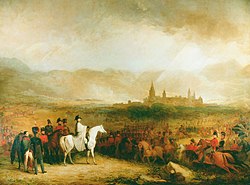
In June 1813, the combined armies of Portugal, Spain, and the United Kingdom under the Duke of Wellington decisively routed the French at the Battle of Vitoria in the Peninsular War, and were now advancing towards the Pyrenees and into France itself.
Image source: Battle of Vitoria
Aug 1, 1813
% complete
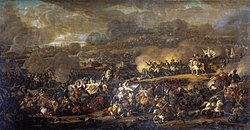
Meanwhile, Charles John had begun a concerted propaganda campaign in Germany, drawing on his experience as Minister of War during the French Revolution, to stoke German nationalist feeling.
Image source: Battle of Leipzig
Aug 1, 1813
% complete
Charles John called on the kings of Bavaria and Saxony, whose armies he had commanded in 1805 and 1809, to repudiate their French alliances.
Aug 12, 1813
% complete
With added details from the Austrians following their joining of the Coalition on 12 August 1813, Charles John's outlined strategy became known as the Trachenberg Plan.
Sep 6, 1813
% complete
Another attempt was made at Berlin on 6 September 1813, this time with Ney in command of 58,000 troops.
Image source: Battle of Dennewitz
Oct 16, 1813
% complete
The Battle of Leipzig, also known as the Battle of the Nations, began on 16 October 1813 at Leipzig, Saxony. It was the culmination of the German campaign of 1813.
Oct 16, 1813 - Oct 19, 1813
% complete
The battle involved about 560,000 soldiers, 2,200 artillery pieces, the expenditure of 400,000 rounds of artillery ammunition, and 133,000 casualties.
Oct 16, 1813 - Oct 19, 1813
% complete
The four days of fighting at Leipzig produced 133,000 casualties, making it one of the largest and bloodiest battles of the Napoleonic Wars.
Oct 17, 1813
% complete
On 17 October 1813, the second day of the Battle of the Nations, the fighting continued as Coalition forces converged on Napoleon's army at Leipzig, Saxony.
Oct 18, 1813
% complete
On 18 October 1813, the third day of the Battle of Leipzig, the massive Coalition armies pressed their attack against Napoleon's forces, expending enormous amounts of artillery ammunition in the struggle.
Oct 19, 1813
% complete
On 19 October 1813, the fourth and final day of the Battle of the Nations, the fighting concluded at Leipzig, Saxony, marking a decisive defeat for Napoleon.
Oct 19, 1813
% complete
The defeat dealt a harsh blow to Napoleon himself, who had a second French army destroyed in as many years, repeating such defeats as the one suffered in 1809 at the Battle of Aspern-Essling, severely damaging his reputation of invincibility.
Dec 31, 1813
% complete
When he went back to Paris at the year's end, his first words on entering the Senate were: 'A year ago all Europe marched with us; today all Europe marches against us.'
Dec 31, 1813
% complete
Half a million troops had been lost in the German Campaign of 1813, underscoring the catastrophic scale of France's defeat in central Europe.
Jan 1, 1814
% complete
With the Confederation of the Rhine dissolved following the defeat at Leipzig, Prussia once again became one of the continent's great powers after its severe setbacks in 1806.
Image source: Confederation of the Rhine
Jan 1, 1814
% complete
With the Confederation of the Rhine dissolved and Prussia restored as a great power, the Coalition armies pressed the advantage and invaded France in early 1814.
Image source: Campaign in north-east France (1814)
May 1, 1814
% complete
Following the defeat at Leipzig and the invasion of France, Napoleon was forced to abdicate and was exiled to Elba in May 1814.
Image source: Abdication of Napoleon, 1815
Oct 18, 1863
% complete
Exactly 50 years after the battle, a Bridge blasting monument was inaugurated in Leipzig in 1863 to commemorate the battle.
May 20, 1913 - Oct 20, 1913
% complete
The 1913 Centennial Exhibition was held in Breslau (now Wrocław), for which was built an extensive venue centered around the Centennial Hall.
Image source: Centennial Hall (Wrocław)
Oct 18, 1913
% complete
The 91-metre (299 ft) Monument to the Battle of the Nations (Völkerschlachtdenkmal) was completed in 1913 according to a design by Bruno Schmitz at a cost of six million German gold marks.
Image source: Monument to the Battle of the Nations
Or browse the full history timeline directory, with more than 2,000 topics.
This Battle of Leipzig timeline was generated with the help of AI, using information found on the internet.
We work hard to keep these timelines accurate, but mistakes do get through. If you spot one, email us at [email protected] and we'll fix it for future visitors.
Generate yours with AI or build it from scratch, for free.
Export your timeline, add your own events, edit or remove AI-generated events, and much more
No credit card required.
Cancel anytime.
Cancel anytime.
You can create an unlimited number of timelines with up to 10 events on each one, customize how they look, export them to PDF, PNG, PowerPoint, CSV, and Excel, and share them with a link. Paid plans raise the event limit and add features like spreadsheet imports and collaborators.
Yes. You can cancel your subscription from your account page at any time, and you will not be charged again. Your subscription stays active for the rest of the period you already paid for.
Yes. We will email you a reminder before the annual renewal, and we will also email you a receipt.
Yes. You can email us within 15 days of any payment, and we will issue you a full refund.
Check out our pricing docs or send us an email anytime: [email protected].