
-
Use Cases
-
Resources
-
Pricing
The Battle of Leyte Gulf was a massive naval engagement fought between the Allied forces (primarily the United States) and the Imperial Japanese Navy from October 23 to 26, 1944, near the Philippine islands of Leyte, Samar, and Luzon. It is widely considered the largest naval battle in history by tonnage and is notable for the first organized use of kamikaze attacks and Japan's final major attempt to contest Allied control of the Pacific. More Less
Jan 1, 1942
% complete
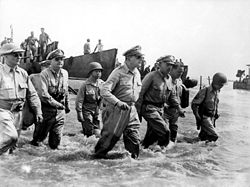
Army General Douglas MacArthur made a famous promise to "return" to the Philippines after being forced to withdraw in 1942. Wishing to fulfill this pledge, he championed an invasion of the islands as the war in the Pacific progressed.
Aug 1, 1942 - Jan 31, 1944
% complete
The Allied campaigns of August 1942 to early 1944 pushed Japanese forces from many of their island bases in the south and central Pacific Ocean, while isolating many of their other bases, most notably in the Solomon Islands, Bismarck Archipelago, Admiralty Islands, New Guinea, Marshall Islands, and Wake Island.
Jun 19, 1944 - Jun 20, 1944
% complete
In June 1944 a series of American amphibious landings supported by the U.S. Navy took place in the Marianas. The catastrophic Battle of the Philippine Sea followed, after which senior Japanese military leaders understood that their remaining naval forces were incapable of achieving a strategic victory against the Allies.
Image source: Battle of the Philippine Sea
Jul 1, 1944
% complete
The Japanese attempted to interdict American landings in the Marianas during the Battle of the Philippine Sea, committing their remaining carrier air power in a desperate effort to halt the American advance.
Sep 30, 1944
% complete
As a result of strategic deliberations, an invasion of Formosa, or any operation requiring much larger ground forces than were available in the Pacific in late 1944, would be delayed until the defeat of Germany made the necessary manpower available.
Image source: Battle of Leyte Gulf
Oct 1, 1944
% complete
By late 1944, the Japanese fleet had become much weaker than that of the Allied forces; it contained fewer capital ships (aircraft carriers and battleships) than the Allies had aircraft carriers in the Pacific.
Oct 12, 1944
% complete
On 12 October 1944, Halsey began a series of carrier raids against Formosa and the Ryukyu Islands with the goal of ensuring that Japanese aircraft based there could not interdict the American amphibious landings on Leyte.
Oct 23, 1944
% complete
Vice-Admiral Jisaburō Ozawa's "Northern Force" was built around the four aircraft carriers of the 3rd Carrier Division—Zuikaku (the last survivor of the six carriers that had attacked Pearl Harbor in 1941) and the light carriers Zuihō, Chitose, and Chiyoda—and included two World War I battleships partially converted to carriers (Hyūga and Ise), three light cruisers, and nine destroyers.
Oct 20, 1944 - Dec 31, 1944
% complete
During the campaign for Leyte, the Allies attempted to interdict Japanese reinforcements while establishing air-sea superiority for a series of amphibious landings in Ormoc Bay, gradually strangling the Japanese garrison on the island.
Image source: Battle of Ormoc Bay
Oct 26, 1944
% complete
Just as Japanese naval airpower had been crippled in June 1944 at the Battle of the Philippine Sea, the naval engagements at Leyte likewise broke the IJN's surface fleet as a meaningful threat to Allied command of the sea.
Oct 26, 1944 - Dec 31, 1944
% complete
Months of hard fighting would be required before the island was completely in Allied hands at the end of December 1944: the Battle of Leyte on land was fought in parallel with an air and sea campaign in which the Japanese reinforced and resupplied their troops on Leyte, while the Allies attempted to interdict them.
Image source: Battle of Leyte
Nov 11, 1944 - Dec 26, 1944
% complete
Alongside the land campaign on Leyte, the Allies established air-sea superiority for a series of amphibious landings in Ormoc Bay, engagements collectively referred to as the Battle of Ormoc Bay, cutting off Japanese reinforcement routes to the island.
Dec 31, 1944
% complete
After months of hard fighting, the island of Leyte was declared completely in Allied hands at the end of December 1944, securing MacArthur's foothold in the Philippines and fulfilling his promise to return.
Jan 24, 1945
% complete
A Japanese vessel involved in the Leyte campaign was sunk by the American submarine Blackfin on 24 January 1945 off Kota Bharu, Malaya, with 37 dead.
Jan 31, 1945
% complete
In January 1945, Myōkō joined the crippled Takao in Singapore, where the Japanese deemed both cruisers irreparable and left them moored in the harbor for the remainder of the war as floating anti-aircraft batteries.
Apr 1, 1945
% complete
Additionally, the loss of Leyte opened the way for the invasion of the Ryukyu Islands in 1945, bringing Allied forces within striking distance of the Japanese home islands.
Image source: Battle of Okinawa
Apr 7, 1945
% complete
The only major operation by the surviving IJN surface ships between the Battle for Leyte Gulf and the surrender of Japan was a suicidal sortie in April 1945 (part of Operation Ten-Go), in which the battleship Yamato and her escorts were destroyed in a lopsided engagement by American carrier aircraft.
Image source: Operation Kikusui I
Oct 21, 1944
% complete
At the start of the battle on 21 October 1944, HMAS Australia suffered 30 officers and sailors dead, and another 62 servicemen wounded in a kamikaze-like attack, foreshadowing the organized kamikaze tactics Japan would employ throughout the battle.
Oct 23, 1944 - Oct 26, 1944
% complete
The Battle of Leyte Gulf began on 23 October 1944 and became the largest naval battle of World War II and by some criteria the largest naval battle in history, with over 200,000 naval personnel involved across its several engagements.
Oct 23, 1944 - Oct 26, 1944
% complete
With over 200,000 naval personnel involved, the Battle of Leyte Gulf ranks by some criteria as the largest naval battle in history, spanning four days and multiple separate engagements across the Philippine Sea.
Oct 23, 1944 - Oct 26, 1944
% complete
Three light cruisers—Ōyodo, Tama, and Isuzu—along with nine destroyers escorted Vice-Admiral Ozawa's decoy Northern Force during the Battle of Leyte Gulf, sacrificing themselves in the hope of drawing Halsey's carriers away from the landing beaches.
Oct 23, 1944
% complete
The cruiser Takao, heavily damaged early in the battle, retired to Singapore, where she was joined in January 1945 by Myōkō, as the Japanese deemed both crippled cruisers irreparable and left them moored in the harbor as floating anti-aircraft batteries.
Oct 25, 1944
% complete
As of 2025, the Battle of Surigao Strait stands as the last battleship-to-battleship action in history, and one of only two battleship-versus-battleship naval battles in the Pacific campaign of World War II.
Oct 25, 1944
% complete
The Battle of Surigao Strait was one of the major engagements of the Leyte Gulf campaign, fought on the night of October 25, 1944, as American forces ambushed the Japanese Southern Force attempting to enter Leyte Gulf through the strait.
Image source: Battle of Leyte Gulf
Oct 25, 1944
% complete
Two World War I battleships partially converted to carriers, Hyūga and Ise—their aft turrets replaced by hangars, aircraft handling decks and catapults—sailed with Ozawa's Northern Force but carried no aircraft in this battle, serving largely as decoys to draw off American forces.
Oct 25, 1944
% complete
According to Fusō survivor Hideo Ogawa, interrogated in 1945, who wrote an article on the battleship's last voyage: "Shortly after 0400 the ship capsized slowly to starboard and Ogawa and others were washed away," without specifically mentioning the bisection of the ship.
Oct 26, 1944
% complete
Ozawa's Northern Force included Zuikaku, the last survivor of the six carriers that had attacked Pearl Harbor in 1941; her loss at Leyte Gulf closed a symbolic chapter that had opened with the start of the Pacific War.
Image source: Japanese aircraft carrier Zuikaku
Jan 1, 1945
% complete
Fusō survivor Hideo Ogawa, interrogated in 1945, provided one of the key firsthand accounts of his battleship's last voyage, describing how shortly after 0400 the ship capsized slowly to starboard and he and others were washed away.
Jun 14, 1957
% complete
The Dealey-class destroyer escort USS Evans (DE-1023) was named in honor of Lt. Ernest E. Evans, commander of USS Johnston, who was posthumously awarded the Medal of Honor for his heroism at the Battle of Leyte Gulf.
Or browse the full history timeline directory, with more than 2,000 topics.
This Battle of Leyte Gulf timeline was generated with the help of AI, using information found on the internet.
We work hard to keep these timelines accurate, but mistakes do get through. If you spot one, email us at [email protected] and we'll fix it for future visitors.
Generate yours with AI or build it from scratch, for free.
Export your timeline, add your own events, edit or remove AI-generated events, and much more
No credit card required.
Cancel anytime.
Cancel anytime.
You can create an unlimited number of timelines with up to 10 events on each one, customize how they look, export them to PDF, PNG, PowerPoint, CSV, and Excel, and share them with a link. Paid plans raise the event limit and add features like spreadsheet imports and collaborators.
Yes. You can cancel your subscription from your account page at any time, and you will not be charged again. Your subscription stays active for the rest of the period you already paid for.
Yes. We will email you a reminder before the annual renewal, and we will also email you a receipt.
Yes. You can email us within 15 days of any payment, and we will issue you a full refund.
Check out our pricing docs or send us an email anytime: [email protected].