-
Use Cases
-
Resources
-
Pricing
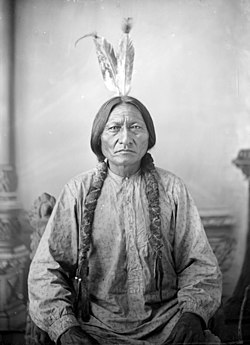
The Battle of Little Bighorn, fought on June 25-26, 1876, along the Little Bighorn River in Montana Territory, was a dramatic victory for an alliance of Lakota Sioux, Northern Cheyenne, and Arapaho warriors over the U.S. Army's 7th Cavalry. Lieutenant Colonel George Armstrong Custer and over 260 of his men were killed, making it the most famous Native American victory during the Great Sioux War of 1876. More Less
1805
% complete
In 1805, fur trader François Antoine Larocque reported joining a Crow camp in the Yellowstone area, providing one of the earliest recorded European accounts of the Crow people in the region that would later include the Little Bighorn valley.
Image source: Battle of the Little Bighorn
1807
% complete
St. Louis-based fur trader Manuel Lisa built Fort Raymond in 1807 to conduct trade with the Crow, establishing an early American commercial presence in Crow territory along the Yellowstone River.
1851
% complete
The area around the Little Bighorn was first formally noted in the 1851 Treaty of Fort Laramie, which attempted to delineate tribal territories on the Great Plains as encroaching settlers increased tensions with Native inhabitants.
Image source: Treaty of Fort Laramie (1851)
1854
% complete
In the latter half of the 19th century, tensions between Native inhabitants of the Great Plains and encroaching settlers resulted in a series of conflicts known as the Sioux Wars, which took place from 1854 to 1890. Most battles in the Great Sioux War, including the Battle of the Little Bighorn, were fought on lands those natives had taken from other tribes since 1851.
Image source: Sioux Wars
May 7, 1868
% complete
On May 7, 1868, the valley of the Little Bighorn became a tract in the eastern part of the new Crow Indian Reservation in the center of old Crow country.
Nov 27, 1868
% complete
In November 1868, while stationed in Kansas, the 7th Cavalry under Custer routed Black Kettle's Southern Cheyenne camp on the Washita River. The attack was at the time labeled a 'massacre of innocent Indians' by the Indian Bureau.
Image source: Battle of the Washita River
1873
% complete
Already in 1873, Crow chief Blackfoot had called for U.S. military assistance against the Sioux, reflecting long-standing rivalries between the tribes over territory in Montana.
1876
% complete
Custer's highly regarded guide, 'Lonesome' Charley Reynolds, informed his superiors in early 1876 that Sitting Bull's forces were amassing weapons, including numerous Winchester repeating rifles and abundant ammunition.
Jun 5, 1876
% complete
Towards the end of spring in 1876, the Lakota and Cheyenne held a Sun Dance attended by some 'agency Indians' who had slipped away from their reservations. During the dance, Sitting Bull reportedly had a vision of 'soldiers falling into his camp like grasshoppers from the sky.' At the same time, U.S. military officials conducted a summer campaign using a 'three-pronged approach' to force them back to reservations.
Image source: Sun Dance
Jun 17, 1876
% complete
The Army's coordination began to go awry on June 17, 1876, when Crook's column retreated after the Battle of the Rosebud, 30 miles southeast of the eventual Little Bighorn battlefield. Crow warriors fought alongside the Army in this engagement.
Image source: Battle of the Rosebud
Jun 25, 1876 - Jun 26, 1876
% complete
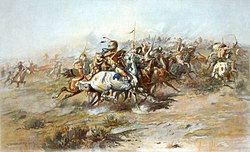
The Battle of the Little Bighorn, known as Custer's Last Stand and to the Lakota as the Battle of the Greasy Grass, was fought June 25–26, 1876 along the Little Bighorn River in the Crow Indian Reservation. Combined Lakota Sioux, Northern Cheyenne, and Arapaho forces defeated the 7th Cavalry, killing Lt. Col. George Armstrong Custer and about a third of his regiment. It was the most significant action of the Great Sioux War of 1876.
Jun 25, 1876
% complete
In the subsequent official 1879 Reno Board of Inquiry requested by Major Reno, Benteen and Reno's men testified that they heard distinct rifle volleys as late as 4:30 pm during the battle, evidence of continued fighting by Custer's battalion.
Image source: Marcus Reno
Aug 8, 1876
% complete
On August 8, 1876, after Terry was further reinforced with the 5th Infantry, the expedition moved up Rosebud Creek in pursuit of the Lakota following their victory at the Little Bighorn.
Image source: Great Sioux War of 1876
Aug 15, 1876
% complete
As a result of the defeat in June 1876, Congress responded by attaching what the Sioux call the 'sell or starve' rider (19 Stat. 192) to the Indian Appropriations Act of 1876 (enacted August 15, 1876), which cut off all rations for the Sioux until they terminated hostilities and ceded the Black Hills to the United States.
Oct 1876
% complete
Colonel Nelson A. Miles took command of the military effort against the Sioux and Cheyenne in October 1876, continuing the Great Sioux War through the winter.
Image source: Nelson A. Miles
Feb 28, 1877
% complete
The Agreement of 1877 (19 Stat. 254, enacted February 28, 1877) officially took away Sioux land including the Black Hills and permanently established Indian reservations, formalizing the cession demanded after the war.
Image source: Compromise of 1877
May 1877
% complete
In May 1877, Sitting Bull led his followers across the border into Canada rather than surrender to U.S. forces after the defeat of the Lakota resistance in the Great Sioux War.
Image source: Sitting Bull
1878
% complete
In 1878, the army awarded 24 Medals of Honor to participants in the fight on the bluffs at the Little Bighorn, most for risking their lives to carry water from the river up the hill to the wounded — the most Medals of Honor ever awarded for a single action.
Image source: Medal of Honor
1879
% complete
In 1879, the site of the battle was first preserved as a United States national cemetery to protect the graves of the 7th Cavalry troopers. Memorialization also began that year with a temporary monument on Last Stand Hill; the current marble obelisk was erected in 1881.
Image source: Little Bighorn Battlefield National Monument
1881
% complete
John Mulvany's 1881 painting Custer's Last Rally was the first of the large images depicting the battle, launching a tradition of dramatic artistic representations of Custer's final stand.
Image source: John Mulvany
1890
% complete
In 1890, marble blocks were added across the battlefield to mark the places where U.S. soldiers fell during the battle, helping visitors visualize the course of the fighting.
1896
% complete
In 1896, Anheuser-Busch commissioned from Otto Becker a lithographed modified version of Cassilly Adams' painting Custer's Last Fight, which was distributed as a print to saloons all over America, making it one of the most widely seen depictions of the battle.
Image source: Custer's Last Fight
1899
% complete
Edgar Samuel Paxson completed his painting Custer's Last Stand in 1899 after years of research and interviews with survivors, creating another iconic large-scale depiction of the battle.
Image source: Last stand
1926
% complete
In 1926, General Custer at the Little Big Horn opened in movie theaters in the U.S., featuring Roy Stewart with John Beck as Custer — an early cinematic treatment of the battle on its 50th anniversary.
Image source: General Custer at the Little Big Horn
1941
% complete
The 1941 film They Died with Their Boots On, starring Errol Flynn, Olivia de Havilland, Arthur Kennedy, Anthony Quinn and Sydney Greenstreet, is a fictionalized, romanticized drama of Custer's life beginning at West Point and concluding with the battle.
Image source: They Died with Their Boots On
1946
% complete
In 1946, the battlefield was re-designated as the Custer Battlefield National Monument, reflecting its association with George Armstrong Custer.
1967
% complete
In 1967, Major Marcus Reno was re-interred in the cemetery at the battlefield with full honors, including an eleven-gun salute, rehabilitating the reputation of the controversial officer.
1991
% complete
Hearings on the name change were held in Billings on June 10, 1991, and during the following months Congress renamed the site the Little Bighorn Battlefield National Monument. The bill also authorized an Indian Memorial to be built near Last Stand Hill honoring Lakota and Cheyenne warriors.
1999
% complete
On Memorial Day 1999, in consultation with tribal representatives, the U.S. National Park Service dedicated the first red granite markers commemorating Native American warriors who fell in the battle. By December 2006, ten warrior markers had been added.
2007
% complete
In 2007, the BBC presented a one-hour drama-documentary titled Custer's Last Stand, continuing the enduring popular fascination with the battle more than 130 years after it occurred.
Image source: Battle of the Little Bighorn
Or browse the full history timeline directory, with more than 2,000 topics.
This Battle of Little Bighorn timeline was generated with the help of AI, using information found on the internet.
We work hard to keep these timelines accurate, but mistakes do get through. If you spot one, email us at [email protected] and we'll fix it for future visitors.
Generate yours with AI or build it from scratch, for free.
Export your timeline, add your own events, edit or remove AI-generated events, and much more
No credit card required.
Cancel anytime.
Cancel anytime.
You can create an unlimited number of timelines with up to 10 events on each one, customize how they look, export them to PDF, PNG, PowerPoint, CSV, and Excel, and share them with a link. Paid plans raise the event limit and add features like spreadsheet imports and collaborators.
Yes. You can cancel your subscription from your account page at any time, and you will not be charged again. Your subscription stays active for the rest of the period you already paid for.
Yes. We will email you a reminder before the annual renewal, and we will also email you a receipt.
Yes. You can email us within 15 days of any payment, and we will issue you a full refund.
Check out our pricing docs or send us an email anytime: [email protected].