
-
Use Cases
-
Resources
-
Pricing
The Battle of Midway was a pivotal naval battle of World War II fought between the United States and Japan near Midway Atoll in the Pacific Ocean. Occurring just six months after Pearl Harbor, the U.S. Navy, aided by codebreaking intelligence, sank four Japanese aircraft carriers, inflicting a devastating defeat that shifted the strategic balance in the Pacific in favor of the Allies. More Less
Jan 1, 1939
% complete
By early 1942, the United States was already three years into a major shipbuilding program mandated by the 1938 Second Vinson Act. This industrial buildup would allow the US Navy to replace losses far faster than Japan, a decisive long-term advantage highlighted by the outcome of Midway.
Image source: Naval Act of 1938
Nov 30, 1941 - Jun 4, 1942
% complete
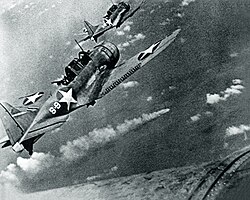
Many of the aircraft used during the June 1942 operations had been operational since late November 1941. Although well-maintained, many were almost worn out and increasingly unreliable, while their crews suffered from constant operations since 7 December 1941, including raids on Darwin and Colombo.
Image source: Battle of Midway
Dec 7, 1941
% complete
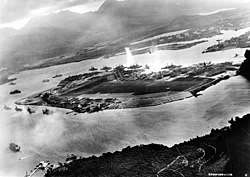
Japan's surprise attack on the US Pacific Fleet at Pearl Harbor on 7 December 1941 brought the United States into World War II. Japanese carriers were constantly on operations from this date onward, including raids on Darwin and Colombo, contributing to crew fatigue and aircraft wear that would affect Japanese readiness at Midway.
Image source: Attack on Pearl Harbor
Jan 1, 1942 - Jun 4, 1942
% complete
Since early 1942, American cryptanalysts had been working to penetrate Japanese naval codes. Their success in reading JN-25 gave the US Navy advance knowledge of Japanese intentions, enabling the ambush at Midway. Cryptanalysis later made possible the shooting down of Admiral Yamamoto's airplane in 1943.
Jan 1942
% complete
Because Japan desired to extend its Pacific defense perimeter and clear the seas for attacks on Midway, Fiji, Samoa, and Hawaii, preliminary planning for the second phase of operations commenced as early as January 1942.
Apr 1942
% complete
Due to strategic disagreements between the Imperial Army (IJA) and Imperial Navy (IJN), and infighting between the Navy's Imperial General Headquarters and Admiral Isoroku Yamamoto's Combined Fleet, a follow-up strategy was not formed until April 1942.
Apr 1942
% complete
Considering the increased strength of American land-based airpower on the Hawaiian Islands since the 7 December 1941 attack, Admiral Yamamoto judged it too risky to attack Pearl Harbor directly, favoring instead an operation against Midway to draw out the US carriers.
Apr 18, 1942
% complete
On 18 April 1942, 16 USAAF B-25 Mitchell bombers launched from USS Hornet bombed Tokyo and several other Japanese cities. The raid acutely heightened Japanese concerns about their defense perimeter and spurred plans to seize Midway.
Image source: Doolittle Raid
May 4, 1942 - May 8, 1942
% complete
Fought one month before Midway, the Battle of the Coral Sea was the first carrier-versus-carrier battle in history. It damaged Japanese carriers Shōkaku and Zuikaku, keeping them out of the Battle of Midway and weakening Japan's carrier force.
Image source: Battle of the Coral Sea
Jan 1, 1942
% complete
John Ford directed the 18-minute 1942 Movietone News documentary The Battle of Midway, released by the War Activities Committee, which received the 1942 Academy Award for Best Documentary, bringing the heroism of the battle to American audiences.
Image source: The Battle of Midway (film)
Aug 17, 1943
% complete
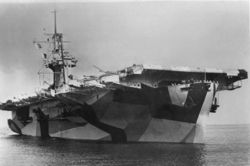
Escort carrier USS Midway (CVE-63) was commissioned on 17 August 1943, the first of several US Navy ships named in honor of the pivotal battle.
Image source: USS St. Lo
Oct 10, 1944
% complete
The escort carrier was renamed St. Lo on 10 October 1944 to clear the name Midway for a large fleet aircraft carrier.
Sep 10, 1945
% complete
USS Midway (CV-41) was commissioned on 10 September 1945, eight days after the Japanese surrender. It is now docked in San Diego, California, as the USS Midway Museum.
Image source: USS Midway (CV-41)
Jan 1, 1949
% complete
Chicago Municipal Airport, important to the war effort in World War II, was renamed Chicago Midway International Airport (or simply Midway Airport) in 1949 in honor of the battle.
Image source: Midway International Airport
May 19, 1998
% complete
On 19 May 1998, Robert Ballard and a team of scientists and Midway veterans from both sides located and photographed Yorktown, which lies 16,650 ft (5,070 m) deep. The ship was remarkably intact for a vessel that had sunk in 1942, with much of the original equipment and even the original paint scheme still visible.
Image source: USS Yorktown (CV-5)
Sep 1999
% complete
In September 1999, a joint expedition between Nauticos Corp. and the US Navy conducted deep-sea surveys in the area of the battle, contributing to the ongoing effort to locate the lost carriers of Midway.
Sep 13, 2000
% complete
On 13 September 2000, Secretary of the Interior Bruce Babbitt designated the lands and waters of Midway Atoll National Wildlife Refuge as the Battle of Midway National Memorial, honoring those who fought in the decisive battle.
Image source: Midway Atoll
Oct 18, 2019
% complete
A research vessel funded by the late Paul Allen and operated with the US Navy announced on 18 October 2019 that it had found the Japanese carrier Kaga at 17,700 ft (5,400 m) beneath the Pacific.
Image source: Japanese aircraft carrier Kaga
Oct 21, 2019
% complete
Days after finding Kaga, the same expedition crew confirmed the discovery of another Japanese carrier lost at Midway, the Akagi, on 21 October 2019.
Image source: Japanese aircraft carrier Akagi
Jun 4, 1942
% complete
Torpedo Squadron 8 of USS Hornet launched an unescorted attack against the Japanese carriers; nearly all its aircraft were shot down, but their sacrifice drew Japanese fighters down to low altitude, setting up the American dive bomber success. John Ford later directed the eight-minute documentary Torpedo Squadron 8 describing their heroism.
Image source: VT-8
Jun 4, 1942 - Jun 7, 1942
% complete
USS Yorktown was badly damaged by aircraft from Hiryū on 4 June 1942, then torpedoed by the Japanese submarine I-168 and sank on 7 June 1942. In September 1999, a joint expedition between Nauticos Corp. and the US Navy searched for the wreck, which Robert Ballard's team located and photographed on 19 May 1998 at 16,650 ft (5,070 m) deep, remarkably intact with original equipment and paint still visible.
Jun 4, 1942 - Jun 5, 1942
% complete
Hiryū, the fourth Japanese carrier, launched counterstrikes that crippled USS Yorktown before being located and attacked by American dive bombers on the afternoon of 4 June 1942. It sank the following morning, completing the destruction of Japan's carrier striking force.
Image source: Japanese aircraft carrier Hiryū
Jun 4, 1942 - Jun 7, 1942
% complete
The Battle of Midway was a major naval battle in the Pacific Theater of World War II that took place on 4–7 June 1942, six months after Japan's attack on Pearl Harbor and one month after the Battle of the Coral Sea. It became the decisive turning point of the Pacific War.
Jun 4, 1942
% complete
Admiral Nagumo's flagship Akagi was struck by American dive bombers on 4 June 1942 and scuttled the following day. Wreckage of the carrier was finally located and confirmed by an expedition on 21 October 2019.
Jun 4, 1942
% complete
Sōryū was struck by multiple bombs from American SBD Dauntless dive bombers on 4 June 1942. Fires raged out of control and the ship was abandoned and sank, marking one of four Japanese carriers lost in a single day.
Image source: Japanese aircraft carrier Sōryū
Jun 4, 1942
% complete
The carrier Kaga was hit by bombs from USS Enterprise dive bombers on 4 June 1942 and sank later that day. Its wreck was discovered at 17,700 ft (5,400 m) deep, announced by the US Navy on 18 October 2019.
Jun 7, 1942
% complete
Morison noted in 1949 that Spruance was criticized for not pursuing the retreating Japanese, allowing their surface fleet to escape after the battle.
Image source: Raymond A. Spruance
Jun 8, 1942 - Dec 31, 1942
% complete
With four carriers sunk at Midway, Saratoga would have been the only American carrier in the Pacific had the battle gone differently, as no new ones were completed before the end of 1942. Of Japan's remaining carriers, only Shōkaku and Zuikaku remained effective fleet carriers until Taihō was commissioned in early 1944; Ryūjō and Zuihō were light carriers, while Jun'yō and Hiyō were second-rate ships of limited effectiveness.
Dec 31, 1942
% complete
The American victory at Midway allowed the US Navy to maintain carrier parity in the Pacific before the first of the new Essex-class fleet carriers became available at the end of 1942, shifting the strategic initiative permanently to the United States.
Apr 18, 1943
% complete
For instance, cryptanalysis—whose success at Midway proved decisive—made possible the shooting down of Admiral Isoroku Yamamoto's airplane in 1943, removing Japan's most gifted naval strategist.
Image source: Operation Vengeance
Dec 1943
% complete
Watanabe died when the destroyer Numakaze sank in December 1943; had he survived the war he would likely have been tried as a war criminal for his role in the mistreatment of prisoners connected to the Midway operations.
Jan 1, 1975
% complete
Clay Blair argued in 1975 that had Spruance pressed on, he would have been unable to launch his aircraft after nightfall, and his cruisers would have been overwhelmed by Yamamoto's powerful surface units, including the battleship Yamato.
Or browse the full history timeline directory, with more than 2,000 topics.
This Battle of Midway timeline was generated with the help of AI, using information found on the internet.
We work hard to keep these timelines accurate, but mistakes do get through. If you spot one, email us at [email protected] and we'll fix it for future visitors.
Generate yours with AI or build it from scratch, for free.
Export your timeline, add your own events, edit or remove AI-generated events, and much more
No credit card required.
Cancel anytime.
Cancel anytime.
You can create an unlimited number of timelines with up to 10 events on each one, customize how they look, export them to PDF, PNG, PowerPoint, CSV, and Excel, and share them with a link. Paid plans raise the event limit and add features like spreadsheet imports and collaborators.
Yes. You can cancel your subscription from your account page at any time, and you will not be charged again. Your subscription stays active for the rest of the period you already paid for.
Yes. We will email you a reminder before the annual renewal, and we will also email you a receipt.
Yes. You can email us within 15 days of any payment, and we will issue you a full refund.
Check out our pricing docs or send us an email anytime: [email protected].