
-
Use Cases
-
Resources
-
Pricing
The Battle of Monte Cassino was a series of four Allied assaults on German fortifications along the Gustav Line in Italy during World War II, fought between January and May 1944. The battle is infamous for the destruction of the historic Monte Cassino Abbey by Allied bombing and for the eventual Polish victory that opened the road to Rome. More Less
1943
% complete
In 1943, the Goumiers were colonial troops formed into four Groupements des Tabors Marocains (Groups of Moroccan Tabors), each consisting of three loosely organised Tabors roughly equivalent to a battalion that specialised in mountain warfare.
Image source: Battle of Monte Cassino
Jul 1943
% complete
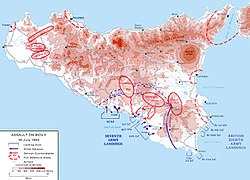
The Allied landings in Sicily in July 1943 were shortly followed by the Allied landings in mainland Italy in September 1943 by two Allied armies commanded by General Sir Harold Alexander, the Commander-in-Chief of the 15th Army Group.
Image source: Allied invasion of Sicily
Sep 1943
% complete
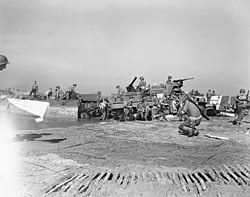
The Allied landings in Italy in September 1943 by two Allied armies were followed by an advance northward on two fronts, one on each side of the central mountain range forming the 'spine' of Italy.
Image source: Allied invasion of Italy
Oct 1943
% complete
Some months earlier, in the Italian autumn of 1943, two officers in the Hermann Göring Panzer Division, Captain Maximilian Becker and Lieutenant Colonel Julius Schlegel, proposed the removal of Monte Cassino's treasures to the Vatican and Vatican-owned Castel Sant'Angelo ahead of the approaching front.
Nov 1, 1943
% complete
The task of removing Monte Cassino's treasures to the Vatican and Vatican-owned Castel Sant'Angelo was completed in the first days of November 1943, saving countless irreplaceable works of art and manuscripts from destruction.
Dec 1943
% complete
Despite its potential excellence as an observation post, German commander in Italy Generalfeldmarschall Albert Kesselring ordered German units not to include the historic Benedictine abbey in their defensive positions, informing the Vatican and the Allies accordingly in December 1943.
Jan 1, 1944
% complete
At the beginning of 1944, the western half of the Winter Line was anchored by German forces holding the Rapido-Gari, Liri, and Garigliano valleys and several surrounding peaks and ridges.
Image source: Winter Line
Jan 1944
% complete
The original estimates that Rome would fall by October 1943 proved far too optimistic, as Allied forces became bogged down against the formidable German Winter Line defenses south of the capital.
Jan 17, 1944
% complete
The plan of Fifth Army commander Lieutenant General Clark was for the British X Corps, under Lieutenant General Richard McCreery, on the left of a thirty-kilometre front, to attack on 17 January 1944 across the Garigliano near the coast with the 5th and 56th Infantry Divisions.
Feb 1944
% complete
In the absence of detailed intelligence at Fifth Army HQ, planners found a book dated 1879 in a Naples bookshop that gave details of the construction of the abbey, aiding preparations for the assault.
May 18, 1944
% complete
During the final phase of the Battle of Monte Cassino, the first flag raised over the ruins of the Monte Cassino monastery on 18 May 1944 at 10:20am was the Polish flag, marking the hard-won capture of the position.
Jun 4, 1944
% complete
Rome was captured on 4 June 1944, just two days before the Normandy invasion, marking the fall of the first Axis capital and a major milestone in the Italian Campaign.
Dec 1943
% complete
According to data compiled by the Italian non-profit organization Dal Volturno a Cassino, 80 Italian soldiers of the Italian Co-belligerent Army were killed in December 1943 alone during the early fighting in the campaign.
Jan 1, 1944 - May 31, 1944
% complete
According to data compiled by Dal Volturno a Cassino, 5,934 Commonwealth soldiers, 4,345 French soldiers, around 3,000 American soldiers, and 1,052 Polish soldiers were killed during the battles for Monte Cassino.
Jun 5, 1944
% complete
Parker states that total Allied casualties spanning the four Cassino battles and the Anzio campaign, with the subsequent capture of Rome on 5 June 1944, were over 105,000, while Axis casualties were at least 80,000.
Jan 1, 1945
% complete
The French Military Cemetery, with more than 4,500 graves for soldiers who fell in the battles around Cassino, is located in Venafro, 15 kilometres east of Cassino.
Feb 11, 1944
% complete
On 11 February 1944, the acting commander of the 4th Indian Division, Brigadier General Dimoline (usually the Commander Royal Artillery in 4th Indian), requested a bombing raid against the monastery above his troops' positions.
Feb 15, 1944
% complete
The bombing mission in the morning of 15 February 1944 involved 142 Boeing B-17 Flying Fortress heavy bombers, followed by 47 North American B-25 Mitchell and 40 Martin B-26 Marauder medium bombers raining destruction on the abbey.
Feb 15, 1944
% complete
On 15 February 1944, Allied bombers dropped 1,400 tonnes of high explosives on the ancient Benedictine abbey, causing widespread damage and completely destroying the monastery founded by Saint Benedict.
Mar 15, 1944
% complete
The town of Cassino was completely razed by air and artillery bombardments, especially by the air raid of 15 March 1944 when 1,250 tonnes of bombs were dropped on the town. Some 2,026 of its prewar population of 20,000 were killed during the raids and the battle.
1957
% complete
A fictional instance of rape by Moroccan troops forms the basis of Alberto Moravia's 1957 novel Two Women, reflecting the controversy surrounding the conduct of some colonial troops during the Italian Campaign.
Image source: Two Women (novel)
1961
% complete
The assertion that the German use of the abbey was 'irrefutable' was removed from the record in 1961 by the Office of the Chief of Military History, reflecting how the US government's official position on the German occupation of Monte Cassino changed over a quarter-century.
1999
% complete
In 1999, a monument commemorating the Battle of Monte Cassino was unveiled in Warsaw, located next to the street named after Władysław Anders, commander of the Polish II Corps that captured the monastery.
2006
% complete
In 2006, a memorial was unveiled in Rome honouring the Allied forces that fought and died to capture the city during the Italian Campaign culminating in the battles of Cassino.
Or browse the full history timeline directory, with more than 2,000 topics.
This Battle of Monte Cassino timeline was generated with the help of AI, using information found on the internet.
We work hard to keep these timelines accurate, but mistakes do get through. If you spot one, email us at [email protected] and we'll fix it for future visitors.
Generate yours with AI or build it from scratch, for free.
Export your timeline, add your own events, edit or remove AI-generated events, and much more
No credit card required.
Cancel anytime.
Cancel anytime.
You can create an unlimited number of timelines with up to 10 events on each one, customize how they look, export them to PDF, PNG, PowerPoint, CSV, and Excel, and share them with a link. Paid plans raise the event limit and add features like spreadsheet imports and collaborators.
Yes. You can cancel your subscription from your account page at any time, and you will not be charged again. Your subscription stays active for the rest of the period you already paid for.
Yes. We will email you a reminder before the annual renewal, and we will also email you a receipt.
Yes. You can email us within 15 days of any payment, and we will issue you a full refund.
Check out our pricing docs or send us an email anytime: [email protected].