-
Use Cases
-
Resources
-
Pricing
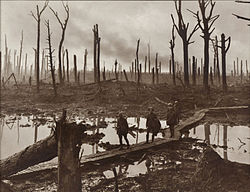
The Battle of Passchendaele, also known as the Third Battle of Ypres, was a major World War I campaign fought on the Western Front near Ypres, Belgium, between July and November 1917. British and Allied forces under General Sir Douglas Haig sought to capture Passchendaele ridge and wear down German forces. The battle became infamous for its horrific conditions, with relentless rain turning the battlefield into a quagmire of deep mud, and for its staggering casualties. After months of grinding combat, Canadian troops finally captured the ruined village of Passchendaele in November 1917 at enormous human cost. More Less
1839
% complete
In the Treaty of London (1839), Belgium was recognised as a sovereign and neutral state after the secession of the southern provinces of the Netherlands in 1830, a status that would later shape British involvement in the region.
Image source: Battle of Passchendaele
1914
% complete
The German 4th Army had held the dominating ground on the southern face of the Ypres salient since the First Battle of Ypres in 1914, setting the strategic context for later offensives.
Aug 4, 1914
% complete
The German invasion of Belgium on 4 August 1914, in violation of Article VII of the Treaty of London, was the British casus belli against Germany and drew Britain into the First World War.
Apr 22, 1915 - May 15, 1915
% complete
The Germans conducted their own Flanders offensive at the Second Battle of Ypres (22 April – 15 May 1915), making the Ypres salient more costly to defend.
Image source: Second Battle of Ypres
1916
% complete
Minor operations took place in the Ypres salient in 1916, some being German initiatives to distract the Allies from their preparations for the offensive at Verdun and later attempts to divert Allied resources from the Battle of the Somme.
Jan 1916
% complete
In January 1916, General Herbert Plumer began to plan offensives against Messines Ridge, Lille and Houthulst Forest. In early 1916, Haig also emphasised the importance of capturing the Gheluvelt plateau.
Image source: Herbert Plumer, 1st Viscount Plumer
Nov 15, 1916 - Nov 16, 1916
% complete
At conferences in November 1916 and May 1917, the Entente decided a strategy that included the Flanders campaign. The commanders agreed on simultaneous attacks to overwhelm the Central Powers on the Western, Eastern and Italian fronts by the first fortnight of February 1917.
Image source: Chantilly Conferences
Dec 8, 1916
% complete
A meeting in London of the Admiralty and the General Staff urged that the Flanders operation be undertaken in 1917 and Joffre replied on 8 December, agreeing to a Flanders campaign after the spring offensive.
Image source: Joseph Joffre
1917
% complete
The Russian army conducted the Kerensky Offensive in Galicia, to honour the agreement struck with the Allies at the Chantilly meeting of 15 to 16 November 1916.
Image source: Kerensky offensive
Feb 1, 1917
% complete
British determination to clear the Belgian coast took on more urgency after the Germans resumed unrestricted submarine warfare on 1 February 1917.
Image source: U-boat campaign
May 1, 1917
% complete
On 1 May 1917, Haig wrote that the Nivelle Offensive had weakened the German army but that an attempt at a decisive blow would be premature.
Image source: Douglas Haig, 1st Earl Haig
Sep 1917 - Oct 1917
% complete
In Operation Albion (September–October 1917), the Germans took the islands at the mouth of the Gulf of Riga.
Image source: Operation Albion
Sep 1, 1917 - Sep 5, 1917
% complete
On the Baltic coast from 1 to 5 September 1917, the Germans attacked with their strategic reserve of six divisions and captured Riga.
Image source: Riga offensive (1917)
1915
% complete
Preparations for operations in Flanders began in 1915, with the doubling of the Hazebrouck–Ypres rail line and the building of a new line from Bergues to Proven, which was doubled in early 1917.
Jan 1917
% complete
In January 1917, the Second Army under General Herbert Plumer with II Anzac, IX, X and VIII corps held the Western Front in Flanders from Laventie to Boesinghe, with eleven divisions and up to two in reserve.
Image source: Second Army (United Kingdom)
Jan 1, 1917 - Mar 31, 1917
% complete
Progress on roads, rail lines, railheads and spurs in the Second Army zone was continuous, and by mid-1917 the area had the most efficient supply system of the BEF.
Feb 14, 1917
% complete
On 14 February 1917, Colonel Norman MacMullen of GHQ proposed that the Gheluvelt plateau be taken by a massed tank attack, reducing the need for artillery; in April a reconnaissance by Captain Giffard LeQuesne Martel found that the area was unsuitable for tanks.
Jul 1917
% complete
Gough planned an offensive based on the GHQ 1917 plan and the instructions he had received from Haig.
Image source: Hubert Gough
Jul 1917
% complete
From July 1917, the area east of Ypres was defended by successive positions: the Albrechtstellung, Wilhelmstellung, and Flandern I, II and III Stellungen, the sixth position being incomplete.
Jun 1917
% complete
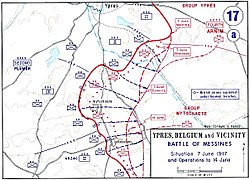
The attack removed the Germans from the dominating ground on the southern face of the Ypres salient, which the 4th Army had held since the First Battle of Ypres in 1914.
Image source: Battle of Messines (1917)
Jul 1917 - Nov 1917
% complete
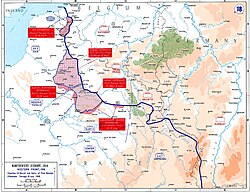
The battle took place on the Western Front from July to November 1917, for control of the ridges south and east of the Belgian city of Ypres in West Flanders, as part of Entente strategy.
Aug 1917
% complete
There were 127 mm (5.0 in) of rain in August 1917, with 84 mm falling on just five days. August had only three dry days, creating the infamous mud conditions of Passchendaele.
Oct 4, 1917
% complete
The Germans scrapped their tactical changes after the Battle of Broodseinde on 4 October, a success for the British bite-and-hold system of offensive tactics.
Image source: Battle of Broodseinde
Oct 12, 1917
% complete
The First Battle of Passchendaele on 12 October 1917 was another Allied attempt to gain ground around Passchendaele, ending in failure amid mud and strong German defences.
Image source: First Battle of Passchendaele
Oct 18, 1917
% complete
The Canadians relieved the II Anzac Corps on 18 October and found that the front line was mostly the same as that occupied by the 1st Canadian Division back in April 1915.
Image source: Second Battle of Passchendaele
Oct 26, 1917 - Nov 10, 1917
% complete
The German 4th Army was prevented from transferring troops away from the Fifth Army and from concentrating its artillery-fire on the Canadians as they prepared for and fought the Second Battle of Passchendaele (26 October – 10 November 1917).
Dec 3, 1917
% complete
The attack on the Polderhoek Spur on 3 December 1917 was a local operation by the British Fourth Army, renamed from the Second Army on 8 November.
Image source: Action on the Polderhoek Spur
1918
% complete
The Battle of the Lys (Fourth Battle of Ypres) and the Fifth Battle of Ypres of 1918 were fought before the Allies occupied the Belgian coast and reached the Dutch frontier.
Image source: Battle of the Lys (1918)
Mar 3, 1918
% complete
On the evening of 3 March 1918, two companies of the 8th Division raided Teal Cottage, supported by a smoke and shrapnel barrage, killed many of the garrison and took six prisoners for one man wounded.
Mar 21, 1918
% complete
When the German armies further south began the Spring Offensive on 21 March 1918, 'good' divisions in Flanders were sent south; the British withdrew the 29th Division on 9 April and transferred it to the Lys.
Image source: German spring offensive
1948
% complete
Published in 1948, James Edmonds put British casualties at 244,897 and estimated German losses at 400,000, though equivalent German figures were not available.
1958
% complete
Leon Wolff, writing in 1958, gave German casualties as 270,713 and British casualties as 448,688, figures later refuted or revised by historians including John Terraine.
2007
% complete
The monument was dedicated by Linda Fabiani, the Minister for Europe of the Scottish Parliament, during the late summer of 2007, the 90th anniversary of the battle. In the United Kingdom, only casualties before 16 August 1917 are commemorated on such memorials.
Jul 2017
% complete
In July 2017 a two-day event was organised in Ypres to mark the centenary of the battle.
Or browse the full history timeline directory, with more than 2,000 topics.
This Battle of Passchendaele timeline was generated with the help of AI, using information found on the internet.
We work hard to keep these timelines accurate, but mistakes do get through. If you spot one, email us at [email protected] and we'll fix it for future visitors.
Generate yours with AI or build it from scratch, for free.
Export your timeline, add your own events, edit or remove AI-generated events, and much more
No credit card required.
Cancel anytime.
Cancel anytime.
You can create an unlimited number of timelines with up to 10 events on each one, customize how they look, export them to PDF, PNG, PowerPoint, CSV, and Excel, and share them with a link. Paid plans raise the event limit and add features like spreadsheet imports and collaborators.
Yes. You can cancel your subscription from your account page at any time, and you will not be charged again. Your subscription stays active for the rest of the period you already paid for.
Yes. We will email you a reminder before the annual renewal, and we will also email you a receipt.
Yes. You can email us within 15 days of any payment, and we will issue you a full refund.
Check out our pricing docs or send us an email anytime: [email protected].