
-
Use Cases
-
Resources
-
Pricing
The Battle of Quebec, fought on September 13, 1759, was a decisive confrontation during the Seven Years' War between British forces under General James Wolfe and French defenders led by the Marquis de Montcalm. Fought on the Plains of Abraham outside Quebec City, the British victory effectively ended French rule in Canada. More Less
1763
% complete
The memory of Pontiac's War in 1763 had made most of the Indians living in the Ohio River valley, the Great Lakes, and the Mississippi River valley distrustful of all whites and reluctant to fight for either Congress or the Crown.
Image source: Pontiac's War
1774
% complete
Tensions between French Catholics and British authorities were eased by the passage of the Quebec Act of 1774, which restored land and many civil rights to the Canadiens. The act had been condemned by the thirteen rebelling colonies.
Image source: Quebec Act
Jun 9, 1775
% complete
On 9 June 1775, Governor Guy Carleton proclaimed martial law and called out the militia in preparation for the threatened American invasion of Quebec.
Image source: Battle of Quebec (1775)
Jul 26, 1775
% complete
On 26 July 1775, Carleton met Guy Johnson, superintendent of the northern district of the Indian Department, together with Daniel Claus and a Mohawk war chief Joseph Brant, seeking support against the Americans.
May 10, 1775
% complete
Shortly after the American Revolutionary War broke out in April 1775, a small enterprising force led by Ethan Allen and Benedict Arnold captured the key Fort Ticonderoga on May 10.
Image source: Capture of Fort Ticonderoga
Jun 27, 1775
% complete
On 27 June 1775, approval for an invasion of Canada was given to General Philip Schuyler by the Continental Congress.
Image source: Invasion of Quebec (1775)
Sep 1775
% complete
The Continental Army began moving into Quebec in September 1775. Richard Montgomery, heading the American vanguard, took Ile-aux-Noix on 2 September 1775.
Sep 5, 1775
% complete
After recruiting 1,050 volunteers, Benedict Arnold departed for Quebec City on 5 September 1775, leading his men through the Maine wilderness toward the Canadian capital.
Image source: Benedict Arnold's expedition to Quebec
Sep 16, 1775
% complete
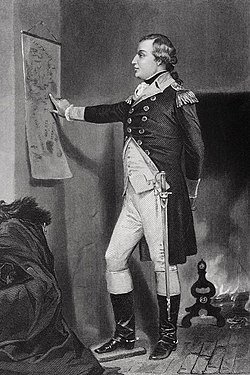
On 16 September 1775, the sickly Schuyler handed over command of his army to Brigadier General Richard Montgomery, who continued the advance into Canada.
Image source: Richard Montgomery
Sep 25, 1775
% complete
On 25 September 1775, an attempt by Ethan Allen to take Montreal in a surprise attack—as the American sympathizer Thomas Walker had promised he would open the city's gates—was foiled, and Allen was captured.
Image source: Ethan Allen
Oct 15, 1775
% complete
On 15 October 1775, heavy guns arrived from Fort Ticonderoga, which allowed the American besiegers to start inflicting damage on Fort St. Johns.
Image source: Siege of Fort St. Jean
Nov 2, 1775
% complete
On 2 November 1775, Montgomery took Fort St. Johns, removing a major obstacle on his path toward Montreal and then Quebec City.
Dec 30, 1775
% complete
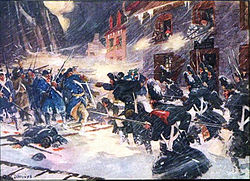
On the afternoon of 30 December 1775, a 'nor'easter' brought heavy snowfall, and Montgomery, knowing much of his army would leave when enlistments expired in two days, ordered his men to form up for an assault on Quebec City.
Dec 31, 1775
% complete
The Battle of Quebec was fought on December 31, 1775, between American Continental Army forces under Montgomery and Arnold and the British defenders of Quebec City under Guy Carleton. The attack was repulsed, and General Montgomery was killed during the assault.
Jan 1, 1776
% complete
Many enlistments of Montgomery's force expired on 31 December 1775. Together with losses taken in the battle, this left Arnold with only 600 men as of 1 January 1776 to besiege Quebec City.
Jan 4, 1776
% complete
General Montgomery's body was recovered by the British on New Year's Day 1776 and was given a simple military funeral on January 4, paid for by Lieutenant Governor Cramahé. His body was later returned to New York in 1818.
Oct 11, 1776
% complete
Although Carleton defeated the American fleet in the Battle of Valcour Island and regained control of Lake Champlain, the rear guard defense managed by Benedict Arnold prevented further action to capture Ticonderoga or Crown Point in 1776.
Image source: Battle of Valcour Island
Jan 8, 1776
% complete
Pélissier's ironworks supplied ammunition, bombs, and cannonballs for the siege of Quebec; he wrote a letter to the Second Continental Congress on January 8, 1776, pointing out measures needed for a successful taking of Quebec. He fled with the Americans when they retreated in May and June 1776.
Mar 1776
% complete
Loyalists were mobilized to make an attack on an American gun battery at Point Levis, but an advance guard of this Loyalist militia was defeated in the March 1776 Battle of Saint-Pierre by a detachment of pro-American local militia.
Image source: Battle of Saint-Pierre
Apr 2, 1776
% complete
Under Major Lewis Dubois, on 2 April 1776 a new battery built by the Americans at Point Lévis started to shell Quebec City and ships in the St. Lawrence River.
Apr 29, 1776
% complete
On 29 April 1776, a commission from Congress arrived in Montreal and attempted to undo damage done by Wooster's administration, but found that public opinion among Canadiens had turned against them.
May 6, 1776 - Jun 1, 1776
% complete
Between May 6 and June 1, 1776, nearly 40 British ships arrived at Quebec City, bringing troops and supplies that ended the American siege and forced the Americans to retreat from the province.
Jan 1778 - Mar 1778
% complete
Following the American victory at Saratoga, Congress voted in January 1778 for another invasion of Canada commanded by the Marquis de La Fayette. However, La Fayette found necessary supplies and horses lacking once he reached Albany and advised cancelling the operation, advice Congress accepted in March 1778.
Or browse the full history timeline directory, with more than 2,000 topics.
This Battle of Quebec timeline was generated with the help of AI, using information found on the internet.
We work hard to keep these timelines accurate, but mistakes do get through. If you spot one, email us at [email protected] and we'll fix it for future visitors.
Generate yours with AI or build it from scratch, for free.
Export your timeline, add your own events, edit or remove AI-generated events, and much more
No credit card required.
Cancel anytime.
Cancel anytime.
You can create an unlimited number of timelines with up to 10 events on each one, customize how they look, export them to PDF, PNG, PowerPoint, CSV, and Excel, and share them with a link. Paid plans raise the event limit and add features like spreadsheet imports and collaborators.
Yes. You can cancel your subscription from your account page at any time, and you will not be charged again. Your subscription stays active for the rest of the period you already paid for.
Yes. We will email you a reminder before the annual renewal, and we will also email you a receipt.
Yes. You can email us within 15 days of any payment, and we will issue you a full refund.
Check out our pricing docs or send us an email anytime: [email protected].