-
Use Cases
-
Resources
-
Pricing
The Battle of Stalingrad was a major confrontation between Nazi Germany and its allies against the Soviet Union for control of the city of Stalingrad in southern Russia. Fought with extreme ferocity, it became one of the deadliest battles in history and is widely regarded as the turning point of World War II in Europe, ending with the surrender of German Field Marshal Friedrich Paulus and his encircled Sixth Army. More Less
1942
% complete
By the spring of 1942, despite the failure of Operation Barbarossa to defeat the Soviet Union in a single campaign, the Wehrmacht had captured vast territories, including Ukraine, Belarus, and the Baltic republics.
Image source: Eastern Front (World War II)
1942
% complete
Hitler remained confident of breaking the Red Army, despite heavy losses west of Moscow in the winter of 1941–42, because large parts of Army Group Centre had been rested and re-equipped.
Image source: Adolf Hitler
Mar 1942
% complete
As the Soviet winter counteroffensive of 1941–1942 culminated in March, the Soviet high command began planning for the summer campaign.
Image source: Winter campaign of 1941–1942
Apr 1942
% complete
Hitler decided that the 1942 summer campaign would target the southern Soviet Union. The start of Case Blue had been planned for late May 1942.
Image source: Case Blue
Jun 28, 1942
% complete
Blau finally opened as Army Group South began its attack into southern Russia on 28 June 1942.
Jul 23, 1942
% complete
On 23 July 1942, Hitler expanded the campaign's objectives to include occupying Stalingrad, a city with immense propaganda value, as it bore the name of the Soviet leader.
Image source: Battle of Stalingrad
Jul 27, 1942
% complete
Order 227 of 27 July 1942 decreed that all commanders who ordered unauthorised retreats would be subject to a military tribunal.
Image source: Order No. 227
Aug 1, 1942
% complete
After German intentions became clear in July, Stalin appointed General Andrey Yeryomenko commander of the Southeastern Front on 1 August 1942.
Image source: Andrey Yeryomenko
Sep 11, 1942
% complete
Beyond the Volga River on the eastern boundary of Stalingrad, additional Soviet units were formed into the 62nd Army under Lieutenant General Vasiliy Chuikov on 11 September 1942.
Image source: Vasily Chuikov
Oct 1942
% complete
German captain Wilhelm Hosenfeld wrote in early October 1942 that 'The fight for Stalingrad now surpasses all our previous struggles—it has rightly been compared to Verdun.'
Image source: Wilm Hosenfeld
Oct 8, 1942
% complete
Beevor noted the 'sinister' message from the Stalingrad Front's Political Department on 8 October 1942 that: 'The defeatist mood is almost eliminated and the number of treasonous incidents is getting lower' as an example of the coercion Red Army soldiers experienced under the Special Detachments (renamed SMERSH).
Image source: SMERSH
Oct 23, 1942
% complete
Starting on 23 October 1942, Romanian pilots flew a total of 4,000 sorties, during which they destroyed 61 Soviet aircraft.
Image source: Romania in World War II
Oct 29, 1942
% complete
A 29 October 1942 article in the SS newspaper Das Schwarze Korps stated 'The Bolshevists attack until total exhaustion, and defend themselves until the physical extermination of the last man and weapon.'
Image source: Das Schwarze Korps
Nov 1942
% complete
In November 1942, after three months of slow advance, the Germans finally reached the river banks, capturing 90% of the ruined city and splitting the remaining Soviet forces into two narrow pockets.
Nov 1942
% complete
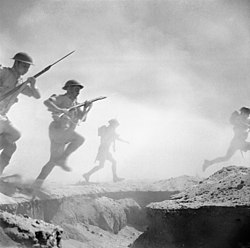
At this point, the British had won the Second Battle of El Alamein in November 1942, adding to Axis setbacks across multiple theaters.
Image source: Second Battle of El Alamein
Nov 1942
% complete
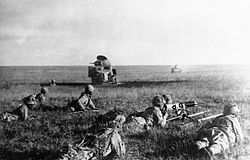
The plan was similar to that used by Zhukov to achieve victory at Khalkhin Gol in 1939, where he had sprung a double envelopment and destroyed the 23rd Division of the Japanese army.
Image source: Battles of Khalkhin Gol
Nov 19, 1942 - Mar 3, 1943
% complete
These operations opened the Winter Campaign of 1942–1943 (19 November 1942 – 3 March 1943), which involved some fifteen Armies operating on several fronts.
Image source: Volkhov Front
Nov 19, 1942
% complete
On 19 November 1942, Operation Uranus was launched. By 19 November 1942, the German forces in the pocket numbered about 210,000, with 50,000 soldiers outside the encirclement.
Image source: Operation Uranus
Nov 19, 1942 - Feb 2, 1943
% complete
Recognising that German troops were ill-prepared for offensive operations during the winter of 1942 and that most of them were deployed elsewhere on the southern sector of the Eastern Front, the Stavka decided to conduct a number of offensive operations between 19 November 1942 and 2 February 1943.
Jan 7, 1943
% complete
The Red Army High Command sent three envoys while, simultaneously, aircraft and loudspeakers announced the terms of capitulation on 7 January 1943. It aimed to break through to the Sixth Army and establish a corridor so it could maintain its 'cornerstone' position on the Volga.
Jan 10, 1943
% complete
The operation launched on 10 January 1943 with what was the single largest bombardment of the war at that point, with nearly 7,000 field guns, launchers and mortars firing against German positions.
Jan 16, 1943
% complete
The loss of the airfield Pitomnik on 16 January 1943 meant an end to air supplies and the evacuation of the wounded.
Image source: Pitomnik Airfield
Jan 21, 1943 - Jan 22, 1943
% complete
The loss of Gumrak on the night of 21/22 January meant an end to air supplies and the evacuation of the wounded.
Jan 30, 1943
% complete
On 30 January 1943, the tenth anniversary of his coming to power, Hitler chose not to speak. The German public was not officially told of the impending disaster until the end of January 1943.
Feb 2, 1943
% complete
On 2 February 1943, the 6th Army, having exhausted its ammunition and food, finally capitulated, making it the first of Hitler's field armies to surrender.
Feb 2, 1943 - Feb 3, 1943
% complete
On 2 February 1943, American journalist Barnet Nover wrote in the Washington Post that 'Stalingrad's role in this war was that of the Battles of the Marne, Verdun and the Second Marne of the last war rolled into one', while on 3 February 1943 the New York Times heralded the destruction of 'the flower of Adolf Hitler's army'.
Feb 23, 1943
% complete
The country celebrated 'Red Army Day' on 23 February 1943. 'And now! We start 1943 under conditions I would never have dared to hope.'
Image source: Defender of the Fatherland Day
Mar 1, 1943 - Mar 10, 1943
% complete
The remaining forces continued to resist, hiding in cellars and sewers, but by early March 1943 the last small and isolated pockets of resistance had surrendered.
Nov 1943
% complete
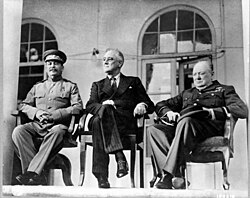
After being put on public display in Britain, the Sword of Stalingrad was presented to Stalin by Winston Churchill at the Tehran Conference later in 1943.
Image source: Tehran Conference
Nov 9, 1944
% complete
In a speech on 9 November 1944, Hitler himself blamed Stalingrad for Germany's impending doom.
1945
% complete
In recognition of the determination of its defenders, Stalingrad was awarded the title Hero City in 1945.
Image source: Hero City (Soviet Union)
1952
% complete
He remained in the Soviet Union until 1952, then moved to Dresden in East Germany, where he spent the remainder of his days defending his actions at Stalingrad and was quoted as saying that Communism was the best hope for postwar Europe.
Image source: Friedrich Paulus
1955
% complete
It was not until 1955 that the last of the 5,000–6,000 survivors were repatriated (to West Germany) after a plea to the Politburo by Konrad Adenauer.
1967
% complete
A colossal monument called The Motherland Calls was erected in 1967 on Mamayev Kurgan, the hill overlooking the city where bones and rusty metal splinters can still be found.
Image source: The Motherland Calls
1989 - 2004
% complete
In 1989, a comprehensive quantitative analysis concluded that Stalingrad was the military turning point of the war, and an analysis in 2004 also concluded that the epic battle sealed the fate of the Germans in the East, establishing the Battle of Stalingrad as the fundamental turning point in the war on the Eastern Front.
Or browse the full history timeline directory, with more than 2,000 topics.
This Battle of Stalingrad timeline was generated with the help of AI, using information found on the internet.
We work hard to keep these timelines accurate, but mistakes do get through. If you spot one, email us at [email protected] and we'll fix it for future visitors.
Generate yours with AI or build it from scratch, for free.
Export your timeline, add your own events, edit or remove AI-generated events, and much more
No credit card required.
Cancel anytime.
Cancel anytime.
You can create an unlimited number of timelines with up to 10 events on each one, customize how they look, export them to PDF, PNG, PowerPoint, CSV, and Excel, and share them with a link. Paid plans raise the event limit and add features like spreadsheet imports and collaborators.
Yes. You can cancel your subscription from your account page at any time, and you will not be charged again. Your subscription stays active for the rest of the period you already paid for.
Yes. We will email you a reminder before the annual renewal, and we will also email you a receipt.
Yes. You can email us within 15 days of any payment, and we will issue you a full refund.
Check out our pricing docs or send us an email anytime: [email protected].