
-
Use Cases
-
Resources
-
Pricing
The Battle of Tannenberg was a major engagement on the Eastern Front of World War I, fought in East Prussia between German forces under Paul von Hindenburg and Erich Ludendorff and the Russian Second Army led by Alexander Samsonov. The Germans encircled and virtually destroyed the Russian army, capturing over 90,000 prisoners and forcing Samsonov's suicide. The victory halted the Russian advance into East Prussia, boosted German morale, and established Hindenburg and Ludendorff as national heroes. More Less
Jan 1, 1800 - Dec 31, 1899
% complete
In addition to the fortifications amongst the Masurian Lake District, the Germans built a series of major forts around Königsberg in the 19th century, which they then modernised over the years.
Image source: Battle of Tannenberg
Jul 28, 1914
% complete
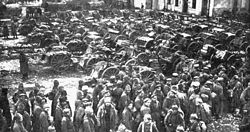
World War I began in July 1914, pitting Russia against Germany. The Battle of Tannenberg was fought in the first month of the war, as Russian armies invaded East Prussia while Germany concentrated on France.
Aug 1, 1914
% complete
The total strength of the fully mobilised German Army in 1914 amounted to 1,191 battalions, the great majority of which would be deployed against France, leaving limited forces for the Eastern Front against Russia.
Jan 1, 2010
% complete
According to historian Prit Buttar, besides the fortifications amongst the Masurian Lake District, the Germans had built major forts around Königsberg in the 19th century and modernised them over the years, shaping the strategic geography of the 1914 campaign.
Aug 17, 1914
% complete
Russian forces invaded German East Prussia in August 1914, confronting German defenders in the Masurian Lake District. The ensuing engagement became known as the Second Battle of Tannenberg, fought between Russia and Germany between 26 and 30 August 1914.
Aug 26, 1914
% complete
On 26 August 1914, the opening day of the battle, German forces engaged the Russian Second Army under Samsonov in East Prussia, beginning five days of fighting that would end in one of Germany's greatest victories of World War I.
Aug 27, 1914
% complete
On 27 August 1914, the German attack pressed deeper into the Russian lines. Samsonov's Second Army came under growing pressure as German units coordinated their encirclement manoeuvre across the Masurian Lake District.
Aug 28, 1914
% complete
On 28 August 1914, the encirclement of the Russian Second Army tightened. Communication failures within the Russian command worsened, with reports not being relayed to Samsonov about what was happening on his flanks.
Aug 29, 1914
% complete
By 29 August 1914, the Russian Second Army's positions had collapsed as German forces completed the encirclement. The battle demonstrated the decisive impact of German coordination against a divided and poorly informed enemy command.
Aug 30, 1914
% complete
On 30 August 1914, the last day of the battle, German victory over the Russian Second Army was complete. The battle, also known as the Second Battle of Tannenberg, ended after five days of fighting between Russia and Germany in the first month of World War I.
Oct 1, 1914
% complete
As a result of their triumph, the Germans tried to repeat the success of the battle already in Poland, near Warsaw in October 1914 as part of the Battle of the Vistula River and the Battle of Łódź.
Aug 25, 1914
% complete
On the evening before the battle, Hindenburg strolled near the ruins of the castle of the Teutonic Order, already thinking about the defeat of the Teutonic Knights by the Poles and Lithuanians in 1410.
Aug 26, 1914
% complete
Along the way, the two younger German commanders drove through the village of Tannenberg (today called Stębark), which reminded them of the defeat of the Teutonic Knights there by the Poles and Lithuanians in 1410.
Aug 29, 1914
% complete
Basil Gourko was told later that Samsonov was not aware of what was happening on his flanks because he was observing the action from a rise in the ground a distance from his wireless set, and reports were not relayed to him.
Jan 1, 1916 - Dec 31, 1917
% complete
Basil Gourko (Vasily Gurko), who commanded the Russian 1st Army Cavalry Division during the war and later learned details of Samsonov's communication failures at Tannenberg, served as chief of the general staff from 1916 to 1917.
Jan 1, 1990
% complete
Accounts such as Basil Gourko's explanation that Samsonov was unaware of events on his flanks because he observed the action far from his wireless set have shaped historical understanding of why the Russian Second Army collapsed so completely.
Jan 1, 1916
% complete
Rennenkampf, whose First Army had failed to support Samsonov during the Tannenberg campaign, was exonerated of blame, but was retired after a dubious performance in Poland in 1916.
Jan 1, 1917
% complete
Following his exoneration for Tannenberg and a dubious performance in Poland, Rennenkampf was retired from service, closing the military career of one of the key Russian commanders associated with the 1914 defeat.
Jan 1, 1927
% complete
A German monument commemorating the Battle of Tannenberg was completed in 1927 in Hohenstein, honouring the German victory over Russia in 1914 and becoming a major memorial site in East Prussia.
Jan 1, 1932
% complete
German film director Heinz Paul made a film, Tannenberg, about the battle, shot in East Prussia in 1932, bringing the famous 1914 victory to the cinema screen.
Jan 1, 1945
% complete
The Tannenberg monument at Hohenstein was blown up in World War II by the Germans themselves during their retreat from Prussia in January 1945, destroying the great memorial to the 1914 victory.
Jan 1, 1971
% complete
The battle is at the center of Aleksandr Solzhenitsyn's novel August 1914, published in 1971, which portrays the Russian defeat at Tannenberg and its consequences for Tsarist Russia.
Image source: August 1914
Jan 1, 2009
% complete
The video game Darkest of Days, released in 2009, featured the Battle of Tannenberg among its playable historical battles, introducing the engagement to a new generation through interactive media.
Image source: Darkest of Days
Jan 1, 2019
% complete
The multiplayer first-person shooter Tannenberg, set on the Eastern Front of World War I, brought the battle into modern gaming alongside Darkest of Days as part of the battle's enduring cultural legacy.
Image source: Tannenberg (video game)
Or browse the full history timeline directory, with more than 2,000 topics.
This Battle of Tannenberg timeline was generated with the help of AI, using information found on the internet.
We work hard to keep these timelines accurate, but mistakes do get through. If you spot one, email us at [email protected] and we'll fix it for future visitors.
Generate yours with AI or build it from scratch, for free.
Export your timeline, add your own events, edit or remove AI-generated events, and much more
No credit card required.
Cancel anytime.
Cancel anytime.
You can create an unlimited number of timelines with up to 10 events on each one, customize how they look, export them to PDF, PNG, PowerPoint, CSV, and Excel, and share them with a link. Paid plans raise the event limit and add features like spreadsheet imports and collaborators.
Yes. You can cancel your subscription from your account page at any time, and you will not be charged again. Your subscription stays active for the rest of the period you already paid for.
Yes. We will email you a reminder before the annual renewal, and we will also email you a receipt.
Yes. You can email us within 15 days of any payment, and we will issue you a full refund.
Check out our pricing docs or send us an email anytime: [email protected].